<?xml version="1.0" encoding="utf-8" ?>
<rdf:RDF xmlns:rdf="http://www.w3.org/1999/02/22-rdf-syntax-ns#" xmlns:dc="http://purl.org/dc/elements/1.1/" xmlns:syn="http://purl.org/rss/1.0/modules/syndication/" xmlns="http://purl.org/rss/1.0/">


<channel rdf:about="http://coast.iwlearn.org/en/search_rss">
  <title>English</title>
  <link>http://coast.iwlearn.org</link>

  <description>
    
            These are the search results for the query, showing results 91 to 105.
        
  </description>


  <image rdf:resource="http://coast.iwlearn.org/logo.png"/>

  <items>
    <rdf:Seq>
      
        <rdf:li rdf:resource="http://coast.iwlearn.org/en/images/partners"/>
      
      
        <rdf:li rdf:resource="http://coast.iwlearn.org/en/countries/cameroon/eco-tourism"/>
      
      
        <rdf:li rdf:resource="http://coast.iwlearn.org/en/countries/Mozambique/copy_of_reef-and-marine-recreation-and-management"/>
      
      
        <rdf:li rdf:resource="http://coast.iwlearn.org/en/countries/Mozambique/copy_of_ems"/>
      
      
        <rdf:li rdf:resource="http://coast.iwlearn.org/en/countries/Mozambique/copy_of_eco-tourism"/>
      
      
        <rdf:li rdf:resource="http://coast.iwlearn.org/en/about/M%20and%20E/the-coast-monitoring-and-evaluation-strategy"/>
      
      
        <rdf:li rdf:resource="http://coast.iwlearn.org/en/about/Stakeholder%20/the-coast-stakeholder-engagement-strategy"/>
      
      
        <rdf:li rdf:resource="http://coast.iwlearn.org/en/about/Staff/meet-the-coast-project-team"/>
      
      
        <rdf:li rdf:resource="http://coast.iwlearn.org/en/about/KMCS/knowledge-management-and-communication"/>
      
      
        <rdf:li rdf:resource="http://coast.iwlearn.org/en/about/coast-project-summary/post-mte-coast-project-summary"/>
      
      
        <rdf:li rdf:resource="http://coast.iwlearn.org/en/about/coast-project-summary"/>
      
      
        <rdf:li rdf:resource="http://coast.iwlearn.org/en/countries/Mozambique/copy_of_reef-and-marine-recreation-and-management/reef-and-marine-recreation-and-management"/>
      
      
        <rdf:li rdf:resource="http://coast.iwlearn.org/en/countries/Mozambique/copy_of_ems/ems"/>
      
      
        <rdf:li rdf:resource="http://coast.iwlearn.org/en/countries/Mozambique/copy_of_eco-tourism/eco-tourism"/>
      
      
        <rdf:li rdf:resource="http://coast.iwlearn.org/en/gallery/photos-videos/videos"/>
      
    </rdf:Seq>
  </items>

</channel>


  <item rdf:about="http://coast.iwlearn.org/en/images/partners">
    <title>partners</title>
    <link>http://coast.iwlearn.org/en/images/partners</link>
    <description></description>
    
    <dc:publisher>No publisher</dc:publisher>
    <dc:creator>Taya Santives</dc:creator>
    <dc:rights></dc:rights>
    <dc:date>2012-07-12T18:48:41Z</dc:date>
    <dc:type>Folder</dc:type>
  </item>


  <item rdf:about="http://coast.iwlearn.org/en/countries/cameroon/eco-tourism">
    <title>Eco Tourism</title>
    <link>http://coast.iwlearn.org/en/countries/cameroon/eco-tourism</link>
    <description>Tttttt </description>
    
    <dc:publisher>No publisher</dc:publisher>
    <dc:creator>g.omedo@unido.org</dc:creator>
    <dc:rights></dc:rights>
    <dc:date>2012-07-12T13:20:04Z</dc:date>
    <dc:type>Folder</dc:type>
  </item>


  <item rdf:about="http://coast.iwlearn.org/en/countries/Mozambique/copy_of_reef-and-marine-recreation-and-management">
    <title>Reef and Marine Recreation and Management</title>
    <link>http://coast.iwlearn.org/en/countries/Mozambique/copy_of_reef-and-marine-recreation-and-management</link>
    <description>RMRM</description>
    
    <dc:publisher>No publisher</dc:publisher>
    <dc:creator>g.omedo@unido.org</dc:creator>
    <dc:rights></dc:rights>
    <dc:date>2012-07-12T13:19:50Z</dc:date>
    <dc:type>Folder</dc:type>
  </item>


  <item rdf:about="http://coast.iwlearn.org/en/countries/Mozambique/copy_of_ems">
    <title>EMS</title>
    <link>http://coast.iwlearn.org/en/countries/Mozambique/copy_of_ems</link>
    <description>EMS Tanzania</description>
    
    <dc:publisher>No publisher</dc:publisher>
    <dc:creator>g.omedo@unido.org</dc:creator>
    <dc:rights></dc:rights>
    <dc:date>2012-07-12T13:19:24Z</dc:date>
    <dc:type>Folder</dc:type>
  </item>


  <item rdf:about="http://coast.iwlearn.org/en/countries/Mozambique/copy_of_eco-tourism">
    <title>Eco Tourism </title>
    <link>http://coast.iwlearn.org/en/countries/Mozambique/copy_of_eco-tourism</link>
    <description>tttttt</description>
    
    <dc:publisher>No publisher</dc:publisher>
    <dc:creator>g.omedo@unido.org</dc:creator>
    <dc:rights></dc:rights>
    <dc:date>2012-07-12T13:19:12Z</dc:date>
    <dc:type>Folder</dc:type>
  </item>


  <item rdf:about="http://coast.iwlearn.org/en/about/M%20and%20E/the-coast-monitoring-and-evaluation-strategy">
    <title>The COAST Monitoring and Evaluation Strategy</title>
    <link>http://coast.iwlearn.org/en/about/M%20and%20E/the-coast-monitoring-and-evaluation-strategy</link>
    <description>The COAST Monitoring and Evaluation Strategy follows up on the Revised Project Summary, the Mid Term Evaluation and the Minutes of the 4th Steering Committee meeting. It seeks to ensure that the Project Briefs developed at the Country Level are integrated into a complete M&amp;E Strategy that monitors results with clear indicators, means of verification, responsible person and a clear time frame.    </description>
    <content:encoded xmlns:content="http://purl.org/rss/1.0/modules/content/"><![CDATA[<p style="text-align: center; "><span style="text-align: justify; "><img src="http://coast.iwlearn.org/en/leatherback261120111.jpg/@@images/c5e0b376-b517-4cbb-8419-05c759295cc1.jpeg" alt="" class="image-inline" title="" /></span></p>
<p style="text-align: -webkit-auto; "><span style="text-align: justify; "> </span><span style="text-align: justify; ">GEF Objective:</span></p>
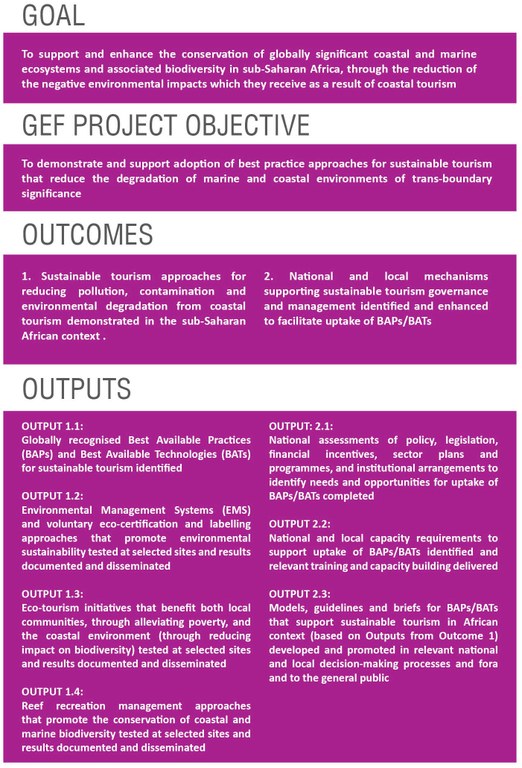
<p style="text-align: justify; "><strong>To demonstrate and support adoption of best practice approaches for sustainable tourism that reduce the degradation of marine and coastal environments of trans-boundary significance</strong></p>
<ul style="text-align: justify; ">
<li><strong>Outcome 1</strong>: Sustainable tourism approaches for reducing pollution, contamination and environmental degradation from coastal tourism demonstrated in the sub-Saharan African context</li>
<li><strong>Outcome 2</strong>: National and local mechanisms supporting sustainable tourism governance and management identified and enhanced to facilitate uptake of BAP/BATs.</li>
</ul>
<table style="text-align: justify; ">
<tbody>
<tr>
<td>
<p><span>Process indicators</span></p>
</td>
<td></td>
</tr>
<tr>
<td rowspan="6">
<p>1. Establishment and strengthening   of Regional Interministerial Project Steering Committee that is actively   involved in the project design and    implementation in demonstrating localized BAP/BAT for Ecotourism,   Environmental Management System (EMS) and Reef and Marine Recreation   Management (R&amp;MRM)</p>
</td>
<td></td>
</tr>
<tr>
<td></td>
</tr>
<tr>
<td></td>
</tr>
<tr>
<td></td>
</tr>
<tr>
<td></td>
</tr>
<tr>
<td></td>
</tr>
</tbody>
</table>
<p style="text-align: justify; "><span>2. Increase in partnerships and involvement in a regional and national level between interministerial and cross-sectoral government bodies, private sector and civic society in adopting localized BAP/BAT for Ecotourism, <span>EMS and R&amp;MRM</span></span></p>
<table style="text-align: justify; ">
<tbody>
<tr>
<td>
<p><strong>Stress Reduction indicator</strong> <strong> </strong></p>
</td>
</tr>
<tr>
<td>
<p>3. Area of underwater   and/or wetland area initiated into improved management systems</p>
</td>
</tr>
</tbody>
</table>
<table style="text-align: justify; ">
<tbody>
<tr>
<td>
<p><strong>Environmental Status   indicator 1</strong></p>
</td>
<td></td>
</tr>
<tr>
<td rowspan="2">
<p>4. Diversification of   livelihood benefiting the marine and coastal conservation as a result of GEF   intervention at the demonsatration site level</p>
<table>
<tbody>
<tr>
<td>
<p><strong>Environmental Status   indicator 2</strong></p>
</td>
<td></td>
</tr>
<tr>
<td rowspan="2">
<p>5. Increased regional and   national stakeholder awareness and documented stakeholder involvement   relation to sustainable tourism and environmental management practices.</p>
</td>
<td></td>
</tr>
<tr>
<td></td>
</tr>
</tbody>
</table>
<p style="text-align: center; "><img src="http://coast.iwlearn.org/en/gallery/kenya/temple-point-mida-creek.jpg/@@images/6e482701-4b7f-4a55-be88-fb5632541e3b.jpeg" alt="Watamu" class="image-inline" title="temple-point-mida-creek.jpg" /></p>
</td>
<td></td>
</tr>
<tr>
<td></td>
</tr>
</tbody>
</table>
<p style="text-align: justify; "><b>For a copy of the COAST Project Monitoring and Evaluation Strategy here</b></p>]]></content:encoded>
    <dc:publisher>No publisher</dc:publisher>
    <dc:creator>g.omedo@unido.org</dc:creator>
    <dc:rights></dc:rights>
    <dc:date>2012-07-11T13:20:00Z</dc:date>
    <dc:type>Page</dc:type>
  </item>


  <item rdf:about="http://coast.iwlearn.org/en/about/Stakeholder%20/the-coast-stakeholder-engagement-strategy">
    <title>The COAST Stakeholder Engagement Strategy</title>
    <link>http://coast.iwlearn.org/en/about/Stakeholder%20/the-coast-stakeholder-engagement-strategy</link>
    <description>COAST Project – Strategy to Re-enforce the involvement of Stakeholders within the activities occurring in each Partner Country (including; the Private Sector, local SME, local NGOs/CBOs and local/national authorities)</description>
    <content:encoded xmlns:content="http://purl.org/rss/1.0/modules/content/"><![CDATA[<p style="text-align: center; "><img src="http://coast.iwlearn.org/en/images/Nigeria%20induction%20training%20group%20photo%20%282%29.jpg/@@images/7e62ddc4-d4a1-4fa9-a741-111a4178b960.jpeg" alt="Nigeria induction training group photo (2).jpg" class="image-inline" title="Nigeria induction training group photo (2).jpg" /></p>
<p style="text-align: justify; ">The aim of this section is to outline a strategy for encouraging the engagement of a wider spread of stakeholders from each of the stakeholder groupings in Coastal Tourism, and thereby maximize the likely uptake and sustainability of best practices and technologies which have been applied and tested within the African context of the COAST Project.</p>
<p style="text-align: justify; ">Stakeholders in the COAST project can be categorized into three on the basis of their involvement as; core implementation actors (being consulted during implementation) secondary actors (second layer of project beneficiaries but not involved in actual implementation) and general participants/beneficiaries, those, and those with whom we will share our results (passive target).</p>
<p style="text-align: justify; "><strong><i>Core actors</i></strong>, represent the group of stakeholders who have direct involvement in implementing project activities, either directly, or through collaboration. For the COAST Project these people are the National Focal Points (FPs), the Demo site Project Coordinators (DPCs) and the Demo Site Management Committee (DSMC) members.</p>
<p style="text-align: justify; ">They also include locally based authorities and NGO/CBOs who are either directly, or indirectly sub-contracted by the project to carry out project activities including training events.</p>
<p style="text-align: justify; ">Those who are, or have been, <strong><i>consulted</i></strong>, by the COAST Project are <strong><i>secondary actors</i></strong>, stakeholders with whom the project is collaborating through addressing common short term, or longer term objectives – for example, local and national government authorities (aside from the tourism and environment sectors – who are participants – refer above), other donor supported country level projects, and GEF supported International Waters transboundary projects, such as the ASLME, GCLME and Benguela Current LME.</p>
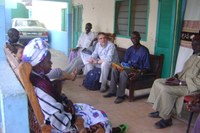
<p style="text-align: justify; "><img src="http://coast.iwlearn.org/en/gallery/meetings-and-trainings/Governance%20and%20Management%20Consultants%20at%20Kartong%20Demo%20Site%20pict.%202.JPG/@@images/55a8cac7-e38b-4582-8a6c-d78b44c3f6fc.jpeg" alt="Governance and Management Consultants at Kartong Demo Site pict. 2.JPG" class="image-left" title="Governance and Management Consultants at Kartong Demo Site pict. 2.JPG" />Finally, there are stakeholders whom the project will ‘target’ within the KM&amp;C Strategy referred to above. These will be <strong><i>general beneficiaries</i></strong> and will be categorized according to the three governance sectors within which the project works; hence some of these stakeholders may be neighbouring coastal communities/ community groups. Others may be members from the private sector such as Hotel and Tour Operators associations, as the project ‘outreaches’ to try to influence additional private sector investors within the coastal tourism industry.</p>
<p style="text-align: justify; ">Finally, there are government agencies and authorities who operate at either the local level (within the Demo site area), or national level, such as government cross sector working groups, technical committees, GEF country level committees, and inter-ministerial committees. Each of these stakeholder groupings will be ‘targeted’ with specific KM&amp;C products derived from the project. These are explained in more detail within the Project’s KM&amp;C implementation plan<a href="file://172.20.134.160/group/UNIDO%20Kenya%20Projects/COAST%20Project/2102_3_16_COAST%20project%20(backed%20up%2016.03.12)/COAST/Partnership/2012.06.27%20%20COAST%20Project%20Stakeholder%20Strategy%20Paper%20(rev2).doc#_ftn1">[1]</a>, but a number of examples are provided below in order to demonstrate how the COAST Project will specifically target and engage with each audience.</p>
<p style="text-align: justify; "><b>For  copy of the COAST Stakeholder Engagement Strategy here</b></p>]]></content:encoded>
    <dc:publisher>No publisher</dc:publisher>
    <dc:creator>g.omedo@unido.org</dc:creator>
    <dc:rights></dc:rights>
    <dc:date>2012-07-11T13:20:00Z</dc:date>
    <dc:type>Page</dc:type>
  </item>


  <item rdf:about="http://coast.iwlearn.org/en/about/Staff/meet-the-coast-project-team">
    <title>Meet The COAST Project Team</title>
    <link>http://coast.iwlearn.org/en/about/Staff/meet-the-coast-project-team</link>
    <description></description>
    <content:encoded xmlns:content="http://purl.org/rss/1.0/modules/content/"><![CDATA[<table class="listing" style="text-align: justify; ">
<tbody>
<tr>
<td>
<p style="text-align: center; "><b><img src="http://coast.iwlearn.org/en/about/Staff/SWL_0650.JPG/@@images/b969503f-bfaa-4af2-8ac3-bff82aa0103f.jpeg" alt="" class="image-right" title="" />UNEP GEF TASK MANAGER, NAIROBI, KENYA</b></p>
<p><b>Eduardo Zandri</b> is responsible for the design and supervision of a diverse portfolio of GEF Biodiversity, multifocal area and International Waters projects in over 40 countries in UNEP. Some of the technical areas covered include Ecosystem Services, Migratory Species and Flyways Conservation, Sustainable Coastal Tourism Development, Marine and Costal Habitats Conservation, Protected Areas Management and endangered species conservation in Africa and in the Arctic Region. He has previously worked in the Netherlands, Cape Verde, Yemen, and Jordan managing GEF projects with UNDP, the World Bank and UNOPS. His academic background is in Tropical and Subtropical Ecology and Agricultural Sciences.</p>
<b> </b></td>
</tr>
<tr>
<td>
<p style="text-align: center; "><b>UNIDO PROJECT MANAGER, VIENNA, AUSTRIA</b><b><img src="http://coast.iwlearn.org/en/about/Staff/Bernaudat.jpg/@@images/36626f4e-5e34-4444-ad9f-6a390c6b69a4.jpeg" alt="" class="image-left" title="" /></b></p>
<p><b>Ludovic Bernaudat</b> is an industrial development officer in the Water Management Unit of the Environmental Management Branch in UNIDO. He has been working in UNIDO, as a project manager, for 8 of the last 11 years. He has an Engineering Degree and a Masters degree (MSc) in Environmental Sciences which he obtained in France. His current portfolio includes projects in the area of mercury pollution, mostly from Artisanal and Small-Scale Gold Mining and in the improvement of water efficiency for industry. Ludovic is also one of the TEST methodology (Transfer of Environmentally Sound Technology) project implementers in UNIDO and under the COAST Project he offers trainings in Senegal and Kenya under the EMS thematic area component.  Together with Marla, he manages the COAST Project at UNIDO Headquarters in Vienna and provides support to the dedicated team in Nairobi.</p>
</td>
</tr>
<tr>
<td>
<p style="text-align: center; "><b>REGIONAL TECHNICAL COORDINATOR, NAIROBI, KENYA</b></p>
<p><b> </b><b><img src="http://coast.iwlearn.org/en/about/Staff/smallsizeofHG.JPG/@@images/0a34b806-98fd-411e-afd3-4acee676b8e3.jpeg" title="" height="167" width="140" alt="" class="image-right" /></b></p>
<p> </p>
<p><b>Hugh Gibbon</b> is the Regional Technical Coordinator of   the COAST Project based in Nairobi, Kenya at the UNIDO Kenya Office. He   has a PhD in Geography and Planning and over 25 years of professional   experience working in Europe, Africa and Asia on conservation, forestry,   tourism and institutional development projects. He also has more than   fifteen years managing and leading multi disciplinary teams working in   project evaluations, natural resource conservation, tourism,   biodiversity and rural livelihoods with a focus on reducing poverty and   improving livelihood options.</p>
</td>
</tr>
<tr>
<td>
<p style="text-align: center; "><b><img src="http://coast.iwlearn.org/en/about/Staff/MarlaPintoRodrigues.jpg/@@images/df8c473a-92ed-44ef-bd3f-0d3c4d13b704.jpeg" alt="" class="image-left" title="" /></b><b>UNIDO HQ TECHNICAL COORDINATOR VIENNA, AUSTRIA</b></p>
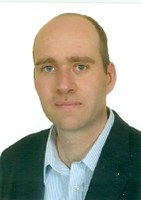
<p><b>Marla McCarroll Pinto Rodrigues</b> is an Environmental Management Specialist located in the Water Management Unit of the Environmental Management Branch in UNIDO where she manages the COAST Project together with Ludovic.  Further to this, she is one of the trainers in Mozambique and Tanzania to implement the UNIDO TEST methodology under the EMS thematic component. She has over 10 years of project design and management experience in multicultural teams in the private sector, government and International Organizations (UN, World Bank) in various technical fields in the environment, energy and sustainable development realm. Marla has lived and worked in several countries in Africa, Asia, Europe, Latin America and the U.S.A. Her Master of Science degree in Environment and Development Management is from the London School of Economics and Political Science in the UK.  She is proficient in 5 languages.</p>
</td>
</tr>
<tr>
<td>
<p style="text-align: center; "><b>UNWTO PROGRAM COORDINATOR, MADRID, SPAIN</b></p>
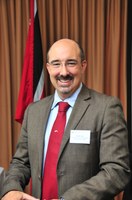
<p><b><img src="http://coast.iwlearn.org/en/about/Staff/FotoML.jpg/@@images/fb776c84-6105-4b47-ba56-4087bbf02efc.jpeg" alt="" class="image-right" title="" />Marcel Leijzer</b> holds a Masters degree in Human Geography and Policy Science from Nijmegen University, the Netherlands. He has wide work experience in issues such as environmental law enforcement, sustainable tourism development, and formulation and resource mobilisation for development assistance projects. Previously, he has worked with the Netherlands Development Organisation (SNV) as a tourism advisor in Tanzania and Bolivia, before becoming a tourism and private sector development officer at the SNV Head Office in the Netherlands. Since 2006, he has worked as a Programme Coordinator in Technical Cooperation and Services with UNWTO where he supports the implementation of a portfolio of approximately 100 ST-EP (Sustainable Tourism – Eliminating Poverty) projects world-wide, as well as the implementation of the eco-tourism and sustainable tourism components of the COAST Project.</p>
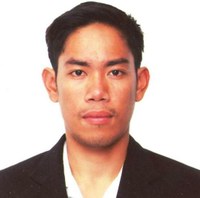
<b> </b></td>
</tr>
<tr>
<td>
<p align="center"><b> </b></p>
<p align="center"><b>TECHNICAL OFFICER, NAIROBI, KENYA</b></p>
<p><b><img src="http://coast.iwlearn.org/en/about/Staff/2012_8_21_Pic_HJDG.jpg/@@images/1f8d6ef3-7e22-4604-b748-38835a1627bb.jpeg" alt="" class="image-left" title="" /></b></p>
<p><b>Harvey John D. Garcia</b> was previously a Volunteer from Voluntary Service Overseas (VSO) recruited from the Philippines.  Placed as a Project Technical Officer for the COAST Project under UNIDO, he provides day to day technical support to the COAST Nairobi Office, Watamu Demo Site in Kenya and Bagamoyo Demo Site in Tanzania. He is also one of the trainers in Kenya, Mozambique and Tanzania to implement the UNIDO TEST methodology under the EMS thematic component.  He has eight years of experience working in environmental conservation with a strong background in conservation research and logistics, project management and environmental education.</p>
<p><b> </b></p>
</td>
</tr>
<tr>
<td>
<p align="center"><b> </b></p>
<p style="text-align: center; "><b><b><img src="http://coast.iwlearn.org/en/about/Staff/GeoffreyPortrait.jpg/@@images/9d2332dd-216c-40d7-98db-e280679ca0d7.jpeg" alt="" class="image-right" title="" /></b></b><b>KNOWLEDGE MANAGEMENT AND COMMUNICATIONS OFFICER, NAIROBI, KENYA</b></p>
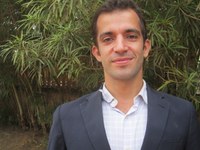
<p><b>Geoffrey Omedo</b> is the Knowledge Management and Communication Officer of the COAST Project. He is an environmental development specialist with 7 years of practical experience in issues of knowledge management; environmental management and planning; climate change (adaptation &amp; mitigation); governance and communication for development. Geoffrey has previous volunteer experience with UNV under UNDP Kenya; work experience for UNOPS (Senegal Operations Centre (SNOC), UNDP’s Africa Adaptation Programme (AAP), the Government of Kenya’s NEPAD Kenya Secretariat and a number of civil society organizations in the area of youth development and sustainable development.</p>
<b> </b></td>
</tr>
</tbody>
</table>
<table class="listing">
<tbody>
<tr>
<td>
<p style="text-align: center; "><b><img src="http://coast.iwlearn.org/en/about/Santiago.JPG/@@images/1ffcd53c-edb1-4ce5-9329-cf623f1f370b.jpeg" alt="Santiago" class="image-left" title="Santiago" /></b><b>TECHNICAL OFFICER, NAIROBI, KENYA</b></p>
<p><b>Santiago Ormeno </b>is responsible for supporting the Eco-tourism thematic area of the COAST Project, at the Regional COAST Project Office in Nairobi. He has more than 7 years professional experience in the fields of tourism development, marketing and communication both in the public and private sectors. He holds a Degree in Communication and post graduate studies in the fields of International Business, Sustainable Tourism and International Cooperation. From March 2011 to July 2013 he was responsible for providing support in the field to the Ministry of Tourism of Cameroon in the implementation of the STEP (Sustainable Tourism – Eliminating Poverty) project in the demo site of Kribi.</p>
<b><br clear="all" /> </b></td>
</tr>
<tr>
<td>
<p style="text-align: center; "><b><img src="http://coast.iwlearn.org/en/about/Staff/HedyPerson.cfm.jpg/@@images/6ded4efe-b5ed-4e2c-8eb4-6623cf43a0a6.jpeg" alt="Hedy Roversi" class="image-right" title="Hedy Roversi" /></b><b>UNIDO HQ PROJECT ASSISTANT, VIENNA, AUSTRIA</b></p>
<p><b>Hedy Roversi</b> is a project assistant located in the Water  Management Unit of the Environmental Management Branch, in the United  Nations Industrial Development Organization. She has more than twenty  years of diversified work experience in International Organizations  ranging from banking services to assistance in Funds Mobilization and  Project Management. She has obtained her Bachelor’s Degree in Political  Science and Public Administration from the American University of  Beirut, Lebanon. She has worked in the Middle East and Europe and is  proficient in four languages.</p>
</td>
</tr>
</tbody>
</table>
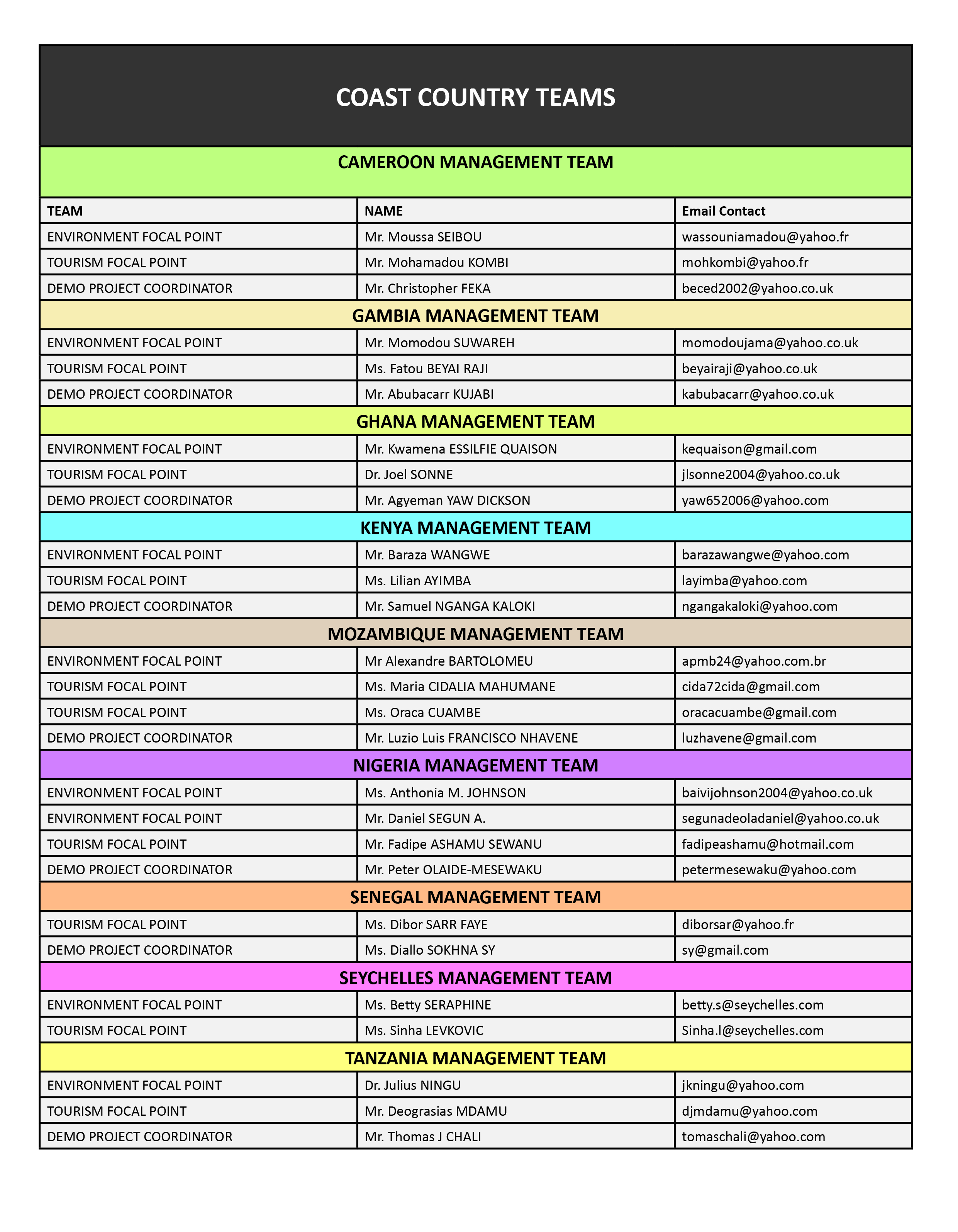
<p style="text-align: center; "><span class="internal-link"><b><a href="http://coast.iwlearn.org/en/about/Staff/COASTTEAMS.jpg.jpg" class="internal-link">For a list of COAST country teams in the nine countries here</a> </b></span></p>
<p style="text-align: justify; "> </p>
<p style="text-align: justify; "><b> </b></p>
<p style="text-align: justify; "> </p>
<p><b> </b></p>]]></content:encoded>
    <dc:publisher>No publisher</dc:publisher>
    <dc:creator>g.omedo@unido.org</dc:creator>
    <dc:rights></dc:rights>
    <dc:date>2012-07-11T13:20:00Z</dc:date>
    <dc:type>Page</dc:type>
  </item>


  <item rdf:about="http://coast.iwlearn.org/en/about/KMCS/knowledge-management-and-communication">
    <title>Knowledge Management and Communication Strategy</title>
    <link>http://coast.iwlearn.org/en/about/KMCS/knowledge-management-and-communication</link>
    <description></description>
    <content:encoded xmlns:content="http://purl.org/rss/1.0/modules/content/"><![CDATA[<h3></h3>
<p><b> Knowledge Management</b></p>
<p style="text-align: justify; "><img src="http://coast.iwlearn.org/en/about/KMCS/P1020051.JPG/@@images/f7f8abb0-da96-49bd-ae9f-ad2ef899d0ae.jpeg" alt="" class="image-inline" title="" /></p>
<p style="text-align: justify; ">GEF through its Knowledge Management Strategy defines Knowledge Managements as a ‘...set of specific actions developed (gathering data, analyzing processes, results and personal experiences, capturing and sharing lessons learned) so that the knowledge of an individual or an institution reaches, in a timely manner, the largest number of people who can benefit from it<i>...’</i>.<b> </b><a class="external-link" href="http://www.thegef.org/gef/sites/thegef.org/files/documents/C.40.Inf_.03_KM_strategy_final_edited_2.pdf">To review GEF Knowledge Management Strategy here</a></p>
<p style="text-align: justify; ">The primary emphasis of the COAST Knowledge Management and Communication Strategy is to enhance the tools to capture processes, lessons and results of country level demonstrations, the experience of its partners, and enhance sharing and dissemination via innovative knowledge management and communication through innovative information exchange tools linked to IW:LEARN.</p>
<p style="text-align: justify; ">The following reports will be produced during project implementation; Lessons learned reports, briefing notes, concept notes, how-to guides, and communities of practice, newsletter, journal papers on Best Available Practices and Technologies (BAPs/ BATs) and such advocacy materials.</p>
<table class="grid listing" style="text-align: justify; ">
<tbody>
<tr>
<td>
<h3 style="text-align: center; "><b>Knowledge Management Result   Areas for the COAST Project</b></h3>
<p>The Knowledge Management and Communication Strategy is one of the two  main strategic documents recommended by the Mid-Term Evaluation (MTE) of  the Collaborative Actions for Sustainable Tourism (COAST) Project  (2009-2013) to enhance project delivery, visibility and streamline the  expected outcomes.</p>
<p>The following four theme result areas will drive the strategy implementation:</p>
</td>
</tr>
<tr>
<td>
<p><b><img src="http://coast.iwlearn.org/en/images/step-regional-training-event-watamu-kenya.jpg/@@images/52e79623-ff15-49d0-9e2f-6e5a7d2341b3.jpeg" alt="step-regional-training-event-watamu-kenya.jpg" class="image-left" title="step-regional-training-event-watamu-kenya.jpg" /></b></p>
<ol>
<li><b>1. </b><b>Coastal Best Practices and Technologies</b> – These KM&amp;C products document some of the best practices and processes within the three main thematic areas of the COAST Project (<i>EMS, Eco-tourism, Reef and Marine Recreation Management</i>) emerging from the COAST Demo Sites. It focuses on showcasing some of the demonstrated localized BAPs/BATs. The portrayal of the best practices contains comprehensive information on the various processes and technologies being applied in the respective local realities;<b> </b></li>
</ol></td>
</tr>
<tr>
<td>
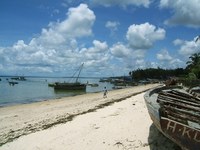
<p><b><b><img src="http://coast.iwlearn.org/en/images/Traditional%20dhow%2C%20Mida%20creek.JPG/@@images/84c49e86-51b2-4610-a863-73a7f8a0e8b0.jpeg" alt="Traditional dhow, Mida creek.JPG" class="image-right" title="Traditional dhow, Mida creek.JPG" /></b>2. Coastal Local Voices</b> – This COAST KM&amp;C result area focuses on documenting the impacts of the project within each site, specifically impacts benefitting the local communities. It entails following up with project leaders, beneficiaries and communities in all the countries and capturing their voices to provide a human account of how their interactions with the project have improved their livelihoods. This uses participatory methodologies and approaches to ensure that the human stories of sustainable coastal tourism in Africa are documented;</p>
<ol> </ol></td>
</tr>
<tr>
<td>
<p><b><b><b><b><img src="http://coast.iwlearn.org/en/gallery/tanzania/fishing-remains-the-most-regular-source-of-income-for-most-local-residents.jpg/@@images/6aaeeeaa-a5e0-491e-acab-789c59734d63.jpeg" alt="fishing-remains-the-most-regular-source-of-income-for-most-local-residents.jpg" class="image-left" title="fishing-remains-the-most-regular-source-of-income-for-most-local-residents.jpg" /></b></b></b></b></p>
<ol>
<li><b>3. </b><b>Coastal Environmental Economic Dynamics</b> – The coastal ecosystem is very valuable to the countries we work in. Hence this KM&amp;C result area seeks to document the value of the COAST Project work in real economic terms. This KM&amp;C result area gives a special emphasis to the private sector players and exhibits how implementation of COAST Project themes (<i>Eco-tourism -including small and Medium Enterprise (SME) developments, EMS, RMRM)</i> are contributing to improved results. It is expected that the private sector players will drive the work to ensure long-term sustainability;<b> </b></li>
</ol></td>
</tr>
<tr>
<td>
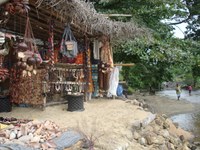
<p><b><b><img src="http://coast.iwlearn.org/en/gallery/meetings-and-trainings/iwc6-6th-biennial-international-waters-conference-17-20-october-2011.jpg/@@images/8bc74ba4-537e-4232-ab11-ee5682c7c3ce.jpeg" alt="iwc6-6th-biennial-international-waters-conference-17-20-october-2011.jpg" class="image-right" title="iwc6-6th-biennial-international-waters-conference-17-20-october-2011.jpg" /></b>4. Coastal Policy Change Processes</b> – The COAST Project KM&amp;C Strategy seeks to identify some of the policy recommendations and interventions emerging that are needed to enhance sustainable coastal tourism at national, regional and global levels. This result area supports outcome two of the COAST Project log frame and will benefit from the Sustainable Tourism Governance and Management (STGM) component being led by UNWTO and supported by UNIDO.</p>
</td>
</tr>
<tr>
<td></td>
</tr>
</tbody>
</table>
<p style="text-align: justify; "><a href="http://coast.iwlearn.org/en/about/KMCS/201374RevisedCOASTProjectKMCStrategy.pdf" class="internal-link"><span class="internal-link">The Revised COAST Project Knowledge Management Strategy</span></a></p>]]></content:encoded>
    <dc:publisher>No publisher</dc:publisher>
    <dc:creator>g.omedo@unido.org</dc:creator>
    <dc:rights></dc:rights>
    <dc:date>2012-07-11T13:20:00Z</dc:date>
    <dc:type>Page</dc:type>
  </item>


  <item rdf:about="http://coast.iwlearn.org/en/about/coast-project-summary/post-mte-coast-project-summary">
    <title>Revised COAST Project Summary</title>
    <link>http://coast.iwlearn.org/en/about/coast-project-summary/post-mte-coast-project-summary</link>
    <description></description>
    <content:encoded xmlns:content="http://purl.org/rss/1.0/modules/content/"><![CDATA[<p style="text-align: justify; "><img src="http://coast.iwlearn.org/en/images/cameroon-2.jpg/@@images/bba68672-dae8-42af-bd6d-78479d894229.jpeg" alt="cameroon-2.jpg" class="image-right" title="cameroon-2.jpg" /></p>
<p style="text-align: justify; ">The COAST Project effectively began in January 2009, and was expected to run for five years up to the end of 2013. A Mid Term Evaluation (MTE) was conducted in order to objectively assess how project performance could be improved during the remaining period of the project. This MTE was completed by the middle of December 2011 and made a number of significant recommendations which aim to enhance project delivery and streamline the expected outcomes. In order to do this, it was advised to produce a simplified Project Document. This resulted in a Revised Project Summary (substituting the previous Project Document) that is based largely upon the MTE recommendations.</p>
<p style="text-align: justify; ">The Revised Project Summary has the following main objectives:</p>
<ul style="text-align: justify; ">
<li><b>First</b>, it aims to present the main elements of the COAST Project in a simple and coherent way, so that from this point onwards team      members and partners can substitute this document in place of the original      Project Document.</li>
<li><b>Secondly</b>, it presents the new strategy and logical framework,      management structure, key roles and summarised indicators against each      output and outcome. </li>
<li><b>Finally</b>, it includes a revised budget and project      time frame extending the project without further cost to 30 June 2014.</li>
</ul>
<h3 style="text-align: center; ">Revised Project Log Frame</h3>
<p style="text-align: center; "><b><img src="http://coast.iwlearn.org/en/about/coast-project-summary/copy_of_COASTLOG.jpg/@@images/4fed66f9-9a6e-4ad7-92cf-0583b16a65b6.jpeg" alt="" class="image-inline" title="" /></b></p>
<ul style="text-align: justify; ">
</ul>
<p style="text-align: justify; "><img src="http://coast.iwlearn.org/en/gallery/senegal/DSC03786.JPG/@@images/56ecc213-a5d1-409e-ba1e-19f2aca6e21a.jpeg" alt="DSC03786.JPG" class="image-right" title="DSC03786.JPG" /></p>
<p style="text-align: justify; ">The MTE recognizes that mainstreaming the lessons learned and results from the project is an intention in the original project design. A Knowledge Management and Communications Strategy is currently being implemented to appropriately capture and disseminate best practices, project impacts, lessons learned and results.</p>
<p style="text-align: center; "> </p>
<p style="text-align: justify; "> </p>
<p style="text-align: justify; "><b><br /></b></p>]]></content:encoded>
    <dc:publisher>No publisher</dc:publisher>
    <dc:creator>g.omedo@unido.org</dc:creator>
    <dc:rights></dc:rights>
    <dc:date>2012-07-11T13:20:00Z</dc:date>
    <dc:type>Page</dc:type>
  </item>


  <item rdf:about="http://coast.iwlearn.org/en/about/coast-project-summary">
    <title>COAST Project Summary</title>
    <link>http://coast.iwlearn.org/en/about/coast-project-summary</link>
    <description>The COAST Project Summary resulted from the Mid Term Evaluation that simplified the COAST Project providing clear and attainable recommendations for the Project. </description>
    
    <dc:publisher>No publisher</dc:publisher>
    <dc:creator>g.omedo@unido.org</dc:creator>
    <dc:rights></dc:rights>
    <dc:date>2012-07-10T08:34:58Z</dc:date>
    <dc:type>Folder</dc:type>
  </item>


  <item rdf:about="http://coast.iwlearn.org/en/countries/Mozambique/copy_of_reef-and-marine-recreation-and-management/reef-and-marine-recreation-and-management">
    <title>Reef and Marine Recreation and Management</title>
    <link>http://coast.iwlearn.org/en/countries/Mozambique/copy_of_reef-and-marine-recreation-and-management/reef-and-marine-recreation-and-management</link>
    <description>RMRM</description>
    <content:encoded xmlns:content="http://purl.org/rss/1.0/modules/content/"><![CDATA[<p>RMRM</p>]]></content:encoded>
    <dc:publisher>No publisher</dc:publisher>
    <dc:creator>g.omedo@unido.org</dc:creator>
    <dc:rights></dc:rights>
    <dc:date>2012-07-10T07:28:25Z</dc:date>
    <dc:type>Page</dc:type>
  </item>


  <item rdf:about="http://coast.iwlearn.org/en/countries/Mozambique/copy_of_ems/ems">
    <title>EMS</title>
    <link>http://coast.iwlearn.org/en/countries/Mozambique/copy_of_ems/ems</link>
    <description>EMS</description>
    <content:encoded xmlns:content="http://purl.org/rss/1.0/modules/content/"><![CDATA[<p>EMS in Inhambane</p>]]></content:encoded>
    <dc:publisher>No publisher</dc:publisher>
    <dc:creator>g.omedo@unido.org</dc:creator>
    <dc:rights></dc:rights>
    <dc:date>2012-07-10T07:28:25Z</dc:date>
    <dc:type>Page</dc:type>
  </item>


  <item rdf:about="http://coast.iwlearn.org/en/countries/Mozambique/copy_of_eco-tourism/eco-tourism">
    <title>Eco Tourism</title>
    <link>http://coast.iwlearn.org/en/countries/Mozambique/copy_of_eco-tourism/eco-tourism</link>
    <description>ET</description>
    <content:encoded xmlns:content="http://purl.org/rss/1.0/modules/content/"><![CDATA[<p>ET</p>]]></content:encoded>
    <dc:publisher>No publisher</dc:publisher>
    <dc:creator>g.omedo@unido.org</dc:creator>
    <dc:rights></dc:rights>
    <dc:date>2012-07-10T07:28:25Z</dc:date>
    <dc:type>Page</dc:type>
  </item>


  <item rdf:about="http://coast.iwlearn.org/en/gallery/photos-videos/videos">
    <title>videos</title>
    <link>http://coast.iwlearn.org/en/gallery/photos-videos/videos</link>
    <description></description>
    
    <dc:publisher>No publisher</dc:publisher>
    <dc:creator>Taya Santives</dc:creator>
    <dc:rights></dc:rights>
    <dc:date>2012-07-02T10:55:14Z</dc:date>
    <dc:type>Folder</dc:type>
  </item>


</rdf:RDF>