<?xml version="1.0" encoding="utf-8" ?>
<rdf:RDF xmlns:rdf="http://www.w3.org/1999/02/22-rdf-syntax-ns#" xmlns:dc="http://purl.org/dc/elements/1.1/" xmlns:syn="http://purl.org/rss/1.0/modules/syndication/" xmlns="http://purl.org/rss/1.0/">


<channel rdf:about="http://coast.iwlearn.org/en/search_rss">
  <title>English</title>
  <link>http://coast.iwlearn.org</link>

  <description>
    
            These are the search results for the query, showing results 11 to 25.
        
  </description>


  <image rdf:resource="http://coast.iwlearn.org/logo.png"/>

  <items>
    <rdf:Seq>
      
        <rdf:li rdf:resource="http://coast.iwlearn.org/en/Newsletter/coast-project-newsletter-4th-quarterly-newsletter"/>
      
      
        <rdf:li rdf:resource="http://coast.iwlearn.org/en/News%20and%20Events/the-coast-project-at-the-gef-iwc7-conference-in-barbados"/>
      
      
        <rdf:li rdf:resource="http://coast.iwlearn.org/en/News%20and%20Events/new-the-sustainable-tourism-governance-and-management-publication"/>
      
      
        <rdf:li rdf:resource="http://coast.iwlearn.org/en/News%20and%20Events/health-of-oceans-declining-fast"/>
      
      
        <rdf:li rdf:resource="http://coast.iwlearn.org/en/News%20and%20Events/unep-strengthened-and-upgraded-to-implement-the-future-we-want"/>
      
      
        <rdf:li rdf:resource="http://coast.iwlearn.org/en/News%20and%20Events/the-chumbe-island-coral-park-in-zanzibar-a-model-of-financially-ecologically-and-socially-sustainable-marine-park-management"/>
      
      
        <rdf:li rdf:resource="http://coast.iwlearn.org/en/News%20and%20Events/unido-supports-the-water-project-in-chipande-community-watamu-demo-site-area"/>
      
      
        <rdf:li rdf:resource="http://coast.iwlearn.org/en/News%20and%20Events/analysis-the-coast-project-supports-a-web-raising-training-at-the-watamu-demo-site"/>
      
      
        <rdf:li rdf:resource="http://coast.iwlearn.org/en/News%20and%20Events/the-coast-project-working-towards-sustainable-coastal-tourism-through-eco-tourism-showcasing-activities-results-and-lessons-from-kartong-demo-site-in-the-gambia"/>
      
      
        <rdf:li rdf:resource="http://coast.iwlearn.org/en/Newsletter/geoffrey-omedo-gmail-com-geoffrey-omedo"/>
      
      
        <rdf:li rdf:resource="http://coast.iwlearn.org/en/Newsletter/coast-project-newsletter-1st-quarterly-newsletter"/>
      
      
        <rdf:li rdf:resource="http://coast.iwlearn.org/en/Newsletter/coast-project-newsletter"/>
      
      
        <rdf:li rdf:resource="http://coast.iwlearn.org/en/News%20and%20Events/the-gambia-training-seminar-on-tourism-and-biodiversity-from-23-to-25-april-2013"/>
      
      
        <rdf:li rdf:resource="http://coast.iwlearn.org/en/News%20and%20Events/sustainable-tourism-a-win-win-for-nature-conservation-and-the-economy"/>
      
      
        <rdf:li rdf:resource="http://coast.iwlearn.org/en/News%20and%20Events/eco-resorts-the-worlds-10-most-relaxing-destinations-for-sustainable-tourism-photos"/>
      
    </rdf:Seq>
  </items>

</channel>


  <item rdf:about="http://coast.iwlearn.org/en/Newsletter/coast-project-newsletter-4th-quarterly-newsletter">
    <title>COAST Project Newsletter: 4th Quarterly Newsletter</title>
    <link>http://coast.iwlearn.org/en/Newsletter/coast-project-newsletter-4th-quarterly-newsletter</link>
    <description></description>
    <content:encoded xmlns:content="http://purl.org/rss/1.0/modules/content/"><![CDATA[<div id="stcpDiv">
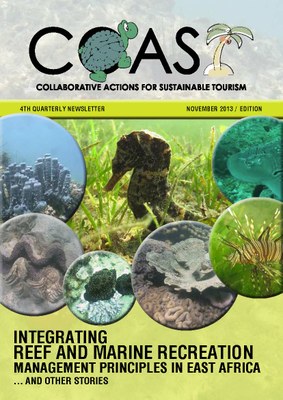
<p>The  COAST Project Newsletter is an easy to read 32 page Newsletter  that  highlights some developments in the subject of sustainable coastal   tourism in the global discourse and progress in COAST Project   implementation.</p>
<p>The November 2013 Edition of this Newsletter places special focus on our activities in the Reef adn marine Recreation Management (RMRM) Thematic Area and contains the following stories and articles:</p>
<p> </p>
<ul>
<li style="text-align: justify; "><a href="http://coast.iwlearn.org/en/Newsletter/4th%20COAST%20Project%20Newsletter%20Edition%20%28November%202013%29.pdf" class="internal-link"><img src="http://coast.iwlearn.org/en/Newsletter%20Cover%20Page%20%282013%29.jpg/@@images/9f0e2717-ac29-4633-b2d9-1ac1ebd2f168.jpeg" alt="Newsletter Cover Page (2013).jpg" class="image-right" title="Newsletter Cover Page (2013).jpg" /></a>A Foreword by the UNIDO Regional Technical Coordinator<span class="Apple-converted-space"> </span><b>Dr.<span class="Apple-converted-space"> </span>Hugh Gibbon;</b></li>
</ul>
<ul style="text-align: start; ">
<li>A Cover Story on <b>Integrating Reef and Marine Recreation Management (RMRM) principles in East Africa: Case Studies from Kenya, Mozambique and Tanzania;</b></li>
<li>An analysis article<b> Showcasing the Seychelles Sustainable Tourism Label (SSTL); <br /></b></li>
<li>A Partnerships for Water Provision Case Study<span class="Apple-converted-space"> </span>highlighting<span class="Apple-converted-space"> </span><b>UNIDO</b><b>’s<span class="Apple-converted-space"> </span>Support to the<span class="Apple-converted-space"> </span>Chipande<span class="Apple-converted-space"> </span>Community in Watamu Demo Site area in Kenya;</b></li>
<li>A Special Feature on how some of the<b> COAST Project countries marked the World Environment Day at the Demonstration Sites;<br /></b></li>
<li>Some News from the <b>COAST Demo Sites</b> in all the nine Project Countries;</li>
<li>A <b>picture gallery </b>of the COAST Demo Site activities;</li>
<li>A Question<span class="Apple-converted-space"> </span>&amp; Answer<span class="Apple-converted-space"> </span>Section with<span class="Apple-converted-space"> </span><b>Dr. Francois Odendaal CEO EcoAfrica;<br /></b></li>
<li style="text-align: justify; ">An Opinion Article on<span class="Apple-converted-space"> </span><b>Experiences and Lessons from the Benguela Current Commission (BCC). </b></li>
</ul>
<p> </p>
<p><b><span class="internal-link">To read the stories in the attached <a href="http://coast.iwlearn.org/en/Newsletter/4th%20COAST%20Project%20Newsletter%20Edition%20%28November%202013%29.pdf" class="internal-link">PDF file or </a></span><a href="http://coast.iwlearn.org/en/Newsletter/4th%20COAST%20Project%20Newsletter%20Edition%20%28November%202013%29.pdf" class="internal-link"><span class="external-link"><span class="internal-link">download the English PDF Newsletter Edition here.</span></span></a></b></p>
<ul style="text-align: start; ">
</ul>
<p style="text-align: center; "> </p>
<p style="text-align: center; "><b><span class="visualHighlight">For our Francophone readers, the <span class="internal-link">French PDF Newsletter Edition will be made available in due course.</span></span></b></p>
<p style="text-align: center; ">Please,  share with us your feedback on  any of these stories. If you want us to  follow up on any of these  stories, or would wish more information on  these articles, please write  to the COAST Project's Knowledge Management  and Communications Officer  on the contacts below.</p>
<p style="text-align: center; "><b>THE EDITORIAL TEAM - UNIDO COAST PROJECT</b></p>
<p align="center"><b>Office Number: +254 20 7625286</b></p>
<p align="center"><b>Cell. Number: +254 722 508010</b></p>
<h3 style="text-align: center; "><b>E-mail:</b><span class="Apple-converted-space"> </span><b><a href="mailto:g.omedo@unido.org?subject=Newsletter">G.Omedo@unido.org</a></b></h3>
</div>]]></content:encoded>
    <dc:publisher>No publisher</dc:publisher>
    <dc:creator>g.omedo@unido.org</dc:creator>
    <dc:rights></dc:rights>
    <dc:date>2013-11-26T06:25:00Z</dc:date>
    <dc:type>Issue</dc:type>
  </item>


  <item rdf:about="http://coast.iwlearn.org/en/News%20and%20Events/the-coast-project-at-the-gef-iwc7-conference-in-barbados">
    <title>THE COAST PROJECT AT THE GEF IWC7 CONFERENCE IN BARBADOS</title>
    <link>http://coast.iwlearn.org/en/News%20and%20Events/the-coast-project-at-the-gef-iwc7-conference-in-barbados</link>
    <description>During this year’s GEF IW7 Conference, the COAST Project showcased a number of materials and informational products to sensitize the participants on the various project outputs and deliveries. </description>
    <content:encoded xmlns:content="http://purl.org/rss/1.0/modules/content/"><![CDATA[<p style="text-align: justify; "><b>Introduction</b></p>
<p style="text-align: justify; ">This year’s GEF International Waters (IW) Conference was held in Barbados from 28<sup>th</sup> – 31<sup>st</sup> October 2013. These annual IW conferences are aimed at facilitating cross-sectoral and portfolio-wide learning and experience sharing, targeting transboundary water systems, such as shared river basins, lakes, groundwater and large marine ecosystems. With a portfolio comprising of 242 projects to date and some US$1.4 billion of GEF grants invested in 149 different countries, this thematic area is of critical importance to the subject of sustainable development. It is important to note here that since the inception of the GEF in 1991, the IW portfolio continues to deliver substantive results and replicable experiences to be scaled up and mainstreamed globally.</p>
<p style="text-align: justify; ">The IWC7 conference<i> </i>brought together approximately 215 participants, including GEF IW project managers, representatives of beneficiary countries, non-governmental organizations, transboundary management institutions, UN Agencies, and the private sector to deliberate on this year’s theme of “<i>Economic Valuation as a Tool to Bridge the Science-Policy Gap”</i>. Mr. Ludovic Bernaudat, the Project Manager, represented the COAST Project during this important fete in the calendar of the IW thematic area.</p>
<p style="text-align: justify; "><b> </b></p>
<p><img src="http://coast.iwlearn.org/en/News%20and%20Events/groupfinalwebkc.jpg/@@images/e774e7b2-5d5c-4ea0-935b-dfe49796a484.jpeg" style="float: left; " title="" class="image-inline" alt="" /></p>
<p style="text-align: justify; "><b>Figure 1: Participants at the IW7 Conference in Barbados pose for a photo during the workshop</b></p>
<p style="text-align: justify; "><b>The COAST Project at the GEF IW7 Conference</b></p>
<p style="text-align: justify; ">During this year’s GEF IW7 Conference, the COAST Project showcased a number of materials and informational products to sensitize the participants on the various project outputs and deliveries. The project displayed banners showcasing project activities at the regional level and in Tanzania and Senegal. Project brochures displaying a summary on the activities at the country level, lanyards and COAST Project branded USB sticks were also distributed to the IW7 conference participants. In addition to these promotional materials, the project also displayed actual eco-tourism products generated by various beneficiaries. Of particular note here are soaps developed by Bagamoyo beneficiaries in Tanzania and crafts from recycled wastes from the ALMA Association in our Inhambane demo Site.  All these were aimed at enhancing the visibility of the COAST Project among the participating delegates <a href="http://coast.iwlearn.org/en/News%20and%20Events/copy_of_NOVEMBER2013_COAST_KMC_ProductsPictorial.pdf" class="internal-link"><b><span class="internal-link"><span class="internal-link"><span class="internal-link"><i>(To see a list of all posters, banners and brochures produced by the COAST Project check here</i></span>)</span>.</span></b></a></p>
<p><img src="http://coast.iwlearn.org/en/News%20and%20Events/unep.jpg/@@images/300fd738-91db-4815-b6d1-3eb9a237b20a.jpeg" style="float: left; " title="" class="image-inline" alt="" /><b>Figure 2: A section of participants at the IW7 Conference pose for a photo during the workshop</b></p>
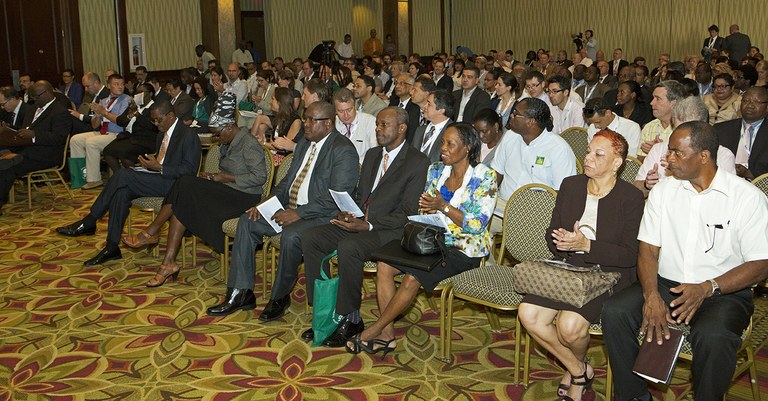
<p style="text-align: justify; ">In addition to the above, our COAST Project website (<a href="http://coast.iwlearn.org/en/"><i>http://coast.iwlearn.org/en</i></a>;) was nominated among 10 other IW: LEARN supported websites to compete for the IW Wonderful Outstanding Web (WOW) Award Competition. (<i>To see the full list of nominated websites </i><a href="http://iwlearn.net/websitetoolkit/wow/iw-wow-2013"><i>http://iwlearn.net/websitetoolkit/wow/iw-wow-2013</i></a><i>;</i>).  Resulting from the competition which saw accepted entries participate in a blitz of online sensitization campaigns aimed at soliciting for votes, a group of judges, consisting of five experts (<i>on transboundary management and ICT</i>) rated the finalists based on the criteria of content, technical component, timeliness and visual appearance. The Top 5 websites were then announced on the opening day of the IWC7 at the further judged by the IWC7 participants during the conference. Our COAST Project Website was ranked 4<sup>th</sup>, after this rigorous competition and received positive reviews from the hundred voters and panel of IW: LEARN judges. The eventual winner for this competition was the Coral Triangle Knowledge Network (CTKN), a knowledge and social network facility supported by the Asian Development Bank (ADB) (to see the winning website, check here <a href="http://www.ctknetwork.org/">http://www.ctknetwork.org/</a>).</p>
<p><img src="http://coast.iwlearn.org/en/News%20and%20Events/copy_of__MG_6371tine5fb.jpg/@@images/bfd32dca-9efd-4d30-a492-f48f007d7f46.jpeg" style="float: left; " title="Plenary" class="image-inline" alt="Plenary" /></p>
<p style="text-align: justify; "><b>Figure 3: The IW7 Conference in Plenary</b></p>
<p style="text-align: justify; "><b>Conclusion and Way forward from the IW7 </b></p>
<p style="text-align: justify; ">From the foregoing, it is important to note that the COAST Project had a good showing at this year’s IW7 Conference. The conference was also useful in helping the participants discuss and agree on best practices in economic valuation for ecosystem services. The conference provided a sound framework to comprehensively evaluate natural and environmental resources, presented various methods to assess the value of ecosystem to human well-beings as well as examples from marine and freshwater ecosystems to illustrate the different concepts and methods. The closing plenary of the IW7 featured reflections on the IWC7 and the key take-home messages from each of the principal sessions.</p>
<p style="text-align: justify; ">The next IW conference, IW8, will be hosted by the East Asian Seas region in 2014.</p>
<p style="text-align: justify; ">To Read more on the IW7 Conference, see here <a href="http://iwlearn.net/abt_iwlearn/events/conferences/iwc7-2013/index_html">http://iwlearn.net/abt_iwlearn/events/conferences/iwc7-2013/index_html</a>;</p>]]></content:encoded>
    <dc:publisher>No publisher</dc:publisher>
    <dc:creator>g.omedo@unido.org</dc:creator>
    <dc:rights></dc:rights>
    <dc:date>2013-11-21T14:15:00Z</dc:date>
    <dc:type>News Item</dc:type>
  </item>


  <item rdf:about="http://coast.iwlearn.org/en/News%20and%20Events/new-the-sustainable-tourism-governance-and-management-publication">
    <title>New - The Sustainable Tourism Governance and Management Publication </title>
    <link>http://coast.iwlearn.org/en/News%20and%20Events/new-the-sustainable-tourism-governance-and-management-publication</link>
    <description>The Sustainable Tourism Governance and Management in Coastal Areas of Africa publication assesses how to apply sustainability principles and policy instruments for coastal tourism development in Africa. </description>
    <content:encoded xmlns:content="http://purl.org/rss/1.0/modules/content/"><![CDATA[<p style="text-align: center; "><a href="http://coast.iwlearn.org/en/copy_of_131021_coast_management_africa_UNIDO_wm.pdf" class="internal-link"><b>To download the English version of the report here</b></a></p>
<p style="text-align: center; "><a href="http://coast.iwlearn.org/en/News%20and%20Events/COASTSustainableTourismGovernanceManagement_French.pdf" class="internal-link"><span class="internal-link"><b>Pour télécharger la version en français, cliquez ici</b></span></a></p>
<p><b>New COAST Project Publication</b></p>
<p style="text-align: justify; "><img src="http://coast.iwlearn.org/en/News%20and%20Events/londji8.JPG/@@images/b7b7884c-e4dc-4ae0-90cc-11227f7a60b9.jpeg" alt="Londji beach" class="image-left" title="Londji beach" />In the past five years, UNWTO, UNIDO and UNEP have actively collaborated to address sustainable tourism development in coastal areas in Africa, through the Global Environment Facility (GEF) funded project, titled “<i>Collaborative Actions for Sustainable Tourism (COAST)</i>”, covering nine Sub-Saharan African countries (<i>Cameroon, the Gambia, Ghana, Kenya, Mozambique, Nigeria, Senegal, Seychelles and Tanzania</i>).</p>
<p style="text-align: justify; ">The project developed best practices on reef and marine recreation management, environmental management systems and eco-tourism, and undertook a desk study and field research in the nine countries to identify national and local mechanisms for sustainable tourism governance and management.</p>
<p style="text-align: justify; "><b>Addressing Sustainability Issues in the Tourism Sector in Africa</b></p>
<p style="text-align: justify; ">Sustainable Tourism Governance and Management in Coastal Areas of Africa presents the results of the research carried out within the framework of the COAST project. It builds on the UNWTO and UNEP publication Making Tourism More Sustainable – A Guide for Policy Makers, by assessing how to apply sustainability principles and policy instruments for coastal tourism development in Africa. Detailed recommendations are provided to strengthen governance and management to ensure that tourism serves as a positive force in coastal areas, helping to conserve environments and biodiversity, minimising environmental impact and contributing to the wellbeing of local communities. While the field research was conducted in the nine COAST project countries, the study also has a generic relevance and can provide guidance for sustainable coastal tourism in other countries, especially in <br />Africa and the developing world.</p>
<p style="text-align: justify; "><img src="http://coast.iwlearn.org/en/News%20and%20Events/Mangroveboardwalkandrestaurant.JPG/@@images/2379f488-469d-4572-a32e-f7cf73e6f77c.jpeg" alt="Mangrove " class="image-right" title="Mangrove " />This report has been prepared for UNWTO by Dr Richard Denman, consultant with The Tourism Company, United Kingdom, who also undertook the studies in The Gambia, Ghana, Kenya, Nigeria, Tanzania and Seychelles. The studies in Cameroon and Senegal were undertaken by Lionel Bécherel and in Mozambique by Jeremy Gottwals. The valuable input of the COAST project focal points, demo site coordinators, national experts appointed to assist with this study and everyone consulted during the course of the work is also gratefully acknowledged.</p>
<p style="text-align: justify; "> </p>
<p> </p>]]></content:encoded>
    <dc:publisher>No publisher</dc:publisher>
    <dc:creator>g.omedo@unido.org</dc:creator>
    <dc:rights></dc:rights>
    <dc:date>2013-11-12T05:50:00Z</dc:date>
    <dc:type>News Item</dc:type>
  </item>


  <item rdf:about="http://coast.iwlearn.org/en/News%20and%20Events/health-of-oceans-declining-fast">
    <title>Health of oceans 'declining fast'</title>
    <link>http://coast.iwlearn.org/en/News%20and%20Events/health-of-oceans-declining-fast</link>
    <description>"Whilst terrestrial temperature increases may be experiencing a pause, the ocean continues to warm regardless. For the most part, however, the public and policymakers are failing to recognise - or choosing to ignore - the severity of the situation.”</description>
    <content:encoded xmlns:content="http://purl.org/rss/1.0/modules/content/"><![CDATA[<p><b><span class="byline-photo byline"><span class="byline-name">By Roger Harrabin</span> <span class="byline-title">Environment analyst</span></span></b></p>
<p><b><span class="byline-photo byline"><span class="byline-title"></span></span></b><img src="http://coast.iwlearn.org/en/News%20and%20Events/copy_of__70241894_c0175287coral_reefspl.jpg" alt="Coral Reefs" class="image-inline" title="Coral Reefs" /></p>
<p style="text-align: justify; ">The health of the world’s oceans is deteriorating even faster than had previously been thought, a report says.</p>
<p style="text-align: justify; ">A review from the International Programme on the State of the Ocean (IPSO), warns that the oceans are facing multiple threats.</p>
<p style="text-align: justify; ">They are being heated by climate change, turned slowly less alkaline by absorbing CO2, and suffering from overfishing and pollution.</p>
<p style="text-align: justify; ">The report warns that dead zones formed by fertiliser run-off are a problem.</p>
<p style="text-align: justify; ">It says conditions are ripe for the sort of mass extinction event that has afflicted the oceans in the past.</p>
<p style="text-align: justify; ">It says: “We have been taking the ocean for granted. It has been shielding us from the worst effects of accelerating climate change by absorbing excess CO2 from the atmosphere.</p>
<p style="text-align: justify; ">“Whilst terrestrial temperature increases may be experiencing a pause, the ocean continues to warm regardless. For the most part, however, the public and policymakers are failing to recognise - or choosing to ignore - the severity of the situation.”</p>
<p style="text-align: justify; ">It says the cocktail of threats facing the ocean is more powerful than the individual problems themselves.</p>
<p style="text-align: justify; ">Coral reefs, for instance, are suffering from the higher temperatures and the effects of acidification whilst also being weakened by bad fishing practices, pollution, siltation and toxic algal blooms.</p>
<p style="text-align: justify; ">Atmospheric threshold</p>
<p style="text-align: justify; ">IPSO, funded by charitable foundations, is publishing a set of five papers based on workshops in 2011 and 2012 in partnership with the International Union for Conservation of Nature (IUCN’s) World Commission on Protected Areas.</p>
<p style="text-align: justify; ">The reports call for world governments to halt CO2 increase at 450ppm. Any higher, they say, will cause massive acidification later in the century as the CO2 is absorbed into the sea.</p>
<p style="text-align: justify; ">It urges much more focused fisheries management, and a priority list for tackling the key groups of chemicals that cause most harm.</p>
<p style="text-align: justify; ">It wants the governments to negotiate a new agreement for the sustainable fishing in the high oceans to be policed by a new global high seas enforcement agency.</p>
<p style="text-align: justify; ">The IUCN’s Prof Dan Laffoley said: "What these latest reports make absolutely clear is that deferring action will increase costs in the future and lead to even greater, perhaps irreversible, losses.</p>
<p style="text-align: justify; ">"The UN climate report confirmed that the ocean is bearing the brunt of human-induced changes to our planet. These findings give us more cause for alarm – but also a roadmap for action. We must use it."</p>
<p style="text-align: justify; ">'Extinction risk'</p>
<p style="text-align: justify; ">The co-coordinator, Prof Alex Rogers from Oxford University has been asked to advise the UN's own oceans assessment but he told BBC News he had led the IPSO initiative because: "It’s important to have something which is completely independent in any way from state influence and to say things which experts in the field felt was really needed to be said."</p>
<p style="text-align: justify; ">He said concern had grown over the past year thanks to papers signalling that past extinctions had involved warming seas, acidification and low oxygen levels. All are on the rise today.</p>
<p style="text-align: justify; ">He agreed there was debate on whether fisheries are recovering by better management following examples in the US and Europe, but said it seemed clear that globally they were not.</p>
<p style="text-align: justify; ">He also admitted a debate about whether overall climate change would increase the amount of fish produced in the sea. Melting sea ice would increase fisheries near the poles whilst stratification of warmer waters in the tropics would reduce mixing of nutrients and lead to lower production, he said.</p>
<p style="text-align: justify; ">He said dead zones globally appeared to be increasing although this may reflect increased reporting.</p>
<p style="text-align: justify; ">"On ocean acidification, we are seeing effects that no-one predicted like the inability of fish to detect their environments properly. It’s clear that it will affect many species. We really do have to get a grip on what’s going on in the oceans," he said.</p>
<p style="text-align: justify; "><a class="external-link" href="http://www.bbc.co.uk/news/science-environment-24369244"><b>For this story check here</b></a></p>]]></content:encoded>
    <dc:publisher>No publisher</dc:publisher>
    <dc:creator>g.omedo@unido.org</dc:creator>
    <dc:rights></dc:rights>
    <dc:date>2013-10-03T16:32:17Z</dc:date>
    <dc:type>News Item</dc:type>
  </item>


  <item rdf:about="http://coast.iwlearn.org/en/News%20and%20Events/unep-strengthened-and-upgraded-to-implement-the-future-we-want">
    <title>UNEP Strengthened and Upgraded to Implement The Future We Want </title>
    <link>http://coast.iwlearn.org/en/News%20and%20Events/unep-strengthened-and-upgraded-to-implement-the-future-we-want</link>
    <description>Governments Call for Governing Council to be Transformed into UN Environment Assembly </description>
    <content:encoded xmlns:content="http://purl.org/rss/1.0/modules/content/"><![CDATA[<div id="stcpDiv">
<p><b>Nairobi,  22 February 2012</b> - Starting from  an office above a supermarket 40 years-ago,  the UN  Environment Programme (UNEP) was today modernized into a strengthened   and upgraded institution better able to meet the challenges and  opportunities  of the 21st century.</p>
<p>The decision,  by ministers of the environment  meeting at the UNEP Governing Council,  implements the call by Heads of States  and governments in the Future We  Want forged at the close of Rio+20 last June.</p>
<div class="related_content_container">
<div class="related_content"></div>
</div>
<p>Governments this week also backed more  predictable, stable and  increased funding for UNEP from the UN Regular Budget  by 2014  -underlining increasing confidence in UNEP's ability and role to   deliver the environmental dimension of sustainable development.</p>
<p>Ministers meeting for the first time under  universal membership of  193 member states- again as a result of the decisions  taken and adopted  last year at Rio+20 and the UN General Assembly later in the  year-  adopted a welter of other decisions relating to the way UNEP will   operate and work as the global platform for environmental policy-making  and  action over the coming years and decades.</p>
<p>Governments called for  the transformation of the existing Governing   Council into a UN  Environment Assembly of  UNEP and to build stronger  links between UNEP's science-based Global  Environment Outlook process  and its ministerial meetings - further implementing  the call  by member  states at Rio + 20 to  strengthen the science-policy interface.</p>
<p>Achim  Steiner,  UN Under-Secretary General and UNEP Executive Director, said  at the close: "The  theme at this historic, universal membership  Governing Council was <i>Rio</i><i>+20: From Outcome to Implementation</i> - and  that was precisely what happened over the past five days".</p>
<p>"Ministers  responsible for the  environment implemented the strengthening and  upgrading of UNEP to an  institution better equipped and resourced to  serve the planet and its people to  meet the ever growing challenges  posed by ecosystem degradation to the growth  of greenhouse gas levels  in the atmosphere while catalyzing transformational  change to seize the  equally fast growing opportunities for a sustainable  development path  change," he said.</p>
<p>"Meanwhile ministers responsible   for the environment took also took forward the wider implementation of  the  Rio+20 outcome document - the Future We Want - across a broad sweep  of issues and  actions from support for 30 countries to make a green  economy transition;  building a stronger science-policy interface, and  strengthening the exercise of  environmental laws to fast tracking  action on persistent and emerging issues,  support for renewable energy  under the UN climate convention and the decade  long initiative on  decoupling natural resource use from economy growth - in short  the  10YFP," said Mr Steiner.</p>
<p>"Heads of State at Rio+20   grasped the sobering science, laid out in reports like UNEP's Global   Environment Outlook-5, and put in the foundations for new pathways and  new  directions to achieve a sustainable century - here ministers and  delegations from  over 150 nations have been the architects and  designers of an evolved UNEP with  greater authority, impact and  pathways to deliver the Future We Want," he  added.</p>
<p>Among the wealth of other decisions taken at the  first Universal Membership of the UNEP Governing Council were:-</p>
<ul>
<li>A UNEP-led consortium will host  and coordinate the <b><i>Climate Technology Centre and Network</i></b><b> (CTCN) </b>which will be the implementing arm of the Technology  Mechanism of the UN Framework Convention on Climate Change (UNFCCC)</li>
</ul>
<p> </p>
<p>The  CTCN  will work on leap-frogging the technical and financial hurdles to  the even  greater take-up of clean and renewable energies to low carbon  tranportation and  energy efficient buildings.</p>
<ul>
<li>Full  operationalization of a decade-long initiative to decouple  economic  growth from unsustainable use of natural resources and pollution   generation-the <b>10 Year Framework of  Programmes for Sustainable Consumption and Production Patterns (10YFP for SCP</b>)</li>
</ul>
</div>
<div>
<p> </p>
<p>The  UNEP-hosted initiative will  assist countries in areas from sustainable  public procurement, lifestyles and education to sustainable buildings  and construction  and sustainable tourism, including ecotourism - again  bringing from outcome to  implementation other key aspects of the Rio+20  Future We Want.</p>
<ul>
<li>Governments also decided to  convene in October this year an <b>intergovernmental  diplomatic conference to formally adopt the Minamata Convention on Mercury</b> that was agreed  in January in Geneva  under a UNEP-facilitated  negotiation-again a further implementation of the  Rio+20 outcome  document.</li>
</ul>
<p>The mercury treaty,  aimed at reducing releases  and emissions of a notorious  health-hazardous heavy metal from source such as  artisanal small-scale  mining, medical equipment and power stations, will open  for signature  at the conference in Japan en route to ratification and  coming into  force.</p>
<p><b>Inclusive  Green Economy</b></p>
<p>The summary by the President of the Governing  Council, <b>Hassan Abdel Hilal</b>,   Minister of Environment, Forests and Physical Development, Sudan,  noted that  many ministers called for a driving forward of the Green  Economy in the context  of sustainable development and poverty  eradication.</p>
<p> </p>
<p>Several suggested that  efforts should initially  focus on areas where fast action might happen  soonest including in area such as  energy, water and agriculture.</p>
<p>UNEP unveiled the Partnership for Action on a  Green Economy (PAGE) in  order to implement the outcomes of Rio+20 and meet the  needs of  countries keen to join such a transformation.</p>
<p>PAGE,  which will initially support 30 countries  on Green Economy work, is  backed by UNEP, the International Labour Organization  (ILO), the United  Nations Industrial Development Organization (UNIDO) and the  United  Nations Institute for Training and Research (UNITAR).</p>
<p><b>Sustainable  Development Goals</b></p>
<p>The meeting also discussed the role of the  environment in the  post-2015 agenda and the discourse surrounding the  development of a set  of Sustainable Development Goals (SDGs) which was informed  by the  presence of Amina J Mohamed, United Nations  Secretary-General Ban  Ki-moon's Special Adviser on Post-2015 Development  Planning.</p>
<ul>
<li>In  his summary, the  President observed that many representatives observed  that UNEP should play an  important role in promoting environmental  sustainability in the proposed goals  and post-2015 agenda </li>
<p> </p>
<li>They also that achieving  sustainable patterns of consumption and production should be one of the SDGs </li>
</ul>
<p> </p>
<p><b>Environmental  Law</b></p>
<p>Governments  also gave a big boost to environmental law, building on  the UNEP-convened World Congress on Justice, Governance and Law  for  Environmental Sustainability held during Rio+20  last June.</p>
<ul>
<li>Ministers   and delegates today asked UNEP to lead the United Nations system and  support  national Governments in the development and implementation of  environmental  rule of law including boosting information disclosure,  environmental auditing  and independent dispute resolution.</li>
</ul>
<p> </p>
<p><b>Medium-Term Strategy and Budget</b></p>
<p>A medium-term strategy for UNEP's  work up to 2017 was also adopted  focusing on themes outlined in the Rio+20  outcome across seven priority  areas while approving a more detailed work plan  for the organization  for 2014-15, which provides for strengthened  responsiveness to country  needs and more funds for direct activities including  via a  re-structuring of elements of UNEP's finances to be more stable and   predictable via an increase to be approved from the UN Regular Budget.</p>
<p><b>From the Launch of Cutting Edge Reports to  World-Class Meeting of Youth, Judges and Women Environment Ministers and Leaders</b></p>
<p>In advance and during the Governing Council UNEP  launched a series of  reports and hosted awareness-raising events and meetings  of other  stakeholders aimed at improving the science base available to policy   makers, prompting further transformative action, and highlighting key  issues  the organization will be working on in 2013 and beyond.</p>
<p>A UNEP-World Health Organization report on  endocrine-disrupting  chemicals unveiled new science on this subset of  chemicals, which  affect the hormone systems of humans and animals.</p>
<ul>
<li>Many such chemicals are  untested for their effects, and <i>The State  of the Science of Endocrine Disrupting Chemicals </i>called  for more research  to understand fully the associations between these  chemicals, found in many  household and industrial products, and  specific diseases and disorders. </li>
</ul>
</div>
<div>
<p> </p>
<p>UNEP and the Food and Agricultural  Organization off the UN's  <i>Think.Eat.Save. Reduce Your Foodprint</i> campaign on cutting food waste hosted a reception dinner for hundreds  of policy  makers. The campaign - whose web site is  www.thinkeatsave.org- is in support of  the UN Secretary-General's Zero  Hunger Challenge.</p>
<ul>
<li>The reception  highlighted  the scale of waste in Kenya and globally by preparing the  meal from almost  2,000 kilogrammes fruit and vegetables that had been  rejected by UK  supermarkets for cosmetic reasons. </li>
</ul>
<p>Young   people representing over 100 countries at the UNEP Tunza International  Youth  Conference, which took place in Nairobi a week  earlier, issued a  statement to the Governing Council calling for governments,  business,  cities and civil society to support UNEP's campaign.</p>
<ul>
<p> </p>
<li>The  Tunza youth statement  also called for reduced food waste and loss to  be a post-2015 development  target as a Sustainable Development Goal.</li>
</ul>
<p> </p>
<p>Also on the topic of the global food system,  the UNEP-commissioned report <i>Our Nutrient  World</i> laid out how humans - in pursuit of greater food production- have in   many areas altered the natural flows of nitrogen, phosphorus and other   nutrients, causing a web of water and air pollution.</p>
<p>The <i>UNEP  Year Book 2013</i> highlighted the accelerated melting of sea ice in the  Arctic, urging  caution on moves to take advantage of the retreating ice to  exploit  resources and open up shipping routes.</p>
<ul>
<li>It  also highlighted a  spike in the illegal wildlife trade that has sent  the numbers of elephants and  rhinos poached soar - an issue that UNEP  and its related conventions such as  CITES are bringing to the attention  of the global public. </li>
<p> </p>
<li>During the meeting for   example UNEP signed an agreement with Shanghai, one of the world's   most-populous cities, to promote awareness among the city's citizens of   negative consequences of the illegal wildlife trade.</li>
</ul>
<p> </p>
<p><b>Women Environment Ministers</b></p>
<p>The day before the Governing Council got  underway, the Network of  Women Ministers and Leaders for the Environment  (NWMLE) and UNEP hosted  the second High-Level Gender Forum.</p>
<p>The forum participants  called upon ministers and  environmental leaders to have dedicated  officials for coordination of related  gender and environment programmes  and agreed to send a consolidated proposal on  gender actions to be  forwarded for consideration by UN Secretary General's  High-level Panel  of Eminent Persons on the Post 2015 Development Agenda.</p>
<ul>
<li>The  women ministers also  requested nations to support the ratification of  the Minamata convention on  Mercury, which opens for signing in October.</li>
</ul>
<p>Other highlights included:</p>
<ul>
<li>The  launch of a  collaboration with the Global Off-Grid Lighting  Association to replace millions  of kerosene lamps, candles and  flashlights used worldwide with modern solar  lighting and reduce the  estimated 74 million tons of annual carbon emissions  from fuel-based  light sources commonly used in developing countries;</li>
<br />
<li>Celebrations  of the first  anniversary of The Climate and Clean Air Coalition, a  global initiative to  significantly reduce emissions of black carbon,  methane and other substances  known as short-lived climate pollutants  (SLCPs) that since its launch has been  joined by 27 countries, bodies  like the  European Commission and the World Bank and 28  non-state  organizations;</li>
<p> </p>
<li>The signing of an  agreement with  HRH Princess Lalla Hasna of Morocco, Chairwoman of the Mohammed  VI  Foundation for the Protection of the Environment, on youth engagement;</li>
<p> </p>
<li>Dozens  of media  roundtables and side events on issues such as the Green  Economy, poverty and  environment linkages, Sustainable Consumption and  Production, renewable energy,  climate change, REDD+, sustainable  transport, and the post-Rio+20 environment  and Sustainable Development  Goals.</li>
</ul>
<p> </p>
<p><a class="external-link" href="http://www.unep.org/newscentre/Default.aspx?DocumentID=2704&amp;ArticleID=9417&amp;l=en"><b>To see this story check here.</b></a></p>
<ul>
</ul>
</div>]]></content:encoded>
    <dc:publisher>No publisher</dc:publisher>
    <dc:creator>g.omedo@unido.org</dc:creator>
    <dc:rights></dc:rights>
    <dc:date>2013-08-12T13:20:00Z</dc:date>
    <dc:type>News Item</dc:type>
  </item>


  <item rdf:about="http://coast.iwlearn.org/en/News%20and%20Events/the-chumbe-island-coral-park-in-zanzibar-a-model-of-financially-ecologically-and-socially-sustainable-marine-park-management">
    <title>The Chumbe Island Coral Park in Zanzibar:  A Model of Financially, Ecologically and Socially Sustainable Marine Park Management</title>
    <link>http://coast.iwlearn.org/en/News%20and%20Events/the-chumbe-island-coral-park-in-zanzibar-a-model-of-financially-ecologically-and-socially-sustainable-marine-park-management</link>
    <description>Public communication, education and awareness-raising on the vulnerability of the marine and forest ecosystems and the importance of sustainable tourism are key pillars of CHICOP’s Environmental Education (EE) programs, which are regularly conducted on Chumbe Island and in Zanzibar.</description>
    <content:encoded xmlns:content="http://purl.org/rss/1.0/modules/content/"><![CDATA[<h1 style="text-align: justify; "></h1>
<p><b>By Ulrike Kloiber and Sibylle Riedmiller, Chumbe Island Coral Park</b><b> </b></p>
<p style="text-align: justify; "><br /> <b> </b></p>
<p style="text-align: center; "><i> “……..A notable example of payments for ecosystem services within the context of coral-reefs habitat is provided by the private and non-profit Chumbe Island Coral Park in the United Republic of Tanzania… local fishermen benefit from the Reef Sanctuary, as research findings confirmed that fish inside the protected no-take zone travel out and increase their yields in the vicinity</i>”..</p>
<p style="text-align: center; "><b>UN Secretary General’s report to the General Assembly on Protection of Coral Reefs for Sustainable Livelihoods and Development (2011)</b></p>
<ol style="text-align: justify; ">
<li><b><i>Background</i></b></li>
</ol>
<p style="text-align: justify; ">From aid project manager to social entrepreneur, founder and director of Chumbe Island Coral Park (CHICOP), Ms. Sibylle Riedmiller, followed her passion for the underwater world when she began efforts in 1992 to create the world’s first privately-managed marine protected area at Chumbe Island in Zanzibar, United Republic of Tanzania. This hitherto uninhabited small coral island 12 kilometers southwest of Zanzibar town is now a fully managed nature reserve that protects a 30-hectare no-take coral reef sanctuary, where fish and corals thrive, and a coral-rag forest reserve covering most of the island's 22 hectares that harbors rare and endangered animals.</p>
<p style="text-align: justify; ">Over the last two decades, CHICOP has created a model of financially, ecologically and socially sustainable Marine Park management, where a collaboration of actions for sustainable coastal tourism supports employment, conservation, research and environmental education for local people. Currently top ranking on TripAdvisor.com (<i>a traveler information and feedback website portal</i>) gives evidence that Chumbe Park has also become a successful sustainable tourism destination, where income from visitors is channeled back into preserving this little stretch of paradise for future generations.</p>
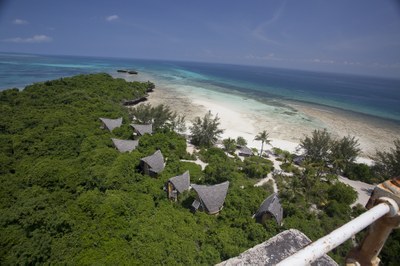
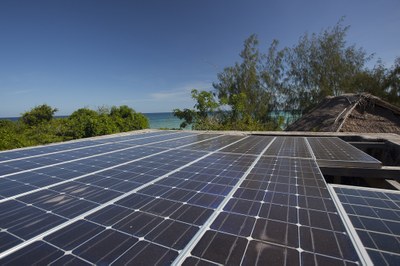
<p style="text-align: justify; ">Maintaining the integrity of the island's pristine ecosystems for posterity is CHICOP's mission. In this regard, not a single tree was cut and only empty clearings left by nature were used when the Visitors' centre and seven eco-bungalows were built. Combining traditional building styles and materials with modern eco-architecture, the technologies for water and energy provision and waste avoidance and recycling of the eco-lodge took full advantage of sunlight, natural ventilation and rainwater, with rainwater catchment, vegetative gray water filtration, composting toilets, solar water heating and photovoltaic power generation.</p>
<p style="text-align: justify; ">The Chumbe model of sustainable tourism that develops and funds a marine park and provides benefits to local people has generated major interest among international conservation organizations and has won CHICOP numerous prestigious awards and global recognition.<a href="#_ftn1">[1]</a></p>
<p style="text-align: center; "><img src="http://coast.iwlearn.org/en/News%20and%20Events/Viewfromlighthouse.jpg/@@images/80c96c2b-7f92-462e-8a5d-b1e4cfb6940f.jpeg" alt="" class="image-inline" title="" /></p>
<p style="text-align: center; ">Figure : A bird’s eye view of the eco-lodges on Chumbe Island (Photo courtesy CHICOP)</p>
<p style="text-align: justify; "><b><i>Joining the ZEITZ Long Run Initiative</i></b><b> </b></p>
<p style="text-align: justify; ">In the year 2008, CHICOP became a founding member of the flagship program of the Jochen Zeitz Foundation, the <i>“Long Run Initiative<a href="#_edn1"><b>[i]</b></a>"</i>. This initiative promotes and certifies tourism enterprises, which directly manage, or significantly contribute to the management of a natural area of conservation value and demonstrate their commitment to sustainability through the 4Cs: Conservation, Community, Culture and Commerce. Performance and processes across the 4Cs are assessed through a certification scheme that awards destinations with the Global Ecosphere Retreat (GER) distinction for the highest level of sustainability.</p>
<p style="text-align: justify; ">In working towards this certification, CHICOP shared and discussed achievements in a challenging environment and lessons learned in the two decades of Chumbe history. After going through a rigorous assessment process by external experts,  CHICOP become the first GER certified Long Run Destination in 2011, in recognition of promoting marine conservation in Tanzania and setting an example for genuine sustainable tourism and environmental education and awareness creation.</p>
<ol style="text-align: justify; ">
<li><b><i>Sustainable Tourism at CHICOP and how it benefits local      communities</i></b></li>
</ol>
<p style="text-align: justify; ">Chumbe Island Coral Park is a private investment into marine and forest conservation with a commercial component, the eco-lodge, which generates the income needed to run the park. Therefore, revenue generated from tourism is reinvested in supporting park management and environmental education programs. This includes various economic incentives for local communities since the lodge opened in 1998.</p>
<table class="vertical listing" style="text-align: justify; ">
<tbody>
<tr>
<td>
<p><b>Benefits to local communities include:</b></p>
</td>
</tr>
<tr>
<td>
<ul>
<li><b>Employment and        career opportunities:</b> The successful integration of environment and        community is an important benchmark for sustainable tourism. In order to        realize this as a fully managed nature reserve, and also due to the        particular eco-technologies installed, CHICOP’s operations are very        labor-intensive. With only seven rooms, CHICOP has probably the highest        employee/room ratio of any tourism business in Tanzania, and three times        the international average for eco-lodges. Wherever possible, CHICOP        employs people from nearby village communities, though they have limited        formal education and thus need much on-the-job-training. Of the 43        employees, 95% are Tanzanians, over two thirds from local communities,        and 5% expatriates. In particular, former fishermen were recruited and        trained as park rangers and stationed on the island. Gender        considerations are also key, with women being given preference and        currently forming 40% of the entire Chumbe workforce. It is important to        note here that a third of the staff are directly involved in        conservation management and education.</li>
</ul>
</td>
</tr>
<tr>
<td>
<ul>
<li><b>Market for local services, produce        and handicraft: </b>Since guests are offered typical Zanzibarian        cuisine, which is a delicious blend of Asian, Arabic, African and        European traditions, CHICOP creates a ready market for local produce,        rather than imported foods. This not only reduces waste and pollution by        minimizing packaging materials of industrially processed food, but also        raises awareness and pride for the local culture. Other income        opportunities for local people include building materials for the        eco-lodge, handicrafts sold in the boutique, the outsourcing of road and        boat transport and craftsmen services during maintenance. </li>
</ul>
</td>
</tr>
<tr>
<td>
<ul>
<li><b>Sustainable        financing for conservation: </b>The sustainable management and promotion        of key ecosystem services (<i>sustainable        fisheries and biodiversity conservation</i>) for the Chumbe region has been        widely recognized, including mention in the recent UN Secretary        General’s report to the General Assembly on protection of coral reefs        for sustainable livelihoods and development for Rio+20, which        states:  <i>‘‘A noted example for PES (Payment for Ecosystem Services)        within the context of coral reefs habitat is the private, non-profit        Chumbe Island Coral Park Ltd (CHICOP) in Tanzania…. Especially local        fishermen benefit from the Reef Sanctuary, as research findings        confirmed that fish inside the protected no-take zone travel out and        increase their yields in the vicinity”.</i></li>
</ul>
</td>
</tr>
</tbody>
</table>
<p style="text-align: justify; "><b><i>Minimizing environmental impacts – water, energy and waste management</i></b></p>
<p style="text-align: justify; ">One of CHICOP’s main objectives is to manage the eco-lodge as a model for sustainable tourism development, providing high-quality services to visitors while promoting environmental awareness through education programs for the local community and all island visitors. Like many developing countries, Zanzibar does not have an effective/efficient solid waste management system in place. Due to lack of infrastructure and public services, waste is burned in the streets or dumped in illegal sites, creating major public health concerns and environmental hazards. To minimize environmental impacts, CHICOP restricts the number of visitors to the island and avoids the purchase of non-biodegradable products. Where possible, goods are sourced locally and transported in locally made, biodegradable baskets. Non-cooked fruit and vegetable waste is collected, composted and used for the composting toilets on the island, while non-biodegradable waste is removed from the island and, where possible, recycled. Only biodegradable detergents and soaps are used and laundry is washed off the island.</p>
<p style="text-align: justify; ">During the year 2012, CHICOP also conducted waste recycling workshops with the help of volunteers, who for example taught local staff how to turn candle stubs from guest dinners into recycled coconut candles. Workshops were held to create hands-on learning tools for visiting students using only recycled materials to illustrate how trash can have a ‘second life’. Such activities illustrate CHICOP’s commitment to environmental sustainability and the commitment to share knowledge and the importance of waste management through practical learning experiences.</p>
<p style="text-align: center; "><img src="http://coast.iwlearn.org/en/News%20and%20Events/SolaronChumbe.jpg/@@images/37a3291c-4aba-48ee-ad8d-cfefd9493787.jpeg" alt="" class="image-inline" title="" /></p>
<p style="text-align: center; ">Figure : CHICOP employs the exclusive use of renewable energy with these solar panels powering the facility (Photo courtesy CHICOP)</p>
<ol style="text-align: justify; ">
<li><b><i>Communication &amp; Environmental Awareness Activities      &amp; Engagement of Partners</i></b><b> </b></li>
</ol>
<p style="text-align: justify; ">While coastal communities depend on fishing for their survival in mainland Tanzania and Zanzibar, there is little evidence of traditional reef management or sensitization about the limitations of this fragile resource. By and large, Government policies, legislation and management capacity fall short in meeting the challenges of rapid environmental degradation and tend to favor investments into unsustainable development and environmentally destructive products and practices.</p>
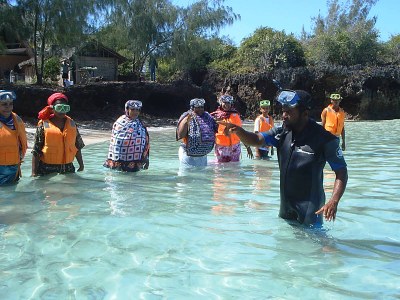
<p style="text-align: justify; "><img src="http://coast.iwlearn.org/en/News%20and%20Events/First_time_snorkellers.jpg/@@images/719003b2-dcec-499d-8e26-4a3184cd5db6.jpeg" alt="" class="image-right" title="" />Figure 19: CHICOP's environmental Educator demonstrates snorkeling techniques to a group of Zanzibar girls on an education tour (Photo: CHICOP)</p>
<p style="text-align: justify; ">Therefore, public communication, education and awareness-raising on the vulnerability of the marine and forest ecosystems and the importance of sustainable tourism are key pillars of CHICOP’s Environmental Education (EE) programs, which are regularly conducted on Chumbe Island and in Zanzibar. The programs offer free island excursions, training workshops and peer education sessions for students, teachers and community members. Based on the approach of ‘<i>Education for Sustainable Development</i><a href="#_ftn2">[2]</a>’, these programs help to close the gap between theoretical knowledge and practice, involve different level of learners and seek solutions to environmental concerns that build on indigenous knowledge, culture and traditions. By the year 2012, over 6000 school children and 900 teachers had visited the island to experience the natural environment with its diverse ecosystems.</p>
<p style="text-align: justify; ">The experiential hands-on activities for schoolchildren and all visitors include guided snorkeling in the reef and walking along the forest trails using all senses such as sight, touch, hearing, taste and smell while ensuring that the teaching contents link up with the national school curricula. CHICOP also supports schools through environmental talks/seminars and helps organize environmental clubs, which are much encouraged by a popular competition for a sustainable future for schools, i.e. the Chumbe Challenge Environmental Award.</p>
<p style="text-align: justify; "><b>The role of research and education: </b> CHICOP started operations in 1991 by conducting baseline surveys of the ecosystems and marine and forest flora and fauna of the island. This was meant to establish the conservation value of the Chumbe reef and coral-rag forest and to convince the Government of Zanzibar that the island should indeed be protected. However, it was clear that the park could not be developed without co-operation of local communities as well. Research and training on marine and forest conservation and sustainable tourism development for income generation was therefore at the center of project implementation. Enforcement of no-take marine parks is challenging around the world, especially when local communities rely on fishing for their livelihood. On the other hand, after a few years of effective closure, the local fishermen benefit from marine parks, as these create breeding sanctuaries for fish and other marine organisms, which restock adjacent and upstream overfished areas, the famous 'spill-over effect'. This was discussed by the CHICOP management in village meetings in the early nineties to win co-operation, and it was agreed that fishermen should be employed and trained as Park Rangers to educate their fellow fishermen about the purpose and benefits of the closure. This approach worked very well. As soon as the spill-over effect became noticeable in the mid nineties, enforcement was no problem anymore, and local fishermen now respected the park boundaries and reported that the catch outside of the boundaries had increased since the establishment of the park.</p>
<p style="text-align: justify; ">Some of the fishermen were trained in data collection for research, park management and monitoring techniques for the reef and the forest to become park rangers.  They also learnt the English language and guidance skills required for island visitors, including environmental education for local schoolchildren. All other island staff, such as cooks, cleaners &amp; waiters are also trained periodically to acquire the basics of reef ecology, forest ecology, English language skills, eco-tourism and eco-technology.</p>
<p style="text-align: justify; "><b>Capacity building of government staff:</b> CHICOP has also helped to raise conservation awareness and understanding of the legal and institutional requirements among government officials. The very innovative and unusual investment proposal of a privately established and managed Marine and Forest reserve required the involvement and approval of altogether seven Government departments. This took over four years to negotiate, followed by intense discussions on the Management Plans 1995 - 2016, which were developed by CHICOP consultants with wide stakeholder participation. This lengthy process has gained CHICOP political support and prepared the ground for improvements in the legal framework for marine conservation, environmental protection and management. Furthermore, an Advisory Committee that was established in the year 1995 includes village leaders, government officials, local academics and the CHICOP management, and meets at least twice per year for discussions about achievements and challenges.</p>
<ol style="text-align: justify; ">
<li><b><i>Conclusion on Results, Experiences from Chumbe Island</i></b><b> </b></li>
</ol>
<p style="text-align: justify; ">From our work in Chumbe, through lessons accumulated over a period of 2 decades, we have established that<b> </b>private management of marine protected areas can be effective and economically viable, even in a challenging political environment. Investment in conservation and in environmentally sound technologies, as well as the employment of additional staff for park management and environmental education programs, raises costs considerably, making it difficult to compete with other tourism enterprises. Favorable conservation and investment policies and taxation would encourage such initiatives, but are not currently available in Tanzania. Close cooperation with government agencies in establishing and protecting this reserve has enhanced the understanding of environmental issues among local and national authorities. In addition, the establishment of the Chumbe nature reserve has benefited local communities by generating income, employment, market for local produce, developing new work skills, and restocking commercial fish species in adjacent marine areas (spill-over). To avoid user conflicts, it is easier to preserve an area that is not used intensively for subsistence or other economic endeavors by local communities.</p>
<p style="text-align: justify; ">With the threats of climate change, marine conservation needs more political support from governments and the international conservation community, as well as recognition of the contributions that the private sector can make to both, effective conservation area management and livelihoods of local people on the ground. Long-term security of tenure and contracts, together with a favorable political, legal and institutional environment are needed to attract more private and community investment in marine conservation particularly in the developing world. The Chumbe Island Coral Park project looks forward to sustain these in the months and years to come.</p>
<p style="text-align: justify; "> </p>
<hr size="1" style="text-align: justify; " width="33%" />
<p style="text-align: justify; "><a href="#_ftnref1">[1]</a> Some of the most prestigious of the approximate 20 of international awards won by CHICOP from 1999 to date include: 1999 British Airways Tourism For Tomorrow Award - Global Winner; 2000 Global 500 <b>UNEP </b>Outstanding Environmental Achievement Award – Winner; 2001 Ecotourism Destination Award - World Winner; National Geographic Society’s Center for Sustainable Destinations (CSD), 2012 Sustainia Award; among others.</p>
<p style="text-align: justify; "><a href="#_ftnref2"><i><b>[2]</b></i></a><i> The Education for Sustainable Development toolkit is available at </i><a href="http://www.esdtoolkit.org/esd_toolkit_v2.pdf"><i>http://www.esdtoolkit.org/esd_toolkit_v2.pdf</i></a><i>;</i></p>
<p style="text-align: justify; "><br clear="all" /></p>
<hr size="1" style="text-align: justify; " width="33%" />
<p style="text-align: justify; "><a href="#_ednref1"><i><b>[i]</b></i></a><i> Website (</i><a href="http://www.thelongrun.com" target="_blank"><i>www.thelongrun.com</i></a><i>; and </i><a href="http://www.zeitzfoundation.org" target="_blank"><i>www.zeitzfoundation.org</i></a><i>; </i><i>)</i></p>
<table style="text-align: justify; ">
<tbody>
<tr>
<td></td>
</tr>
</tbody>
</table>
<p style="text-align: justify; "><i> </i></p>]]></content:encoded>
    <dc:publisher>No publisher</dc:publisher>
    <dc:creator>g.omedo@unido.org</dc:creator>
    <dc:rights></dc:rights>
    <dc:date>2013-07-03T15:16:21Z</dc:date>
    <dc:type>News Item</dc:type>
  </item>


  <item rdf:about="http://coast.iwlearn.org/en/News%20and%20Events/unido-supports-the-water-project-in-chipande-community-watamu-demo-site-area">
    <title>UNIDO SUPPORTS THE WATER PROJECT IN CHIPANDE COMMUNITY, WATAMU DEMO SITE AREA</title>
    <link>http://coast.iwlearn.org/en/News%20and%20Events/unido-supports-the-water-project-in-chipande-community-watamu-demo-site-area</link>
    <description>UNIDO through a partnership with the Government of Slovenia is working to support a water treatment project in Kilifi County, Kenya for the local community around the Chipande Primary School. </description>
    <content:encoded xmlns:content="http://purl.org/rss/1.0/modules/content/"><![CDATA[<p align="center"><i>“Water is central to the well‐being of people and the planet,"</i></p>
<p align="center"><b>United Nations Secretary‐General Ban Ki‐moon in a video message for the International Year of Water Cooperation 2013</b></p>
<p style="text-align: justify; "><b>Introduction</b></p>
<p style="text-align: justify; ">At the dawn of the new millennium in the year 2000, the global community committed to a raft of noble goals, the Millennium Development Goals (MDGs). These were broad policy statements ranging from halving extreme poverty rates to halting the spread of HIV/AIDS and achieving universal primary education, all by the target date of 2015. As the clock ticks towards the year 2015, many are closely watching whether delivery on these goals was achieved or not. As development practitioners churn out numbers and statistics to evaluate whether the goals of halving the poverty levels; enhancing education access; improving maternal health; reducing the infant mortality rates at birth; and others have been met, there is a sobering realization that at the centre of all these efforts, is the MDG goal on ensuring environmental sustainability, with a specific target of halving by the year 2015, the proportion of people without sustainable access to safe drinking water All these MDG’s will however rely heavily on MDG number 8, on   developing a global partnership for development. (<a href="http://www.un.org/milleniumgoals">www.un.org/milleniumgoals</a>).</p>
<p style="text-align: justify; ">Indeed, this is the central message in the year 2013, which is the year of world cooperation for ‘<i>water as an ingredient for global cooperation for peace, prosperity and sustainable development’</i>. During the World Water Day celebration on 22<sup>nd</sup> March this year, the global community leaders made it inherently clear that the fulfillment of basic human needs, the environment, socio‐economic development and poverty reduction are all dependent on water. In this regard, cooperating around this precious resource is key for security, poverty eradication, social equity and gender equality.</p>
<p style="text-align: justify; "><b>The MDG’s Goals on Water Access: From Policy to Action</b></p>
<p style="text-align: justify; ">In an effort to transform these goals into tangible actions, UNIDO through a partnership with the Government of Slovenia is working to support a water treatment project in Kilifi County, Kenya for the local community around the Chipande Primary School.  The water project was designed in 2010 with the principal objective of contributing to an increase in the proportion of the population of the Watamu-Mida community with a clean and reliable supply of drinking water. UNIDO attracted support from the Slovenia Government, which donated water treatment equipment for water purification. This equipment comprises of a standalone mobile unit for water filtration, which uses reverse osmosis. The equipment is expected to produce 130 litres per hour of pure potable water, and hence lead to the purification of the saline water that has been a permanent feature of the Chipande area for decades now.</p>
<p style="text-align: center; "><img src="http://coast.iwlearn.org/en/News%20and%20Events/2012.11.26Pictureofshippedequipment1.JPG/@@images/e2857572-327f-4f92-bde2-ac0e6a6572a0.jpeg" alt="" class="image-inline" title="" /></p>
<p style="text-align: center; ">Figure : A picture of the water treatment equipment. The equipment utilizes reverse osmosis technology.</p>
<p style="text-align: justify; ">This equipment is expected to reduce the water borne diseases associated with the use of unhygienic water by the local communities. In this regard, the water project is an example of a tangible way that UNIDO is partnering with the Government of Slovenia, as part of the efforts by the global community, towards the eventual realization of the MDG goal number seven of ensuring environmental sustainability that includes addressing the issue of access to safe drinking water. The COAST Project is providing technical  support and working to mainstream some of the key results that will emerge from this project through the National Environmental Management Authority (NEMA) ( <i>a Government of Kenya agency</i>), for the benefit of the local communities and the residents of the Watamu Demo Site. This project also builds upon the current activities being executed by the COAST Project in the Watamu Demo Site.</p>
<p style="text-align: justify; "><b>Community Organization in Support of the Water Project</b></p>
<p style="text-align: justify; ">According to Mr. Haroon Papu, the Chair of the Chipande Water Project Community, the water problems in the area arising from the high deposits of salt in the water are a major cause of concern. The entire Chipande community comprising of close to 6000<b> </b>members with a vibrant mix of -community schools, churches and private hotels suffer from a lack of potable water resulting in high incidence of water borne diseases. This background came in handy when in the year 2010, the Regional Technical Coordinator of the COAST project, Dr. Hugh Gibbon, visited the area, interacted with the local communities and noted the water stress problems affecting the area. This then served to provide the impetus for the identification and eventual selection of the site for the construction of the water purification plant.</p>
<p style="text-align: justify; ">The Water Project’s connection with the Coast project is through the thematic area of Environmental Management Systems (EMS). The water project uses a Best Available Technology (BAT) which is reverse osmosis equipment powered by solar and wind power source. This technology is environmentally, socially and economically sustainable and the knowledge and expertise for its management is transferred to the community through on-site training.</p>
<p style="text-align: justify; ">The water project formally began on 25<sup>th</sup> May 2011 with the formal agreement between UNIDO and the local communities on the details of the water project at the Chipande Primary School site, in Kilifi County. In the wake of these discussions, the local community then came together and formed a local community group comprising of the local chief, the school headmaster, elders and women representatives, to spearhead the local efforts required for the success of this project. This committee of 15 members handles issues ranging from identifying the site, obtaining requisite approvals from local leadership, provision of community support, and enhancing community buy in and ownership. It also expects to continue providing an oversight role for the sustainable use of the water from this project. This includes ensuring that the sustainability plans for this project are firmly in place.</p>
<p style="text-align: justify; "><i> “It has been a long and hard road, people expected results overnight. Community members had different expectations, but these all bordered on availability of good, healthy water in the area</i>”, Mr. Haroon Papu, Chair of the community group emphasizes.</p>
<p style="text-align: justify; "> </p>
<p style="text-align: center; "><img src="http://coast.iwlearn.org/en/News%20and%20Events/Chipande18.jpg/@@images/b7c3d13a-a338-46b8-8013-2f01c38ad552.jpeg" alt="Chipande School" class="image-inline" title="Chipande School" /></p>
<p style="text-align: center; ">Figure : The water project will benefit Chipande Primary School by providing them with clean water. Currently, the school relies on this saline water for household use (Photo: COAST Project)</p>
<p style="text-align: justify; ">During this preparatory phase, the Chipande Water Project Committee has kept going, with a dedicated sense of unity and determination, and has managed to cultivate broad support and ownership among the entire community. The committee keeps encouraging the community by providing as much information as possible to the wider membership, and with the docking of the water equipment at the Port of Mombasa on 6<sup>th</sup> March, 2013, there is a general feeling that their efforts are on the verge of being realized. The Deputy Head master of the Chipande School, Mr. Wyxtone Lewa notes that the school community is waiting for the finalization of the water project with immense anticipation. It is hoped that the water project will deal with the water problems afflicting the community and ameliorate the problems associated with the continual use of the saline impure water by the students and the teachers.</p>
<p style="text-align: justify; "><img src="http://coast.iwlearn.org/en/News%20and%20Events/Chipande31.jpg/@@images/303a9783-33a2-40c6-bb2d-dee713cf2617.jpeg" alt="" class="image-left" title="" />Figure : The construction of the platform for the water plant is now completed. The water equipment installation is expected to commence at the earliest opportunity (Photo: COAST Project)</p>
<p style="text-align: justify; "><b>Challenges Affecting the Community organization and Proposed Solutions </b></p>
<p style="text-align: justify; ">In the period preceding the shipment, eventual construction and installation of the water treatment equipment at Chipande Primary School, the local committee has had to surmount a number of challenges to keep the project on course.</p>
<p style="text-align: justify; ">These include the following:</p>
<p style="text-align: justify; "><i>1. Managing expectations from the entire community</i> – The Chipande community expects this water project to provide a permanent solution to their pervasive water problems. In a way, they see this project as the silver bullet, and a magic wand to solve all their water problems. To ensure increased understanding by the local community of the technical elements of the project, the committee strives to continuously provide reliable information, while encouraging the locals to be cautiously optimistic and be ready to support the project.</p>
<p style="text-align: justify; "><i>2. Managing hygienic problems that may still arise from the project </i>- It is important to note that, even with the eventual installation and operation of the water purification project, problems related to water hygiene are likely to continue. These hygienic challenges may arise from the use and re-use of contaminated water buckets by the community, leading to even more contamination of the purified water.  While the technical specifications of the water equipment expect the purified water to be of high hygienic standards, the continual use of these contaminated buckets by the local community may end up negating the very principle of the water project. It may also lead to a loss of confidence and ownership by the local community, especially if these hygienic problems result in health problems. In anticipation of these, the local committee is planning to undertake aggressive awareness campaigns, and encourage the locals to buy new and cleaner water buckets, which will need to be occasionally cleaned to ensure the expected gains from this project are sustained in the long run.</p>
<p style="text-align: justify; "><i>3. Managing the capacity problems of the purified water – </i>In the discussion with the members of the Chipande community, one can sense a palpable air of expectation that finally, after decades of water stress in the area, this UNIDO supported project is on the verge of offering a long term sustainable water solution to the community.  However, discussions with Mr. Imran Jalalkhan, the National Coordinator working on the water project, it is clear that the expected clean water may not be sufficient for every household in the area. He explains that the 130 liter per hour only translates to close to 1300 litres of water per day, and with the reliance on renewable energy sources (<i>wind and solar</i>) this may  not be enough for the community. A number of storage tanks have been installed within the school compound, but there is need for an investment in more tanks to ensure the water is stored to avoid unnecessary wastages and contamination if not properly stored.</p>
<p style="text-align: justify; "><b>Thinking Ahead: Proposed Sustainability Plans</b></p>
<p style="text-align: justify; ">In the short and long run, the importance of such projects can only be realized if the issues of sustainability are firmly integrated in the implementation process. This is why the community is now already reflecting on some of the ways to enhance the sustainability of the water project. Issues such as maintenance, replacement of equipment parts arising from general wear and tear, provision of security for the water treatment facility and revenue generation require innovative responses from the community leadership.</p>
<p style="text-align: justify; "><img src="http://coast.iwlearn.org/en/News%20and%20Events/Chipande35.jpg/@@images/6f508f5d-b9fa-460e-a5ba-b7f969717eea.jpeg" alt="" class="image-right" title="" />Figure : Mr. Imran Jalalkhan, the Water Project Coordinator (right)   discussing with the COAST Project Demo Project Coordinator, Mr. Samuel Nganga during a site visit to the Chipande Water Project site. (Photo: COAST Project)</p>
<p style="text-align: justify; ">According to Mr. Imran Jalalkhan, the local community leadership is already thinking up of ways and means to enhance the sustainability and widespread awareness and education of the project. Various ideas have been floated by the members and if well executed, these may result in optimal benefits to the community, and long term solutions to the water deficit in the area.</p>
<ul style="text-align: justify; ">
<li><i>Alternative sources of energy to complement the renewable energy sources:</i> - Some of the issues that the local community is pursuing to enhance productivity of the water plant include, sourcing for electricity to complement the renewable energy components of the project. The equipment is to run on wind and solar energy, but discussions have been held between the community and the local leaders on how to receive power under the Government of Kenya’s Rural Electrification Plan. This would result in more power to sustain production even at night, and in this regard enhance the capacity of the plant.</li>
</ul>
<p style="text-align: justify; "> </p>
<ul style="text-align: justify; ">
<li><i>Designing a sound economic plan for the purified water:</i> - If the capacity of the permeate water fails to satisfy all the households in the area, the Chipande Community Committee will propose a roadmap where the water will be availed to the public utilities in the area such as the school free of charge, and source for partnerships to support the bottling and selling of this water in the local community at an affordable rate. In this way, the project may generate some revenue that would be injected back into the project, and support local ownership and growth of this project.</li>
</ul>
<p style="text-align: justify; "><b>Conclusion</b></p>
<p style="text-align: justify; ">It is important to realize that the ongoing global efforts at enhancing access of potable water for water stressed communities’ needs to be actually felt at the community level. If the communities in the coastal area of the Watamu Demo Site benefit from this water project, then such success stories have to be documented and disseminated widely to encourage other such efforts in the world. The local community in Chipande understands that by benefitting from this project, they have a responsibility to design further strategies that will enhance its sustainability.  UNIDO, the Government of Kenya and the Government of Slovenia may only have injected some resources in the area, but the challenge of ensuring sustainability rests with the locals, and in the days and months to come, the local leadership will be required to give this project, the wings it requires to soar and to continue providing clean water for the community, in the long run. While the local community continues to await the flow of the pure water, the implementation of this project has had to surmount a number of logistical challenges associated with the shipment and eventual installation of this water plant. However, most of these hurdles have since been cleared, and the people of Chipande community now expectantly wait for clean water, the end product this global partnership supported by UNIDO.</p>]]></content:encoded>
    <dc:publisher>No publisher</dc:publisher>
    <dc:creator>g.omedo@unido.org</dc:creator>
    <dc:rights></dc:rights>
    <dc:date>2013-07-03T14:47:55Z</dc:date>
    <dc:type>News Item</dc:type>
  </item>


  <item rdf:about="http://coast.iwlearn.org/en/News%20and%20Events/analysis-the-coast-project-supports-a-web-raising-training-at-the-watamu-demo-site">
    <title>The COAST Project Supports a Web-raising Training at the Watamu Demo Site</title>
    <link>http://coast.iwlearn.org/en/News%20and%20Events/analysis-the-coast-project-supports-a-web-raising-training-at-the-watamu-demo-site</link>
    <description>Web-raising is touted as a “best practice in enhancing the work of communities in the tourism industry”</description>
    <content:encoded xmlns:content="http://purl.org/rss/1.0/modules/content/"><![CDATA[<p><b> </b></p>
<p><b>Background</b></p>
<p style="text-align: justify; ">The COAST Project is working to showcase some of the global best practices and technologies that can enhance the growth and development of sustainable tourism in the coastal areas in nine countries in Africa (<i>Cameroon, The Gambia, Ghana, Kenya, Mozambique, Nigeria, Senegal, Seychelles and Tanzania</i>). In order to provide support to the COAST Project countries by working to domesticate some principles of information technology in Africa, the project executed a web-raising training for representatives from the Watamu Demo Site (<i>Kenya</i>) and Kribi Demo Site (<i>Cameroon</i>). This was done under the project’s Knowledge Management and Communication Strategy.</p>
<p style="text-align: justify; ">These two COAST Project countries, Kenya and Cameroon, were selected to benefit from this training after a rapid web audit that identified the two as best placed to benefit and demonstrate to the other project countries how web based applications could be used as a best practice in marketing tourism destinations. The ensuing results, experiences and lessons from this training will be documented and shared with all the COAST Project countries, and particular demonstrable results will be converted into a web raising toolkit that can easily be used by the partner country tourist destination areas that seek to benefit from online marketing presence to enhance their branding.</p>
<p><b>The COAST Project’s Web-raising Capacity Building Training for Kenya and Cameroon</b></p>
<p style="text-align: justify; ">This three day workshop was organized at the Turtle Bay Beach Club from<i> </i>20<sup>th</sup> to 23<sup>rd</sup> March, 2013.<i> </i>The participants from Kenya ranged from private sector representatives, civil society organizations and government stakeholders. These stakeholders play a critical role in the work of the COAST Project at the local level. The Kribi Demo Site was represented by Mr. Santiago Ormeno, the UNIDO Technical Officer supporting COAST Project activities at the Demo Site in Cameroon. Mr. Ormeno will execute a number of follow up web-raising training activities at the Kribi Demo Site to enhance the online presence of eco-tourism in Kribi and build capacities of the local tourism sector in online marketing tools.</p>
<p align="center"><img src="http://coast.iwlearn.org/en/News%20and%20Events/DSC00288.JPG/@@images/7278db22-25b9-4779-8049-2116c9cb00fb.jpeg" alt="" class="image-inline" title="" /></p>
<p style="text-align: center; ">Figure : Participants to the web-raising training undertaking a field visit to the Dabaso boardwalk, a COAST Project supported activity in Watamu Demo Site (Photo: COAST Project)</p>
<p><b>What is web-raising and how does it apply to a tourism destination?</b></p>
<p style="text-align: justify; ">Prof. Simon Milne, Professor of Tourism and the Associate Head of School at the New Zealand Tourism Research Institute (NZTRI), contends that web-raising is touted as a “<i>best practice in enhancing the work of communities in the tourism industry</i>”. Prof. Milne has led numerous researches in this subject in New Zealand and the wider Pacific Islands. From his work, he demonstrates convincingly how Information Technology (IT) and access to the internet can significantly improve tourists’ experiences by exposing to them hitherto unknown authentic attraction sites in a given locality. In addition, through web-raising, it is possible for local communities and service providers to be more engaged in the tourism industry and therefore stand a chance to benefit from direct revenues that flow into these communities. To help the COAST Project execute this training workshop, Prof. Simon Milne was invited to provide his technical expertise to help the project review the web presence of the two sites and recommend strategies for building their web presence in ensuing months<i>. </i></p>
<p><b>How does Web-raising apply to Marketing a Tourist Destination?</b></p>
<p style="text-align: justify; ">The concept of web-raising integrates Information Technology (<i>IT</i>) and access to the web to ensure improved branding and marketing of tourist destinations. The NZTRI view’s web-raising as a process that can enable communities and related stakeholders to use the internet to maximize the potential of tourism to be a tool for sustainable economic development. A key focus is on how to use the internet to enhance the economic linkages between tourism and the surrounding economy while also lessening negative impacts on community quality of life and the broader ecosystem. According to Prof. Milne, web-raising is not an end in itself, but rather a process that evolves over a number of stages and can be customized to meet different cultural, environmental and economic realities.</p>
<p style="text-align: justify; ">This concept has been successfully implemented in some parts of the globe, and particularly in New Zealand, Tonga and Eua Islands <i>(Islands in South Pacific)</i> to significantly improve both, the visitor experience as well local business and service provision opportunities for these local communities. Resulting from such web-raising examples, local businesses and local community have combined resources to provide deeper insights into the experiences that await the visitor. In the end, communities that had been previously poorly linked into the domestic and international tourism market, and have been perpetually ‘<i>bypassed’</i> in terms of tourism spend and visitor engagement opportunities, find real niches to work and support touristic practices that also benefits them. It is also provides a good opportunity to integrate environmental sustainability principles within the tourism industry.</p>
<p><b>The COAST Project: Results from the Web-Audit for Watamu and Kribi Demo Site</b></p>
<p style="text-align: justify; "><b> </b>It is important to realize that most tourists’ first point of call for information on any given tourist destination they plan to visit is through the internet. The search engines that are mostly used include Google, Yahoo, Bing, Ask and AOL. For tourists, a number of traveler rating sites, with interactive feedback mechanisms that allow travelers to post their reviews are rising in popularity. They include TripAdvisor; Lonely Planet and Wiki pages. Hence, during this internet search, a tourist would wish to see a positive branding and more information on attraction sites to visit even before leaving their home countries. In a way, the tourists would wish to experience the real visit, even before setting off for the journey. In realization of this fact, a team of researchers from the NZTRI conducted a web audit of the Watamu and Kribi Demo Sites before the training. The audit comprised of a comprehensive review of all the key on-line resources that a prospective visitor would check for Kribi and Watamu Demo Sites.</p>
<p>So, the question is, what do tourists who want to visit Watamu and Kribi see on the internet, before setting off for their holidays? Below is a summary of the key findings:</p>
<table class="grid listing">
<tbody>
<tr>
<td>
<p>Web Audit for Watamu Demo Site</p>
<ul>
<li style="text-align: justify; ">On   searching for the word ‘<i>Kenya’</i> no   search engine had the word Watamu popping up. However, various links showed   other areas which are more popular tourist destination areas, including Diani   in South Coast of Kenya.  Various other   searches of the words ‘<i>tourism Kenya’</i>;   ‘<i>Kenya tourism’</i>; <i>‘Kenya eco-tourism’</i> and such did not   yield a result with Watamu on the 3 main pages. It is only after  searching <i>‘Kenya marine eco-tourism’</i> that Watamu showed up in the main   search area through the website of the Watamu Marine Association (WMA),   Magical Kenya site, Kenya Wildlife Service (KWS), Ministry of Tourism Kenya,   Eco Tourism Kenya and the Turtle Bay Hotel;</li>
<li style="text-align: justify; ">It is important to note that a few   of the pages found offer much detailed information on Watamu, especially   describing local communities, infrastructure, culture, and local economic   development or conservation efforts. The information presented is mostly   concerned with the aesthetic aspects and attractions of the destination; </li>
<li style="text-align: justify; ">On   searching for ‘<i>Watamu Kenya’</i>, the   following websites had a lot more information on the Demo Site TripAdvisor,   Lonely Planet, Wikipedia, Turtle Bay Hotel, Hemingways Watamu, and a host of   other hotels in the area. This information was more detailed, and contained   some specific attractions that would attract visitors to the area, but with   little community and environmental linkages. Watamu hotels however received   very good reviews from the visitors on the travel rating website, TripAdvisor   (<i>with a total of 5866 reviews</i>);</li>
<li style="text-align: justify; ">Social   media presence for Watamu was found to be impressive, with various Face book   and Twitter pages dedicating themselves to marketing the Watamu area,   including WMA, Hemingways, Watamu Association, Local Ocean Trust etc. On   searching for <i>‘Watamu images’</i> on   the search engines, very attractive beaches and enticing marine life   activities are observed, but with local population, culture and authenticity   components totally missing.</li>
</ul>
</td>
</tr>
<tr>
<td>
<p><b>Web   Audit for Kribi Demo Site</b></p>
<ul>
<li style="text-align: justify; ">On searching for ‘<i>Cameroon’</i> on the five main search engines, the word Kribi never   popped up in the results. Even tourism links for Cameroon appeared on one of   the search engines (Bing), but with no specific link to the national tourism   board;</li>
<li style="text-align: justify; ">On searching for the words ‘<i>Cameroon Tourism’; ‘Cameroon Eco-tourism’</i>;   and ‘<i>Cameroon Marine Eco-tourism’</i> all results from the main search engines fail to mention the Kribi Demo Site.   Even government websites, which show up in these searches fail to make   specific reference to Kribi. Even on broadening the search to ‘<i>Coastal Marine Tourism in Cameroon</i>’,   the results did not change;</li>
<li style="text-align: justify; ">On   searching the word ‘Kribi”, the Google search engine directs the reader to   three main Tourism Organizations on information pertaining to Kribi area, and   they are; Ministry of Tourism Cameroon; Cameroon Association for Responsible   Tourism (<i>CAMAST</i>); and Camtours.org   (<i>a tour operator website</i>) but   still, not much information on the Kribi Demo Site;</li>
<li style="text-align: justify; ">Only   sites that have information on Kribi are Wikipedia with some YouTube video   link. There is need to begin applying the web-raising concept by first   influencing the key government websites to at least have a specific reference   to the Kribi Demo Site;</li>
<li style="text-align: justify; ">Most of the news stories on Kribi from the web are   about industrial development. The Kribi destination area is not available on <i>TripAdvisor</i>. Creation of this profile   is the easiest way to get the site more visibility in successive web audits.   Some of the hotels in Kribi are however well rated on TripAdvisor and they   include Hotel Ilomba, Hotel Coasta Blanca, Les Gites de Kribi and Hotel du   Phare among others.</li>
<li style="text-align: justify; ">On social media, one community page has been   created on Kribi, but is mainly used as a promotional page for a local hotel.   The pages are not updated regularly. The image search of Kribi Demo Site   however presents a good balance of natural resources, local population,   culture (<i>food</i>) and authenticity.</li>
</ul>
</td>
</tr>
</tbody>
</table>
<p><b>Conclusion</b></p>
<p style="text-align: justify; ">From this training, a number of key issues were agreed upon, with an action plan being adopted to support the efforts by the DMSC’s in Watamu to enhance the web presence of the COAST Project Demo Site. For Kribi, an action plan that involves further trainings has been developed to support the local stakeholders become familiar with the opportunities presented by the Internet for promotion of their tourism products, to build the loyalty of regular tourists and to conceive new destination marketing tools. By and large, it is important to note that if fully integrated within the tourism industry, web-raising can contribute to building new tourism brands in areas that are not necessarily known as tourism destinations, and promote a positive perception by potential tourists and investors. It can also enhance the search-ability and marketability of a tourist area that doesn’t fit the conventional definition, as many other destinations in Sub Saharan Africa, that remain <i>off-the-beaten-paths</i> of mainstream tourism.</p>
<p style="text-align: justify; ">Websites such as AirBnB (<i>stays at local houses</i>), Trip Advisor (<i>information about tourism sites and hotels</i>), and Google Places (<i>geo-location of small business</i>) serve as a new direct channels for community based tourism and eco-tourism. Web-raising therefore has the potential of ensuring that more tourism income is directly being infused within the local communities, hence accruing more direct benefits to a given society.  Since the subject of green consumerism and responsible tourism is on the rise in recent years, this concept can be effectively used to market destinations that pay particular emphasis on sustainability issues. Therefore, lessons and experiences that will emerge from the COAST Project’s application of the web-raising concept in Kenya and Cameroon will be shared to ensure broader uptake in the next course of project implementation.</p>]]></content:encoded>
    <dc:publisher>No publisher</dc:publisher>
    <dc:creator>g.omedo@unido.org</dc:creator>
    <dc:rights></dc:rights>
    <dc:date>2013-07-03T14:40:00Z</dc:date>
    <dc:type>News Item</dc:type>
  </item>


  <item rdf:about="http://coast.iwlearn.org/en/News%20and%20Events/the-coast-project-working-towards-sustainable-coastal-tourism-through-eco-tourism-showcasing-activities-results-and-lessons-from-kartong-demo-site-in-the-gambia">
    <title>THE COAST PROJECT WORKING TOWARDS SUSTAINABLE COASTAL TOURISM THROUGH ECO-TOURISM:  SHOWCASING ACTIVITIES, RESULTS AND LESSONS FROM KARTONG DEMO SITE IN THE GAMBIA</title>
    <link>http://coast.iwlearn.org/en/News%20and%20Events/the-coast-project-working-towards-sustainable-coastal-tourism-through-eco-tourism-showcasing-activities-results-and-lessons-from-kartong-demo-site-in-the-gambia</link>
    <description>The COAST Project has been executing its activities aimed at demonstrating and supporting the adoption of Best Available Practices and Best Available Technologies (BAPs/BATs) approaches for sustainable coastal tourism that reduces the degradation of marine and coastal environments of trans-boundary significance.</description>
    <content:encoded xmlns:content="http://purl.org/rss/1.0/modules/content/"><![CDATA[<ol>
<li><b>Overview of Tourism in The Gambia</b></li>
</ol>
<p style="text-align: justify; ">Tourism is important in The Gambia as a leading foreign exchange earner and one of the pillars for the eradication of poverty. In this regard, the government's stated policy is to promote tourism and its contribution to economic growth by marketing the country as the ‘<i>Smiling Coast of Africa’</i>, a popular and affordable winter destination attracting tourists in search of sun, sand, sea and rich cultural experiences.<i> </i>The main objective is to increase the contribution of tourism to the economy and to raise the general living standards of all Gambians. To this end, the government is continuing its efforts to broaden the tourism market, improve quality standards, and ensure rational use of the country’s Tourism Development Area by supporting ideals of responsible and sustainable tourism. The Gambia is one of the nine participating countries and is executing its activities at the Kartong Demo Site, through a collaborative venture with the United Nations World Tourism Organization (UNWTO), the Gambia Tourism Board (GT Board) and the Gambia’s National Environment Agency (NEA).</p>
<p> </p>
<ol>
<li style="text-align: justify; "><b>2. </b><b>Background Information on the Kartong Demo Site</b></li>
</ol>
<p style="text-align: justify; ">Kartong is one of the oldest settlements in The Gambia situated about 43km from Banjul (<i>the capital city</i>) and only 10 minutes across a river from the Senegalese Region of Cassamance. The area is growing rapidly and currently has an estimated population of 5,000 people of multi ethnic settlement and different religious practice. Community members engage primarily in farming, fishing, trading and most importantly in tourism related activities. The shape of Kartong village (<i>also known locally as Kartung</i>) is narrow and surrounded on three sides by Cassamance (<i>Senegal</i>) by a famous natural feature known as Hallahin Bolong (<i>river</i>). To cross to the other bank of the Hallahin Bolong (river), there is a crossing taking not more than five minutes of canoe paddling. The Demo Site area is famed for providing eco-lodges; traditional dances; authentic cultural experiences; river excursions; bird watching; a rich variety of local cuisine; picnic areas; and expansive and clean beaches. To interact with the locals, a trip to the sacred crocodile pool popularly known as ‘<i>Folonko’</i> and the ‘<i>Balanta’</i> Palm wine tapping center would afford visitors a real treat.</p>
<p style="text-align: center; "><img src="http://coast.iwlearn.org/en/News%20and%20Events/P1020279.JPG/@@images/018721d6-ffee-4c7b-929f-0104fa4b68e4.jpeg" alt="Halahin" class="image-inline" title="Halahin" /></p>
<p align="center"> </p>
<p>Figure 1: The Hallahin Bolong River, acting as the border between Senegal and The Gambia. It is thriving with fishing, oyster harvesting, tourism and cultural activities (Photo: COAST Project)</p>
<p align="center"><img src="http://coast.iwlearn.org/en/News%20and%20Events/2013.04.18kartongmapTouristfacilities.jpg/@@images/1289eb31-7b22-4d76-bda8-ddadaf40d754.jpeg" alt="Kartong" class="image-left" title="Kartong" /></p>
<p>Figure 2: Map showing the Kartong Demo Site’s key touristic sites</p>
<p> </p>
<ol>
<li><b>3. </b><b>Showcasing the COAST Project Work in The Gambia </b></li>
</ol>
<p> </p>
<p style="text-align: justify; ">The COAST Project has been executing its activities aimed at demonstrating and supporting the adoption of Best Available Practices and Best Available Technologies (BAPs/BATs) approaches for sustainable coastal tourism that reduces the degradation of marine and coastal environments of trans-boundary significance. Previously, the project had activities in three sites in The Gambia (<i>Tumani Tenda, Denton Bridge and Kartong</i>) but a Mid Term Review conducted in 2012 recommended a strategic emphasis on Kartong site, with the other two sites benefiting through knowledge sharing and mainstreaming of sustainable coastal tourism BAPs/BATs and lessons. Kartong is also emerging as a national icon for responsible and sustainable tourism, and is expected to lead the way in generating valuable lessons and results that will spur a national re-awakening to place sustainability criteria at the peak of the tourism development plans in The Gambia.</p>
<ol>
<li style="text-align: justify; "><b>Working with Local Communities to      Deliver Sustainable Tourism Practices in Kartong </b></li>
</ol>
<p style="text-align: justify; ">Through collaboration with UNWTO, GT Board and the NEA, the project is currently implementing a number of activities under the eco-tourism thematic area. The eco-tourism thematic area seeks to provide local communities ample opportunities to engage in, and benefit from the tourism industry. It seeks to also ensure that the nexus between environment and community eventually translates to sustainable tourism practices that are beneficial to the Kartong area.</p>
<p>Some of the activities being undertaken by the COAST Project to enhance this are summarized below:</p>
<ol>
<li style="text-align: justify; "><b>a. </b><b>Community Awareness on Protection and Management of Marine and Coastal environment</b></li>
</ol>
<p style="text-align: justify; ">This has been achieved through a series of workshops, trainings and public forums that have been done to ensure the local communities and the tourists in the area contribute effectively to environmental conservation in order to protect the marine and coastal environment. For instance, the project has held trainings of over 20 community members on environmental issues to protect the marine and coastal ecosystems, and a training for 25 staff from tourism and hospitality institutions on how to become biodiversity champions; and the project will organize a ‘train the trainers’ seminar for 6 members of the Kartong Association of Responsible Tourism (KART) and the Village Development Committee  to build capacity within the community so that they can conduct their own training programs on environment. The project also supports a number of beach clean ups and community sensitization workshops at Kartong. During the annual Kartong Cultural Festival, a one day triathlon event is set to be organized in Kartong that will include activities such as athletics, bike riding and regatta style rowing on the Hallahin River. The overriding message during this event will be the need to protect the rich marine and coastal environment in the area.</p>
<p style="text-align: justify; ">To support all these activities, the COAST Project is supporting the local Kartong Responsible Tourism Association (KART Assoc.) by equipping and furnishing their local offices with solar energy, a computer, printer and basic office functionalities. The lack of electricity in the area is a key impediment to the running of such a centre, and with the expected purchase and installation of solar panels at the office this year, the KART Association will be empowered to effectively deliver on the eco-tourism plans for the Kartong area. A follow up training program to equip the key staff with business and administration skills required to run the KART office and staff at the community owned Tesito Camp has also been planned within this year. This training will cover administration including record keeping, customer service, IT, food hygiene and business management.</p>
<ol>
<li><b>b. </b><b>Managing Solid Wastes through Recycling and Manure for Income Generation</b></li>
</ol>
<p style="text-align: justify; ">The COAST Project is working with the local partners in Kartong to support efforts of sustainable management of the solid wastes in the area. In this regard, the project purchased 20 waste bins for project tourist attractions with 10 bins being branded green for degradable waste materials and another ten in red color for non-degradable waste. A series of community awareness sessions will be conducted to teach the local people on how to use these bins to ensure successful application. These bins have since been distributed to the area, and are located at key tourist attraction sites to help manage the pervasive problem of waste management in the area. It is deplorable for tourists to visit a site and find a mountain of plastic, which are also known to cause fatal injuries and even deaths to marine life. Through this initiative, the COAST Project hopes to encourage the local partners in Kartong to adopt these bins and to conduct periodic clean ups activities to help rid the area of the wastes. In addition to the bins, the project plans to conduct training for 25 locals on waste recycling into organic fertilizer and crafts (<i>bracelets, footwear, bangles etc</i>), which can be sold to tourists visiting the area.</p>
<p align="center"><img src="http://coast.iwlearn.org/en/News%20and%20Events/copy_of_FILE0026.JPG/@@images/3fffe261-32d2-465f-85fd-6504884a8986.jpeg" alt="" class="image-right" title="" /></p>
<p align="center">Figure 3: The NEA and GT Board officials including the COAST Project DPC handing over the waste bins to the local community in Kartong</p>
<ol>
<li style="text-align: justify; "><b>c. </b><b>Supporting Eco-tourism for Employment Creation and Empowerment of Local Communities in Kartong</b></li>
</ol>
<p style="text-align: justify; ">The issue of economic empowerment of the local communities is at the heart of the eco-tourism project being executed by the COAST Project in Kartong. Indeed, if the local communities get to benefit from the resources emanating from the tourism industry, they enhance local community ownership and improve the standards of living. In return, this may lead to immense environment benefits, since the local people now view their local surroundings as a valuable resource that is having direct impacts on their livelihoods. This is the importance of eco-tourism, as a key platform for supporting sustainable and responsible tourism practices. The COAST Project has identified a number of valuable opportunities and projects that will directly inject some resources into the local households.</p>
<p>They include:</p>
<ul>
<li style="text-align: justify; ">Development of the Tesito Camp, a local community owned facility, into a camping site with solar energy and facilities like toilets, showers and proper waste disposal arrangement. Additional eco-tourism activities will involve the introduction of Gambian cookery classes with the village women leading these sessions for visitors;</li>
<li style="text-align: justify; ">The organization of a familiarization trip for local and international tour operators to Kartong in order to expand the market to more operators for the South Gambia cross-village excursion that is a combination of bush and river adventure covering the villages of Sifoe and Berending before ending in Kartong; </li>
<li style="text-align: justify; ">Enhancement of the local handicraft sector by introducing new craft products such as pottery as well as building workshops and points of sale for Kartong artists;</li>
<li style="text-align: justify; ">Rehabilitation and fencing of the Folonko crocodile pool to keep intruding animals away and introduce an entrance fee to the sacred site to raise some revenue to support the local community and their conservation efforts;</li>
<li style="text-align: justify; ">Purchase of 10 bicycles to<b> </b>introduce more environmentally friendly activities such as village cycling with the view to hire bikes out to visitors at the following locations: Sandele, Hallahin Camp and the KART Tourists Information Office. A training on tour guiding for 10 youths from Kartong will be undertaken for the youths who will be conducting the  bicycle tour as well as the village walking tour;</li>
</ul>
<p> </p>
<p align="center"><img src="http://coast.iwlearn.org/en/News%20and%20Events/SAM_0066.JPG/@@images/f10d269a-451d-42a8-a24b-24af61b3e50c.jpeg" alt="" class="image-inline" title="" /></p>
<p align="center">Figure 4: The COAST Project Environment Focal Point Mr. Momodou Suwareh handing over the 10 bicycles to the KART Association (Photo: COAST Project)</p>
<table class="grid listing">
<tbody>
<tr style="text-align: justify; ">
<td><ol>
<li><b>Sustainable Coastal Tourism: Some        Best Practices Emerging at the Kartong Demo Site </b></li>
</ol></td>
</tr>
<tr>
<td>
<p style="text-align: justify; ">ü  <i>Sandele Eco-Lodge</i> – This is a wonderful eco-lodge that has successfully integrated the   environmental conservation and community involvement within Kartong. It is   one of the best resorts for holidays and conferences in Kartong and employs   the exclusive use of renewable energy (<i>solar   and wind</i>) and employment of the local community members. It also has a   specific trust fund where some percentage of the resources generated from the   lodge is integrated back for the good of the local community. While the land   on which the facility rests belongs to the local community, the locals have   surrendered it to the proprietors of Sandele on a lease of 25 years, after   which the facility will revert to the local community.</p>
</td>
</tr>
<tr>
<td>
<p> </p>
</td>
</tr>
<tr>
<td>
<p style="text-align: justify; ">ü  <i>TESITO Eco Camp</i> – This is one of the emerging best practices expected from Kartong. Tesito   Eco-Camp is essentially, a community owned and managed eco camp site that   straddles the beach area in Kartong. It closely neighbors a Ramsar wetland   site, and has expansive spaces for camping picnics and a good beach that   would attract tourists. If well managed, the Tesito Eco-Camp has a potential   to emerge as a good example of how local communities in the tourism industry   can own and manage an eco-camp deriving financial income that would spur   local development in the area. The COAST Project will continue to work with   its partners (UNWTO, GT Board and NEA) to enhance environmental management   principles at this site and to design a workable business model for the camp.</p>
</td>
</tr>
<tr>
<td>
<p> </p>
</td>
</tr>
<tr>
<td>
<p style="text-align: justify; ">ü  <i>KART Association</i> – The Kartong Association for Responsible Tourism (KART) is an association of   small businesses that sell their goods and services to tourists in Kartong.   The group recognizes every single member of the Kartong community as a   stakeholder either directly or indirectly due to their role in the thriving   tourism industry. KART Association is an active member in the COAST Project   Demo Site Management Committee (DSMC), and is a champion for responsible and   sustainable tourism practices within the area. For instance, KART has   developed a Code of Conduct for its members in the tourism industry and also   adopted a Responsible Tourism Policy that acknowledges the importance of   integrating sustainability principles for the benefit of the local community   members. The offices of the KART Association are the central tourist   information centre for Kartong. The office is centrally located, and has   visible tourist information that provides the background to the area, some   information on the popular visitor sites and a history of community. The   COAST Project, through the Eco-tourism activities is working to empower KART   to be champions of sustainable tourism in Kartong.</p>
</td>
</tr>
<tr>
<td>
<p> </p>
</td>
</tr>
<tr>
<td>
<p style="text-align: justify; ">ü  <i>Reptile Farm</i> – The reptile farm, located at the periphery of the Kartong site provides a   rare chance for the tourists to Kartong to view a number of reptiles commonly   found in the area. The farm has tortoises, a number of species of snakes (<i>black mamba, green mamba, pythons, cobras,)</i> crocodiles, lizards and many more. The snakes are normally kept for medical   research (<i>venom</i>), conservation and   for aesthetic value. An emerging best practice is where the local community   who have now been sensitized to always inform the reptile farm management   whenever they spot such reptiles in their neighborhood. These are then   captured and safely accommodated within the reptile park. This has led to a   reduction of the killing of some of these, especially the snakes.</p>
</td>
</tr>
<tr>
<td>
<p> </p>
</td>
</tr>
<tr>
<td>
<p style="text-align: justify; ">ü  <i>Folonko Sacred Site </i>–   This is a sacred site for the Kartonka people, with deep cultural heritage   value to the community. The site has some sacred crocodiles and is known to   be a prayer site for various people who have some specific requests, which   according to the locals, are normally granted once one pays a visit to the   site and pays homage to the crocodiles. Many tourists also visit the site,   and interact with the community members living around the site.</p>
</td>
</tr>
</tbody>
</table>
<p> </p>
<ol>
<li><b>6. </b><b>Conclusion </b></li>
</ol>
<p style="text-align: justify; ">Resulting from our ongoing work in the Kartong Demo Site in The Gambia, it is clear that the COAST Project is on the right track to deliver on its core objective of supporting and enhancing the conservation of globally significant coastal and marine ecosystems and associated biodiversity in Sub-Saharan Africa, through the reduction of the negative environmental impacts which they receive as a result of coastal tourism. The eco-tourism activities at the Demo Site are expected to help enhance the local economic impact of tourism and to motivate local people to protect the environment and biodiversity of the area, and turn Kartong into a tourist destination site in The Gambia that places a maxim on sustainable and responsible tourism practices. It is the intention that valuable lessons and experiences can be learned from the activities in Kartong, which will be useful to share with professionals and institutions dealing with sustainable coastal tourism in Africa and beyond. When all these activities will have been executed at the Kartong Demo Site, the COAST Project will generate useful results, experiences and good lessons for replication in other similar coastal destinations in the region. It is also our hope that these activities will continue beyond the COAST Project life span to enhance the place of Kartong Demo Site as a sustainable coastal tourist destination in The Gambia.</p>]]></content:encoded>
    <dc:publisher>No publisher</dc:publisher>
    <dc:creator>g.omedo@unido.org</dc:creator>
    <dc:rights></dc:rights>
    <dc:date>2013-07-03T14:21:47Z</dc:date>
    <dc:type>News Item</dc:type>
  </item>


  <item rdf:about="http://coast.iwlearn.org/en/Newsletter/geoffrey-omedo-gmail-com-geoffrey-omedo">
    <title>geoffrey.omedo@gmail.com - Geoffrey Omedo</title>
    <link>http://coast.iwlearn.org/en/Newsletter/geoffrey-omedo-gmail-com-geoffrey-omedo</link>
    <description></description>
    
    <dc:publisher>No publisher</dc:publisher>
    <dc:creator>g.omedo@unido.org</dc:creator>
    <dc:rights></dc:rights>
    <dc:date>2013-06-24T14:24:53Z</dc:date>
    <dc:type>Subscriber</dc:type>
  </item>


  <item rdf:about="http://coast.iwlearn.org/en/Newsletter/coast-project-newsletter-1st-quarterly-newsletter">
    <title>COAST Project Newsletter 1st Quarterly Newsletter</title>
    <link>http://coast.iwlearn.org/en/Newsletter/coast-project-newsletter-1st-quarterly-newsletter</link>
    <description>Quarterly Newsletter, September 2012/Edition 1 </description>
    <content:encoded xmlns:content="http://purl.org/rss/1.0/modules/content/"><![CDATA[<p>The  COAST Project Newsletter is an easy to read 24 page Newsletter  that highlights some developments in the subject of sustainable coastal  tourism in the global discourse and progress in <a href="http://coast.iwlearn.org/en/TheCOASTProjectNewsletter2012.pdf" class="internal-link"><img src="http://coast.iwlearn.org/en/COVER.jpg/@@images/ace5520b-9cb0-4338-abfb-cb15d1cc6940.jpeg" alt="" class="image-right" title="" /></a>COAST Project implementation.</p>
<p>The September Edition of this Newsletter contains the following stories and articles:</p>
<ul>
<li>A Foreword by Eduardo Zandri, the UNEP GEF Task Manager</li>
<li>A Cover Story on the <b>Rio+20 Outcomes in relation to Sustainable Coastal Tourism</b></li>
<li>Information on the COAST Mid Term Review Recommendations and the Revised Project Log Frame</li>
<li>Some News from the COAST Demo Sites in all the nine Project Countries</li>
<li>A picture gallery of the COAST Demo Site activities</li>
<li>A Question &amp; Answer Section with Dr. Hugh Gibbon, the Regional Technical Coordinator of the COAST Project</li>
<li>Analysis Article on Best Available Practices &amp; Technologies in the COAST Project</li>
<li>An Opinion Article on why Knowledge Management is Critical for the success of the COAST Project</li>
<li>Get to know the COAST Project Staff and Country Management Teams</li>
</ul>
<p style="text-align: center; "><b> <a href="http://coast.iwlearn.org/en/TheCOASTProjectNewsletter2012.pdf" class="internal-link">To download the Newsletter Edition here</a></b></p>
<p style="text-align: center; ">Please,  share with us your feedback on any of these stories. if you want us to  follow up on any of these stories, or would wish more information on  these articles, please write to the COAST Project's Knowledge Management  and Communications Officer on the contacts below.</p>
<p style="text-align: center; "><b>THE EDITORIAL TEAM - UNIDO COAST PROJECT</b></p>
<p align="center"><b>Office Number: +254 20 7625286</b></p>
<p align="center"><b>Cell. Number: +254 722 508010</b></p>
<h3 style="text-align: center; "><b>E-mail:</b> <b><a href="mailto:g.omedo@unido.org?subject=Newsletter">G.Omedo@unido.org</a></b></h3>]]></content:encoded>
    <dc:publisher>No publisher</dc:publisher>
    <dc:creator>tine</dc:creator>
    <dc:rights></dc:rights>
    <dc:date>2013-06-05T08:50:00Z</dc:date>
    <dc:type>Issue</dc:type>
  </item>


  <item rdf:about="http://coast.iwlearn.org/en/Newsletter/coast-project-newsletter">
    <title>COAST Project Newsletter: 3rd Quarterly Newsletter </title>
    <link>http://coast.iwlearn.org/en/Newsletter/coast-project-newsletter</link>
    <description>World Environment Day Special Edition

</description>
    <content:encoded xmlns:content="http://purl.org/rss/1.0/modules/content/"><![CDATA[<p><a href="http://coast.iwlearn.org/en/Newsletter/coast-project-newsletter/coast-project-3rd-quarterly-newsletter-pdf" class="external-link"><span> 
<img align="right" class="image-right" height="400" src="http://coast.iwlearn.org/coast/en/News%20and%20Events/coastCoverPage.jpg/@@images/365daac5-adc8-49d9-b206-7455ca99205c.jpeg" width="283" /></span></a>The COAST Project Newsletter is an easy to read 30 page Newsletter that highlights some developments in the subject of sustainable coastal tourism in the nine participating countries in Sub-Saharan Africa (Cameroon, The Gambia, Ghana, Kenya, Mozambique, Nigeria, Senegal, Seychelles and Tanzania).</p>
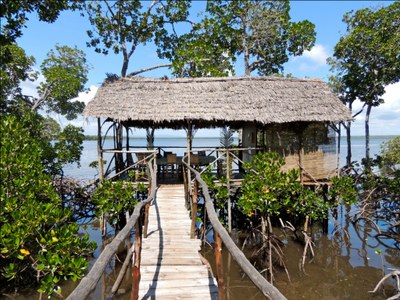
<p><span>The June Edition of this Newsletter is a special World Environment Day Edition that contains the following stories and articles:</span></p>
<ul style="text-align: start; ">
<li><span>A Foreword by </span><span>the UNIDO Project Manager<span class="Apple-converted-space"> </span></span><b><span>Mr.<span class="Apple-converted-space"> </span></span><span>Ludovic<span class="Apple-converted-space"> </span></span><span>Bernaudat;</span></b><span> </span></li>
<li><span>A Cover Story on </span><b><span>Showcasing Activities, Results and Lessons from<span class="Apple-converted-space"> </span></span><span>Kartong</span><span><span class="Apple-converted-space"> </span>in the Gambia;</span></b></li>
<li><span>A Partnerships for Water Provision Case Study<span class="Apple-converted-space"> </span></span><span>article highlighting</span><span><span class="Apple-converted-space"> </span><b>UNIDO</b></span><b><span>’</span><span>s</span><span><span class="Apple-converted-space"> </span></span><span>Support to the<span class="Apple-converted-space"> </span></span><span>Chipande</span><span><span class="Apple-converted-space"> </span>Community in Watamu Demo Site area in Kenya;</span></b></li>
<li><span>Some News from the COAST Demo Sites in all the nine Project Countries</span></li>
<li><span>A picture gallery of the COAST Demo Site activities;</span></li>
<li><span>A </span><span>Question</span><span><span class="Apple-converted-space"> </span>&amp; </span><span>Answer</span><span><span class="Apple-converted-space"> </span>Section with<span class="Apple-converted-space"> </span></span><b><span>Prof. Simon Milne on the Web-raising concept and how it applies to tourism;</span></b></li>
<li><span>An Opinion Article on<span class="Apple-converted-space"> </span></span><b><span>Chumbe</span></b><span><b><span class="Apple-converted-space"> </span>Island Coral Park in Zanzibar</b>: A Model of Financially, Ecologically and Socially Sustainable Marine Park Management.<br /><br /></span><b><span class="internal-link">Find these and other stories 
in </span><span class="internal-link">
<a href="http://coast.iwlearn.org/en/Newsletter/coast-project-newsletter/coast-project-3rd-quarterly-newsletter-pdf" class="external-link">the PDF Newsletter Edition here</a>.</span></b></li>
</ul>
<p> </p>
<p style="text-align: center; ">Please,   remember to share with us your feedback on any of these stories. If you want us to   follow up on any of these stories, or would wish for more information on   these articles, please write to the COAST Project's Knowledge Management   and Communications Officer using the contacts below.</p>
<p style="text-align: center; "><b>THE EDITORIAL TEAM - UNIDO COAST PROJECT<br />
Office Number: +254 20 7625366<br />
Cell. Number: +254 722 508010<br />
E-mail:</b><span class="Apple-converted-space"> </span><b><a href="mailto:g.omedo@unido.org?subject=Newsletter">G.Omedo@unido.org</a></b></p>
<p style="text-align: center; "><b>Like us on Facebook at: <a href="http://www.facebook.com/TheCoastProject">http://www.facebook.com/TheCoastProject</a>; </b></p>
<p style="text-align: center; "><b>Follow us on Twitter at: <a href="https://twitter.com/TheCOASTProject">https://twitter.com/TheCOASTProject</a>; </b></p>
<p><b><br /></b></p>]]></content:encoded>
    <dc:publisher>No publisher</dc:publisher>
    <dc:creator>g.omedo@unido.org</dc:creator>
    <dc:rights></dc:rights>
    <dc:date>2013-06-05T08:30:00Z</dc:date>
    <dc:type>Issue</dc:type>
  </item>


  <item rdf:about="http://coast.iwlearn.org/en/News%20and%20Events/the-gambia-training-seminar-on-tourism-and-biodiversity-from-23-to-25-april-2013">
    <title>The Gambia, Training Seminar on Tourism and Biodiversity, from 23 to 25 April 2013</title>
    <link>http://coast.iwlearn.org/en/News%20and%20Events/the-gambia-training-seminar-on-tourism-and-biodiversity-from-23-to-25-april-2013</link>
    <description>Employees in the tourism sector need to act as champions for biodiversity conservation and environmental protection in their enterprise and community</description>
    <content:encoded xmlns:content="http://purl.org/rss/1.0/modules/content/"><![CDATA[<div class="clearfix content">
<div class="field-news-date field">
<div class="field-items">
<div class="odd field-item"><span class="date-display-single">April 2013</span></div>
</div>
</div>
<p style="text-align: justify; ">From  April 23 to 25, 2013, UNWTO organized a training seminar in The Gambia  on Tourism and Biodiversity.  The objective of the seminar was to give  guidance to employees in the tourism sector to act as champions for  biodiversity conservation and environmental protection in their  enterprise and community. The training took place within the framework  of the COAST (Collaborative Actions for Sustainable Tourism) project in  Africa, a GEF funded project implemented by UNEP as implementing agency,  UNIDO as executing agency and UNWTO as associate agency, including  activities in nine countries in Africa (Cameroon, Gambia, Ghana, Kenya,  Mozambique, Nigeria, Senegal, Seychelles, and Tanzania).</p>
<p style="text-align: justify; ">The seminar was attended by 25 employees  from selected hotels and small and community based tourism enterprises.  A large part of the participants came from the village of Kartong at  the border with Senegal, which is the demonstration site of the COAST  project in The Gambia. UNWTO is collaborating with the Gambia Tourism  Board and tourism stakeholders in Kartong to implement a COAST  eco-tourism project in the village that aims to build sustainable  livelihoods and protect the environment and biodiversity through  eco-tourism development. The training seminar in The Gambia was  especially meant to strengthen the link between the sustainable  livelihood component and the biodiversity conservation component of this  COAST project.</p>
<p style="text-align: justify; "><img height="225" src="http://dtxtq4w60xqpw.cloudfront.net/sites/all/files/resize/images/p4240127-300x225.jpg" style="float: right; " width="300" />The seminar was organized in a  participatory and interactive manner and included technical  presentations, case study examples and group exercises on the following  topics: sustainable tourism, biodiversity, marine and coastal  biodiversity, environmental protection in tourism, environmental  management in tourism, and being a champion. The participants learned to  analyze the main threats to biodiversity and the environment in their  destination, and discussed ideas and examples on how to act as champions  for biodiversity conservation and environmental protection. On the  third day of the seminar, the participants carried out a field exercise  in the Sandele eco-lodge in Kartong, learning from the many good  examples that the lodge provides on environmental sustainability.</p>
<p style="text-align: justify; ">Based on the examples provided and  lessons learned, at the end of the seminar the participants prepared an  action plan to act as champions for biodiversity conservation and  environmental protection in their enterprise and community, which in  particular addressed the waste management problem in Kartong.  All  participants indicated that the seminar had been very relevant for their  professional activities and that it had provided them with good ideas  to put into practice. The participants from Kartong already agreed to  carry out the first awareness raising and clean-up activities during the  weekend after the seminar, as an initial step towards implementing  their action plan. Based on the positive outcome of the seminar, UNWTO  will explore with UNIDO and UNEP/GEF if the seminar can be replicated in  other participating countries in the COAST project in Africa.</p>
<p style="text-align: justify; "><a class="external-link" href="http://step.unwto.org/en/news/2013-05-14/gambia-training-seminar-tourism-and-biodiversity-23-25-april-2013"><b>This article first appeared on the UNWTO Newsletter accessible here</b></a></p>
</div>]]></content:encoded>
    <dc:publisher>No publisher</dc:publisher>
    <dc:creator>g.omedo@unido.org</dc:creator>
    <dc:rights></dc:rights>
    <dc:date>2013-05-30T15:08:06Z</dc:date>
    <dc:type>News Item</dc:type>
  </item>


  <item rdf:about="http://coast.iwlearn.org/en/News%20and%20Events/sustainable-tourism-a-win-win-for-nature-conservation-and-the-economy">
    <title>Sustainable tourism a win-win for nature conservation and the economy</title>
    <link>http://coast.iwlearn.org/en/News%20and%20Events/sustainable-tourism-a-win-win-for-nature-conservation-and-the-economy</link>
    <description>sustainable tourism as optimal use of environmental resources that constitute a key element in tourism development, maintaining essential ecological processes and helping to conserve natural heritage and biodiversity</description>
    <content:encoded xmlns:content="http://purl.org/rss/1.0/modules/content/"><![CDATA[<p style="text-align: justify; ">The <i>United Nations World Tourism Organization</i> (<i>UNWTO</i>)  defines sustainable tourism as optimal use of environmental resources  that constitute a key element in tourism development, maintaining  essential ecological processes and helping to conserve natural heritage  and biodiversity. Key elements to achieve sustainable tourism include  appropriate planning, regulating and monitoring of tourist activities,  as well as the involvement of local communities, for example through  training activities and providing access to credit schemes, so they can  set up small tourism businesses. The Ibera Marches in Argentina and Lake  Nakuru in Kenya, are two examples that illustrate how practicing  sustainable tourism has delivered a two-fold benefit for nature  conservation and economic development.<span id="more-10666"></span></p>
<p style="text-align: justify; ">In the Ibera Marshes in Argentina, conservation-based tourism  activities have revived the economy of Colonia Carlos Pellegrini, near  the Ramsar Site “Lagunas y Esteros del Iberá”, by creating new jobs, and  allowing local inhabitants stay employed in the town rather than  migrate to cities to look for work. Around 90% of the population now  works in the tourism sector. In order to favour local employment, the  site managers provide local rangers and guides with training on working  as tourist guides and local communities receive support to establish  municipal nature trails.</p>
<p style="text-align: justify; ">Lake Nakuru in Kenya every year receives around 149,500 international  and 95,500 domestic visitors, who are charged an entrance fee of US$ 80  and US$ 11 respectively. The income generated from the entrance fees  and concession fees from the lodges, contribute to paying the costs of  the park management. Overall, around 70% of Kenya’s international  tourism is targeted to the country’s wildlife, and therefore  biodiversity conservation is not only an environmental objective, but it  is also crucial for the country’s economy. Awareness about the  importance of nature is promoted each year  through a large-scale  environmental education programme, involving about 100,000 school  students, and by using inexpensive wildlife viewing tours, that the  National Park runs for residents.</p>
<p style="text-align: justify; "><i>Case example sources: Ramsar and UNWTO (2012)</i></p>
<p style="text-align: justify; "><i>Extracted from the report: <a href="http://www.teebweb.org/wp-content/uploads/2013/04/TEEB_WaterWetlands_Report_2013.pdf">The Economics of Ecosystems and Biodiversity for Water and Wetlands</a>,</i> section 5.4 highlighting sustainable tourism.</p>
<p style="text-align: justify; "><i>The report presents insights on critical water-related ecosystem  services and the wider ecosystem services from wetlands, in order to  encourage additional policy momentum, business commitment, and  investment in the conservation, restoration, and wise use of wetlands.</i></p>
<p> </p>
<p><a class="external-link" href="http://100sd.wordpress.com/2013/05/13/sustainable-tourism-a-win-win-for-nature-conservation-and-the-economy/"><b>Source / Fuente: teebweb.org</b></a></p>
<p><b></b><b>Author / Autor: </b><b> teebweb.org</b></p>
<p><b></b><b> </b>Date / Fecha: 10/05/13</p>]]></content:encoded>
    <dc:publisher>No publisher</dc:publisher>
    <dc:creator>g.omedo@unido.org</dc:creator>
    <dc:rights></dc:rights>
    <dc:date>2013-05-30T14:59:19Z</dc:date>
    <dc:type>News Item</dc:type>
  </item>


  <item rdf:about="http://coast.iwlearn.org/en/News%20and%20Events/eco-resorts-the-worlds-10-most-relaxing-destinations-for-sustainable-tourism-photos">
    <title>Eco-Resorts: The World's 10 Most Relaxing Destinations For Sustainable Tourism (PHOTOS) </title>
    <link>http://coast.iwlearn.org/en/News%20and%20Events/eco-resorts-the-worlds-10-most-relaxing-destinations-for-sustainable-tourism-photos</link>
    <description>And it's a vacation you can feel good about: From a  private island and reserve off the coast of Zanzibar equipped with the  latest eco-technology to a sustainable lodge celebrating Pueblo culture  in Taos, New Mexico, all are committed to preserving the surrounding  land, benefiting native communities and employing local staff.</description>
    <content:encoded xmlns:content="http://purl.org/rss/1.0/modules/content/"><![CDATA[<p><b>The Huffington Post</b> |  																				 																						 											                                                By <a href="http://www.huffingtonpost.com/carolyn-gregoire" rel="author">Carolyn Gregoire</a> <span class="follow-author-mini"> </span> <span class="posted-and-updated"> Posted: <span>03/16/2013 10:39 am EDT</span> </span></p>
<p>The health benefits of spending time in nature are well-documented,  as are the stress-relieving benefits of taking a vacation. Travelers  looking to really get away from it all, and help conserve some of the  world's most pristine natural habitats, should consider de-stressing at a  relaxing and secluded eco-resort.</p>
<p>Good for your stress levels and for the environment, these  destinations are both tranquil and invigorating, often featuring spa  services and complimentary yoga classes alongside rainforest tours and  water sports. And it's a vacation you can feel good about: From a  private island and reserve off the coast of Zanzibar equipped with the  latest eco-technology to a sustainable lodge celebrating Pueblo culture  in Taos, New Mexico, all are committed to preserving the surrounding  land, benefiting native communities and employing local staff.</p>
<p>Click through the photos for 10 of the most tranquil (and  conservation-minded) eco-tourism destinations around the globe, and tell  us: Would you go on an eco-vacation? Share your thoughts in the  comments or tweet <a href="https://twitter.com/HuffPostTravel" target="_hplink">@HuffPostTravel</a>.</p>
<p> </p>
<p><a class="external-link" href="http://www.huffingtonpost.com/2013/03/16/relaxing-eco-resorts_n_2862646.html?utm_hp_ref=travel"><b>To see the 10 Photos check here</b></a></p>]]></content:encoded>
    <dc:publisher>No publisher</dc:publisher>
    <dc:creator>g.omedo@unido.org</dc:creator>
    <dc:rights></dc:rights>
    <dc:date>2013-05-30T14:55:10Z</dc:date>
    <dc:type>News Item</dc:type>
  </item>


</rdf:RDF>