<?xml version="1.0" encoding="utf-8" ?>
<rdf:RDF xmlns:rdf="http://www.w3.org/1999/02/22-rdf-syntax-ns#" xmlns:dc="http://purl.org/dc/elements/1.1/" xmlns:syn="http://purl.org/rss/1.0/modules/syndication/" xmlns="http://purl.org/rss/1.0/">


<channel rdf:about="http://coast.iwlearn.org/en/search_rss">
  <title>English</title>
  <link>http://coast.iwlearn.org</link>

  <description>
    
            These are the search results for the query, showing results 21 to 35.
        
  </description>


  <image rdf:resource="http://coast.iwlearn.org/logo.png"/>

  <items>
    <rdf:Seq>
      
        <rdf:li rdf:resource="http://coast.iwlearn.org/en/Newsletter/coast-project-newsletter-1st-quarterly-newsletter"/>
      
      
        <rdf:li rdf:resource="http://coast.iwlearn.org/en/Newsletter/coast-project-newsletter"/>
      
      
        <rdf:li rdf:resource="http://coast.iwlearn.org/en/News%20and%20Events/the-gambia-training-seminar-on-tourism-and-biodiversity-from-23-to-25-april-2013"/>
      
      
        <rdf:li rdf:resource="http://coast.iwlearn.org/en/News%20and%20Events/sustainable-tourism-a-win-win-for-nature-conservation-and-the-economy"/>
      
      
        <rdf:li rdf:resource="http://coast.iwlearn.org/en/News%20and%20Events/eco-resorts-the-worlds-10-most-relaxing-destinations-for-sustainable-tourism-photos"/>
      
      
        <rdf:li rdf:resource="http://coast.iwlearn.org/en/News%20and%20Events/tourists-sight-rare-turtle-hatchings"/>
      
      
        <rdf:li rdf:resource="http://coast.iwlearn.org/en/News%20and%20Events/angola-rehabilitating-angolas-protected-coastal-areas"/>
      
      
        <rdf:li rdf:resource="http://coast.iwlearn.org/en/News%20and%20Events/nigeria-the-problem-of-wastes-and-plastics"/>
      
      
        <rdf:li rdf:resource="http://coast.iwlearn.org/en/News%20and%20Events/working-towards-a-shared-vision-for-sustainable-coastal-tourism-in-kribi-cameroon"/>
      
      
        <rdf:li rdf:resource="http://coast.iwlearn.org/en/News%20and%20Events/the-coast-project2019s-governance-and-management-mechanisms-for-sustainable-tourism-in-coastal-areas-in-africa"/>
      
      
        <rdf:li rdf:resource="http://coast.iwlearn.org/en/News%20and%20Events/gambia-coast-project-calls-for-responsible-tourism-protection-of-coastal-environment"/>
      
      
        <rdf:li rdf:resource="http://coast.iwlearn.org/en/Newsletter/2nd-coast-project-newsletter-february-2013-edition-3"/>
      
      
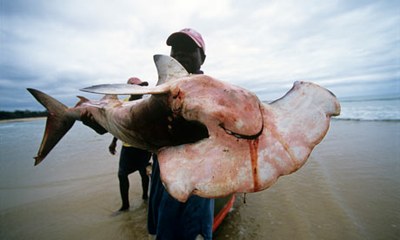
        <rdf:li rdf:resource="http://coast.iwlearn.org/en/News%20and%20Events/chinese-appetite-for-shark-fin-soup-devastating-mozambique-coastline"/>
      
      
        <rdf:li rdf:resource="http://coast.iwlearn.org/en/News%20and%20Events/the-future-we-want-from-rio-20-analysis-of-outcomes-on-coastal-and-marine-ecosystems-in-the-sustainable-coastal-tourism-context"/>
      
      
        <rdf:li rdf:resource="http://coast.iwlearn.org/en/News%20and%20Events/why-knowledge-management-is-vital-for-the-coast-project-success"/>
      
    </rdf:Seq>
  </items>

</channel>


  <item rdf:about="http://coast.iwlearn.org/en/Newsletter/coast-project-newsletter-1st-quarterly-newsletter">
    <title>COAST Project Newsletter 1st Quarterly Newsletter</title>
    <link>http://coast.iwlearn.org/en/Newsletter/coast-project-newsletter-1st-quarterly-newsletter</link>
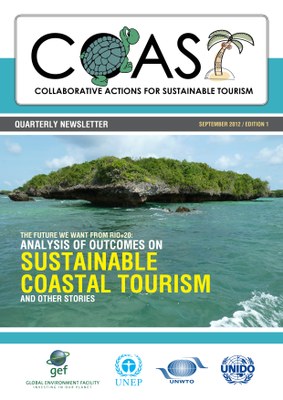
    <description>Quarterly Newsletter, September 2012/Edition 1 </description>
    <content:encoded xmlns:content="http://purl.org/rss/1.0/modules/content/"><![CDATA[<p>The  COAST Project Newsletter is an easy to read 24 page Newsletter  that highlights some developments in the subject of sustainable coastal  tourism in the global discourse and progress in <a href="http://coast.iwlearn.org/en/TheCOASTProjectNewsletter2012.pdf" class="internal-link"><img src="http://coast.iwlearn.org/en/COVER.jpg/@@images/ace5520b-9cb0-4338-abfb-cb15d1cc6940.jpeg" alt="" class="image-right" title="" /></a>COAST Project implementation.</p>
<p>The September Edition of this Newsletter contains the following stories and articles:</p>
<ul>
<li>A Foreword by Eduardo Zandri, the UNEP GEF Task Manager</li>
<li>A Cover Story on the <b>Rio+20 Outcomes in relation to Sustainable Coastal Tourism</b></li>
<li>Information on the COAST Mid Term Review Recommendations and the Revised Project Log Frame</li>
<li>Some News from the COAST Demo Sites in all the nine Project Countries</li>
<li>A picture gallery of the COAST Demo Site activities</li>
<li>A Question &amp; Answer Section with Dr. Hugh Gibbon, the Regional Technical Coordinator of the COAST Project</li>
<li>Analysis Article on Best Available Practices &amp; Technologies in the COAST Project</li>
<li>An Opinion Article on why Knowledge Management is Critical for the success of the COAST Project</li>
<li>Get to know the COAST Project Staff and Country Management Teams</li>
</ul>
<p style="text-align: center; "><b> <a href="http://coast.iwlearn.org/en/TheCOASTProjectNewsletter2012.pdf" class="internal-link">To download the Newsletter Edition here</a></b></p>
<p style="text-align: center; ">Please,  share with us your feedback on any of these stories. if you want us to  follow up on any of these stories, or would wish more information on  these articles, please write to the COAST Project's Knowledge Management  and Communications Officer on the contacts below.</p>
<p style="text-align: center; "><b>THE EDITORIAL TEAM - UNIDO COAST PROJECT</b></p>
<p align="center"><b>Office Number: +254 20 7625286</b></p>
<p align="center"><b>Cell. Number: +254 722 508010</b></p>
<h3 style="text-align: center; "><b>E-mail:</b> <b><a href="mailto:g.omedo@unido.org?subject=Newsletter">G.Omedo@unido.org</a></b></h3>]]></content:encoded>
    <dc:publisher>No publisher</dc:publisher>
    <dc:creator>tine</dc:creator>
    <dc:rights></dc:rights>
    <dc:date>2013-06-05T08:50:00Z</dc:date>
    <dc:type>Issue</dc:type>
  </item>


  <item rdf:about="http://coast.iwlearn.org/en/Newsletter/coast-project-newsletter">
    <title>COAST Project Newsletter: 3rd Quarterly Newsletter </title>
    <link>http://coast.iwlearn.org/en/Newsletter/coast-project-newsletter</link>
    <description>World Environment Day Special Edition

</description>
    <content:encoded xmlns:content="http://purl.org/rss/1.0/modules/content/"><![CDATA[<p><a href="http://coast.iwlearn.org/en/Newsletter/coast-project-newsletter/coast-project-3rd-quarterly-newsletter-pdf" class="external-link"><span> 
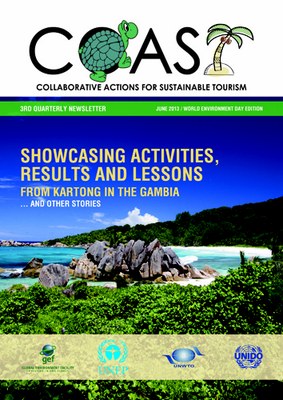
<img align="right" class="image-right" height="400" src="http://coast.iwlearn.org/coast/en/News%20and%20Events/coastCoverPage.jpg/@@images/365daac5-adc8-49d9-b206-7455ca99205c.jpeg" width="283" /></span></a>The COAST Project Newsletter is an easy to read 30 page Newsletter that highlights some developments in the subject of sustainable coastal tourism in the nine participating countries in Sub-Saharan Africa (Cameroon, The Gambia, Ghana, Kenya, Mozambique, Nigeria, Senegal, Seychelles and Tanzania).</p>
<p><span>The June Edition of this Newsletter is a special World Environment Day Edition that contains the following stories and articles:</span></p>
<ul style="text-align: start; ">
<li><span>A Foreword by </span><span>the UNIDO Project Manager<span class="Apple-converted-space"> </span></span><b><span>Mr.<span class="Apple-converted-space"> </span></span><span>Ludovic<span class="Apple-converted-space"> </span></span><span>Bernaudat;</span></b><span> </span></li>
<li><span>A Cover Story on </span><b><span>Showcasing Activities, Results and Lessons from<span class="Apple-converted-space"> </span></span><span>Kartong</span><span><span class="Apple-converted-space"> </span>in the Gambia;</span></b></li>
<li><span>A Partnerships for Water Provision Case Study<span class="Apple-converted-space"> </span></span><span>article highlighting</span><span><span class="Apple-converted-space"> </span><b>UNIDO</b></span><b><span>’</span><span>s</span><span><span class="Apple-converted-space"> </span></span><span>Support to the<span class="Apple-converted-space"> </span></span><span>Chipande</span><span><span class="Apple-converted-space"> </span>Community in Watamu Demo Site area in Kenya;</span></b></li>
<li><span>Some News from the COAST Demo Sites in all the nine Project Countries</span></li>
<li><span>A picture gallery of the COAST Demo Site activities;</span></li>
<li><span>A </span><span>Question</span><span><span class="Apple-converted-space"> </span>&amp; </span><span>Answer</span><span><span class="Apple-converted-space"> </span>Section with<span class="Apple-converted-space"> </span></span><b><span>Prof. Simon Milne on the Web-raising concept and how it applies to tourism;</span></b></li>
<li><span>An Opinion Article on<span class="Apple-converted-space"> </span></span><b><span>Chumbe</span></b><span><b><span class="Apple-converted-space"> </span>Island Coral Park in Zanzibar</b>: A Model of Financially, Ecologically and Socially Sustainable Marine Park Management.<br /><br /></span><b><span class="internal-link">Find these and other stories 
in </span><span class="internal-link">
<a href="http://coast.iwlearn.org/en/Newsletter/coast-project-newsletter/coast-project-3rd-quarterly-newsletter-pdf" class="external-link">the PDF Newsletter Edition here</a>.</span></b></li>
</ul>
<p> </p>
<p style="text-align: center; ">Please,   remember to share with us your feedback on any of these stories. If you want us to   follow up on any of these stories, or would wish for more information on   these articles, please write to the COAST Project's Knowledge Management   and Communications Officer using the contacts below.</p>
<p style="text-align: center; "><b>THE EDITORIAL TEAM - UNIDO COAST PROJECT<br />
Office Number: +254 20 7625366<br />
Cell. Number: +254 722 508010<br />
E-mail:</b><span class="Apple-converted-space"> </span><b><a href="mailto:g.omedo@unido.org?subject=Newsletter">G.Omedo@unido.org</a></b></p>
<p style="text-align: center; "><b>Like us on Facebook at: <a href="http://www.facebook.com/TheCoastProject">http://www.facebook.com/TheCoastProject</a>; </b></p>
<p style="text-align: center; "><b>Follow us on Twitter at: <a href="https://twitter.com/TheCOASTProject">https://twitter.com/TheCOASTProject</a>; </b></p>
<p><b><br /></b></p>]]></content:encoded>
    <dc:publisher>No publisher</dc:publisher>
    <dc:creator>g.omedo@unido.org</dc:creator>
    <dc:rights></dc:rights>
    <dc:date>2013-06-05T08:30:00Z</dc:date>
    <dc:type>Issue</dc:type>
  </item>


  <item rdf:about="http://coast.iwlearn.org/en/News%20and%20Events/the-gambia-training-seminar-on-tourism-and-biodiversity-from-23-to-25-april-2013">
    <title>The Gambia, Training Seminar on Tourism and Biodiversity, from 23 to 25 April 2013</title>
    <link>http://coast.iwlearn.org/en/News%20and%20Events/the-gambia-training-seminar-on-tourism-and-biodiversity-from-23-to-25-april-2013</link>
    <description>Employees in the tourism sector need to act as champions for biodiversity conservation and environmental protection in their enterprise and community</description>
    <content:encoded xmlns:content="http://purl.org/rss/1.0/modules/content/"><![CDATA[<div class="clearfix content">
<div class="field-news-date field">
<div class="field-items">
<div class="odd field-item"><span class="date-display-single">April 2013</span></div>
</div>
</div>
<p style="text-align: justify; ">From  April 23 to 25, 2013, UNWTO organized a training seminar in The Gambia  on Tourism and Biodiversity.  The objective of the seminar was to give  guidance to employees in the tourism sector to act as champions for  biodiversity conservation and environmental protection in their  enterprise and community. The training took place within the framework  of the COAST (Collaborative Actions for Sustainable Tourism) project in  Africa, a GEF funded project implemented by UNEP as implementing agency,  UNIDO as executing agency and UNWTO as associate agency, including  activities in nine countries in Africa (Cameroon, Gambia, Ghana, Kenya,  Mozambique, Nigeria, Senegal, Seychelles, and Tanzania).</p>
<p style="text-align: justify; ">The seminar was attended by 25 employees  from selected hotels and small and community based tourism enterprises.  A large part of the participants came from the village of Kartong at  the border with Senegal, which is the demonstration site of the COAST  project in The Gambia. UNWTO is collaborating with the Gambia Tourism  Board and tourism stakeholders in Kartong to implement a COAST  eco-tourism project in the village that aims to build sustainable  livelihoods and protect the environment and biodiversity through  eco-tourism development. The training seminar in The Gambia was  especially meant to strengthen the link between the sustainable  livelihood component and the biodiversity conservation component of this  COAST project.</p>
<p style="text-align: justify; "><img height="225" src="http://dtxtq4w60xqpw.cloudfront.net/sites/all/files/resize/images/p4240127-300x225.jpg" style="float: right; " width="300" />The seminar was organized in a  participatory and interactive manner and included technical  presentations, case study examples and group exercises on the following  topics: sustainable tourism, biodiversity, marine and coastal  biodiversity, environmental protection in tourism, environmental  management in tourism, and being a champion. The participants learned to  analyze the main threats to biodiversity and the environment in their  destination, and discussed ideas and examples on how to act as champions  for biodiversity conservation and environmental protection. On the  third day of the seminar, the participants carried out a field exercise  in the Sandele eco-lodge in Kartong, learning from the many good  examples that the lodge provides on environmental sustainability.</p>
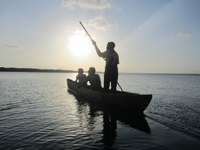
<p style="text-align: justify; ">Based on the examples provided and  lessons learned, at the end of the seminar the participants prepared an  action plan to act as champions for biodiversity conservation and  environmental protection in their enterprise and community, which in  particular addressed the waste management problem in Kartong.  All  participants indicated that the seminar had been very relevant for their  professional activities and that it had provided them with good ideas  to put into practice. The participants from Kartong already agreed to  carry out the first awareness raising and clean-up activities during the  weekend after the seminar, as an initial step towards implementing  their action plan. Based on the positive outcome of the seminar, UNWTO  will explore with UNIDO and UNEP/GEF if the seminar can be replicated in  other participating countries in the COAST project in Africa.</p>
<p style="text-align: justify; "><a class="external-link" href="http://step.unwto.org/en/news/2013-05-14/gambia-training-seminar-tourism-and-biodiversity-23-25-april-2013"><b>This article first appeared on the UNWTO Newsletter accessible here</b></a></p>
</div>]]></content:encoded>
    <dc:publisher>No publisher</dc:publisher>
    <dc:creator>g.omedo@unido.org</dc:creator>
    <dc:rights></dc:rights>
    <dc:date>2013-05-30T15:08:06Z</dc:date>
    <dc:type>News Item</dc:type>
  </item>


  <item rdf:about="http://coast.iwlearn.org/en/News%20and%20Events/sustainable-tourism-a-win-win-for-nature-conservation-and-the-economy">
    <title>Sustainable tourism a win-win for nature conservation and the economy</title>
    <link>http://coast.iwlearn.org/en/News%20and%20Events/sustainable-tourism-a-win-win-for-nature-conservation-and-the-economy</link>
    <description>sustainable tourism as optimal use of environmental resources that constitute a key element in tourism development, maintaining essential ecological processes and helping to conserve natural heritage and biodiversity</description>
    <content:encoded xmlns:content="http://purl.org/rss/1.0/modules/content/"><![CDATA[<p style="text-align: justify; ">The <i>United Nations World Tourism Organization</i> (<i>UNWTO</i>)  defines sustainable tourism as optimal use of environmental resources  that constitute a key element in tourism development, maintaining  essential ecological processes and helping to conserve natural heritage  and biodiversity. Key elements to achieve sustainable tourism include  appropriate planning, regulating and monitoring of tourist activities,  as well as the involvement of local communities, for example through  training activities and providing access to credit schemes, so they can  set up small tourism businesses. The Ibera Marches in Argentina and Lake  Nakuru in Kenya, are two examples that illustrate how practicing  sustainable tourism has delivered a two-fold benefit for nature  conservation and economic development.<span id="more-10666"></span></p>
<p style="text-align: justify; ">In the Ibera Marshes in Argentina, conservation-based tourism  activities have revived the economy of Colonia Carlos Pellegrini, near  the Ramsar Site “Lagunas y Esteros del Iberá”, by creating new jobs, and  allowing local inhabitants stay employed in the town rather than  migrate to cities to look for work. Around 90% of the population now  works in the tourism sector. In order to favour local employment, the  site managers provide local rangers and guides with training on working  as tourist guides and local communities receive support to establish  municipal nature trails.</p>
<p style="text-align: justify; ">Lake Nakuru in Kenya every year receives around 149,500 international  and 95,500 domestic visitors, who are charged an entrance fee of US$ 80  and US$ 11 respectively. The income generated from the entrance fees  and concession fees from the lodges, contribute to paying the costs of  the park management. Overall, around 70% of Kenya’s international  tourism is targeted to the country’s wildlife, and therefore  biodiversity conservation is not only an environmental objective, but it  is also crucial for the country’s economy. Awareness about the  importance of nature is promoted each year  through a large-scale  environmental education programme, involving about 100,000 school  students, and by using inexpensive wildlife viewing tours, that the  National Park runs for residents.</p>
<p style="text-align: justify; "><i>Case example sources: Ramsar and UNWTO (2012)</i></p>
<p style="text-align: justify; "><i>Extracted from the report: <a href="http://www.teebweb.org/wp-content/uploads/2013/04/TEEB_WaterWetlands_Report_2013.pdf">The Economics of Ecosystems and Biodiversity for Water and Wetlands</a>,</i> section 5.4 highlighting sustainable tourism.</p>
<p style="text-align: justify; "><i>The report presents insights on critical water-related ecosystem  services and the wider ecosystem services from wetlands, in order to  encourage additional policy momentum, business commitment, and  investment in the conservation, restoration, and wise use of wetlands.</i></p>
<p> </p>
<p><a class="external-link" href="http://100sd.wordpress.com/2013/05/13/sustainable-tourism-a-win-win-for-nature-conservation-and-the-economy/"><b>Source / Fuente: teebweb.org</b></a></p>
<p><b></b><b>Author / Autor: </b><b> teebweb.org</b></p>
<p><b></b><b> </b>Date / Fecha: 10/05/13</p>]]></content:encoded>
    <dc:publisher>No publisher</dc:publisher>
    <dc:creator>g.omedo@unido.org</dc:creator>
    <dc:rights></dc:rights>
    <dc:date>2013-05-30T14:59:19Z</dc:date>
    <dc:type>News Item</dc:type>
  </item>


  <item rdf:about="http://coast.iwlearn.org/en/News%20and%20Events/eco-resorts-the-worlds-10-most-relaxing-destinations-for-sustainable-tourism-photos">
    <title>Eco-Resorts: The World's 10 Most Relaxing Destinations For Sustainable Tourism (PHOTOS) </title>
    <link>http://coast.iwlearn.org/en/News%20and%20Events/eco-resorts-the-worlds-10-most-relaxing-destinations-for-sustainable-tourism-photos</link>
    <description>And it's a vacation you can feel good about: From a  private island and reserve off the coast of Zanzibar equipped with the  latest eco-technology to a sustainable lodge celebrating Pueblo culture  in Taos, New Mexico, all are committed to preserving the surrounding  land, benefiting native communities and employing local staff.</description>
    <content:encoded xmlns:content="http://purl.org/rss/1.0/modules/content/"><![CDATA[<p><b>The Huffington Post</b> |  																				 																						 											                                                By <a href="http://www.huffingtonpost.com/carolyn-gregoire" rel="author">Carolyn Gregoire</a> <span class="follow-author-mini"> </span> <span class="posted-and-updated"> Posted: <span>03/16/2013 10:39 am EDT</span> </span></p>
<p>The health benefits of spending time in nature are well-documented,  as are the stress-relieving benefits of taking a vacation. Travelers  looking to really get away from it all, and help conserve some of the  world's most pristine natural habitats, should consider de-stressing at a  relaxing and secluded eco-resort.</p>
<p>Good for your stress levels and for the environment, these  destinations are both tranquil and invigorating, often featuring spa  services and complimentary yoga classes alongside rainforest tours and  water sports. And it's a vacation you can feel good about: From a  private island and reserve off the coast of Zanzibar equipped with the  latest eco-technology to a sustainable lodge celebrating Pueblo culture  in Taos, New Mexico, all are committed to preserving the surrounding  land, benefiting native communities and employing local staff.</p>
<p>Click through the photos for 10 of the most tranquil (and  conservation-minded) eco-tourism destinations around the globe, and tell  us: Would you go on an eco-vacation? Share your thoughts in the  comments or tweet <a href="https://twitter.com/HuffPostTravel" target="_hplink">@HuffPostTravel</a>.</p>
<p> </p>
<p><a class="external-link" href="http://www.huffingtonpost.com/2013/03/16/relaxing-eco-resorts_n_2862646.html?utm_hp_ref=travel"><b>To see the 10 Photos check here</b></a></p>]]></content:encoded>
    <dc:publisher>No publisher</dc:publisher>
    <dc:creator>g.omedo@unido.org</dc:creator>
    <dc:rights></dc:rights>
    <dc:date>2013-05-30T14:55:10Z</dc:date>
    <dc:type>News Item</dc:type>
  </item>


  <item rdf:about="http://coast.iwlearn.org/en/News%20and%20Events/tourists-sight-rare-turtle-hatchings">
    <title>Tourists sight rare turtle hatchings</title>
    <link>http://coast.iwlearn.org/en/News%20and%20Events/tourists-sight-rare-turtle-hatchings</link>
    <description>Sea turtles are rare and endangered marine species.</description>
    <content:encoded xmlns:content="http://purl.org/rss/1.0/modules/content/"><![CDATA[<p><b>By PHILIP MWAKIO</b></p>
<p><a href="http://www.standardmedia.co.ke/?searchtext=Tourists&amp;searchbutton=SEARCH"> Tourists</a>, hotel staff and conservationists got a rare surprise when 88 sea <a href="http://www.standardmedia.co.ke/?searchtext=turtle&amp;searchbutton=SEARCH"> turtle</a> hatchlings were released into the open sea at the scenic Mombasa Serena Beach Resort and Spa on Sunday. Sea <a href="http://www.standardmedia.co.ke/?searchtext=turtle&amp;searchbutton=SEARCH"> turtle</a>s are rare and endangered marine species.</p>
<p>The beach frontage is a traditional sea <a href="http://www.standardmedia.co.ke/?searchtext=turtle&amp;searchbutton=SEARCH"> turtle</a> nesting area where giant <a href="http://www.standardmedia.co.ke/?searchtext=turtle&amp;searchbutton=SEARCH"> turtle</a> species come to lay eggs.</p>
<p>An  exited British family on holiday, led by John Black from Bristol, said  they were extremely happy to have taken part in closely monitoring the <a href="http://www.standardmedia.co.ke/?searchtext=turtle&amp;searchbutton=SEARCH"> turtle</a>s since they laid eggs, which were put in special cages before hatching.</p>
<p>The Blacks pledged to frequent the scene to monitor regular <a href="http://www.standardmedia.co.ke/?searchtext=turtle&amp;searchbutton=SEARCH"> turtle</a> hatchings.</p>
<p>“We  have experienced this rare spectacle which has made us appreciate  responsible sustainable tourism in real practise,” said Mr Black, a  business consultant, who is accompanied on this holiday by his wife Dee,  son Paul and daughter-in-law Sue.</p>
<p>According to Serena Hotel  Deputy General Manager Edwin Chemisto, the hotel has taken nature and  marine conservation seriously and has employed a full-time naturalist to  impart special knowledge and skills on key conservation issues.</p>
<p> </p>
<p><a class="external-link" href="http://www.standardmedia.co.ke/?articleID=2000084632&amp;story_title=tourists-sight-rare-turtle-hatchings;"><b>Article first appeared here </b></a></p>]]></content:encoded>
    <dc:publisher>No publisher</dc:publisher>
    <dc:creator>g.omedo@unido.org</dc:creator>
    <dc:rights></dc:rights>
    <dc:date>2013-05-30T14:48:06Z</dc:date>
    <dc:type>News Item</dc:type>
  </item>


  <item rdf:about="http://coast.iwlearn.org/en/News%20and%20Events/angola-rehabilitating-angolas-protected-coastal-areas">
    <title>Angola: Rehabilitating Angola's Protected Coastal Areas</title>
    <link>http://coast.iwlearn.org/en/News%20and%20Events/angola-rehabilitating-angolas-protected-coastal-areas</link>
    <description>Ministry of Environment will work with the Global Environment Facility (GEF), the European Union (EU) and the United Nations Development Programme (UNDP) to protect a 1.5 million hectare swathe of land known as Iona National Park, which forms part of a conservation area straddling the border with Namibia.</description>
    <content:encoded xmlns:content="http://purl.org/rss/1.0/modules/content/"><![CDATA[<p style="text-align: justify; ">Luanda — In an important move to promote sustainable development across its national territory, the Government of Angola will step up its efforts to protect a vast natural area along the Atlantic coast.</p>
<p style="text-align: justify; ">Under a new agreement, the country's Ministry of Environment will work with the Global Environment Facility (GEF), the European Union (EU) and the United Nations Development Programme (UNDP) to protect a 1.5 million hectare swathe of land known as Iona National Park, which forms part of a conservation area straddling the border with Namibia.</p>
<p style="text-align: justify; ">"This incredible biodiversity isn't just a beauty of nature, it sustains human life through ecosystem services such as agriculture, health, in addition to generating revenues from tourism. We absolutely must protect them," UNDP Resident Representative and UN Resident Coordinator, Maria do Valle Ribeiro, said.</p>
<p style="text-align: justify; "><img src="http://coast.iwlearn.org/en/News%20and%20Events/copy_of_Dugoutcanoetoursatsunset.JPG/@@images/d5ab082e-83f0-4877-a52a-ef44bcec163b.jpeg" alt="Canoe" class="image-right" title="Canoe" />The area's unique ecosystems host populations of springbok, ostriches, oryx, zebras, and other wildlife, in addition to unique plants, including the Welwitschia, a species endemic to the Namibe region and a national symbol.</p>
<p style="text-align: justify; ">The project will aim to assess the size and dynamics of these plants and animals, as well as the threats they face.</p>
<p style="text-align: justify; ">Hunting is normally not practiced by the communities living within Iona National Park. However, poaching, fuelled by the illegal trade in bush meat, has become a major threat to the wildlife populations of the area and represents important potential losses in tourism revenue.</p>
<p style="text-align: justify; ">It is estimated that 15,000 people live in the Iona National Park, most of them nomads known as the Muhimba who derive their livelihoods from livestock.</p>
<p style="text-align: justify; ">Access to water is a huge concern and an important source of human-wildlife conflict. The Muhimba are known for maintaining their rich and unique cultural heritage in the face of sometimes strong external pressures.</p>
<p style="text-align: justify; ">"The project will reduce poverty and improve living conditions among the communities living on the perimeter of the project," the Ambassador of the EU, Javier Puvol.</p>
<p style="text-align: justify; ">Aiming to enforce anti-poaching efforts and reach out to populations in what is expected to become a model national park, the US$10 million project - formally launched at an event in Luanda earlier this year - will rehabilitate infrastructure, finance equipment and train rangers in anti-poaching techniques.</p>
<p style="text-align: justify; ">It will also involve local populations, developing with them community-based eco-tourism activities so they can generate additional income.</p>
<p style="text-align: justify; ">At the national level, the project will provide advice, staffing, training and technical support to the Ministry of Environment so it can design a national strategy for the management of protected areas in Angola.</p>
<p style="text-align: justify; ">An assessment of the current state of Angola's national parks is expected, with preparation of detailed plans for the rehabilitation of six protected areas.</p>
<p style="text-align: justify; ">Ecosystems and biodiversity provide the goods and services that help to sustain human life and wellbeing among local communities. Protecting them is key to ensuring Angola continues to further sustainable human development for all generations.</p>]]></content:encoded>
    <dc:publisher>No publisher</dc:publisher>
    <dc:creator>g.omedo@unido.org</dc:creator>
    <dc:rights></dc:rights>
    <dc:date>2013-04-17T11:36:15Z</dc:date>
    <dc:type>News Item</dc:type>
  </item>


  <item rdf:about="http://coast.iwlearn.org/en/News%20and%20Events/nigeria-the-problem-of-wastes-and-plastics">
    <title>Nigeria: The Problem of Wastes and Plastics</title>
    <link>http://coast.iwlearn.org/en/News%20and%20Events/nigeria-the-problem-of-wastes-and-plastics</link>
    <description>So plastics are not only priority pollutants, they are threats to our health and ecology because of the ingredients chemical used in producing them or chemicals they absorb from environment of their chemical contents</description>
    <content:encoded xmlns:content="http://purl.org/rss/1.0/modules/content/"><![CDATA[<p style="text-align: justify; "><i>By Abah John Abah, sailor/geologist and public interest commentator on energy and environment resides in Lagos, Nigeria.</i></p>
<p style="text-align: justify; "><i></i>Iya Segun etches her living selling scraps of containers, mostly plastics, in the ever-bubbling Agege railway market. For her, business is good making about $4 a day to cater for her four kids. Across Lagos, in Ojota Valley market, Adeniji under bridge, to Panteka in Kaduna, Sabongeri in Kano and other markets across the country, thousands like her are living off wares of sorted plastic wastes.</p>
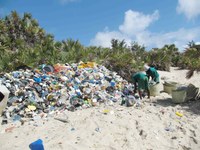
<p style="text-align: justify; "><img src="http://coast.iwlearn.org/en/News%20and%20Events/30_9Thewholelot.jpg/@@images/b6b4d631-d2d8-4edd-84f5-f5e5d5a4667d.jpeg" alt="Plastics and Wastes" class="image-left" title="Plastics and Wastes" />They are third in the chain of waste industry that starts at refuse collections from streets and houses, turning out millions of tons of wastes, more than 50% plastics. Refuse management by authorities here in Nigeria stops at the dump sites where lots of poor masses scavenge on these huge dumps for a living. Other dump sites are in waters and seas from where plastics continue their deadly journeys. The scraps picked by these scavengers end up as wares for Iya Segun and thousands like her. From their makeshift warehouses, the plastic wastes find two paths; approximately half go back to homes and the other half to recycling plants. Either of these paths leads to deadly consequences.</p>
<p style="text-align: justify; ">Plastics are everywhere, from our wears- shoes, bags, headgears and even women hairs attachments; our automobiles; office and household electronics/computers; storage facilities/containers and sachets/wraps of various products and foods. Let us put them in two broad classes. The ones originally produced for food packaging and storage, which are safe health-wise; and the other class unsafe for our health, originally produced to carry non-consumables and hazardous substances. So plastics are not only priority pollutants, they are threats to our health and ecology because of the ingredients chemical used in producing them or chemicals they absorb from environment of their chemical contents. It is hard to separate the two broad classes because of how they end up after reuse and recycling. If a plastic container of harmful chemical ends up being reused by an uninformed person to contain food you can guess the risk. The safe ones originally meant for consumable may later be used to carry harmful product and come back to being used for food again. Beyond this health risks plastics constitute a lot more environmental hazards.</p>
<p style="text-align: justify; ">A few times I have entered Rio de Janeiro, Brazil, through the busy Guanabara Bay. This Port approach boasts of the panoramic view of the famous Statue of Christ the Redeemer situated on the 2,340ft Mount Corcovado in Rio and the exotic shoreline resorts/beaches but alas! The Guanabara Bay is a dish-pot of all kinds of rubbish, mostly plastics pouring into the western Atlantic. The sight takes all the excitement from any tourist hoping to have a great time in Rio. The Coast line of Nigeria is not much better. Imagine a tourist checking out the much hyped elitist Lagos Atlantic City, a sprawling ambitious city development project on recovered strip of land along the coast. He checks into a resort in the new city and decides on a yacht sail off the jetty of the expensive yacht club but, all that greeted him are stinking wastes, full of plastic dumped off the coast by the many water-side slums of Lagos that are even greater eye-sours.</p>
<p style="text-align: justify; ">But plastics go beyond this in constituting physical hazards. A few years ago, I was in the famous city of Kano. Like most bustling cities in Nigeria, there are plastics littered everywhere in all forms- bags, food/water sachets and bottles. If this was a bad scene, the real hazard didn't hit me till an experience I had one evening that week. After being guest to a relative, I was anxious to return to my lodge before the building rain cloud bursts. I was advised to wait out the expected rain but I didn't get what they meant. For me, I would be okay if I get a taxi before the rain. I was not familiar with the far North of Nigeria and their erratic weather elements. While waiting on the street side for taxi, a big storm preceding the rain started. In matter of seconds I could not see ten feet ahead of me as the huge dusts swells around. Before I could scamper for safety I had big plastic cellophane blown across my face, totally blindfolding me. Since then, the sight of plastic litters annoys me. Yet this is just a tip of the physical hazards associated with plastics wastes.</p>
<p style="text-align: justify; ">At the peak of the rainy season last year, floods sacked many cities and communities across the country. Many have blamed the failure of infrastructure, amongst other things as the main cause of the floods. Some even dubbed it a natural disaster. I don't know how many see plastic wastes as the number one culprit. Nothing renders drainage infrastructure useless as fast as plastics. Plastic as non biodegradables meant they don't decay. In rain runoffs, they are washed down to build up in drainages reducing their carrying capacities, if not totally blocking them. The multiple effects of this can be monumental.</p>
<p style="text-align: justify; ">It has been established that 78% of hazardous wastes are plastics and as pointed out earlier, many of the harmful chemicals associated with plastics pose serious health risks to man and other living things. The plastic wares of Iya Segun mentioned above, wherever they end up, either in our homes or recycling plants come at a grave risk to our health. Imagine such plastic, externally washed anew, ends in our home as water/food containers. For many years, this container slowly, invisibly, ooze into your water harmful substances that were its ingredient raw materials or absorbed from whatever is earlier contained in it. The result is worse if you heat your food/water in this plastic when the harmful substances get quickly squeezed out. Many of these substances are carcinogenic, that is they have the potential to cause cancers. Others are estrogenic, meaning they negatively affect our reproductive systems. Some causes instant poisoning.</p>
<p style="text-align: justify; ">Apart from direct impacts on our lives, hazardous plastic wastes pose far-reaching ecological danger on both land and marine environments. The marine world is a complex ecosystem. As on land, marine animals feed on themselves and other smaller faunas and floras. These lower lives, the preys and the predators all face the dangers from plastics. The harmful chemicals slowly seeping into waters affects their health and puts them at risk of extinction thereby creating ecological imbalance. Some fishes swallow whole plastics mistaking them for food. I'm not claiming fishes are so dumb as not to recognize their foods. As a mariner, after unsuccessfully trying to bait a fish with the wrong food I know you must be adept in fish eating habits before you can fish. This story may explain what I mean: Not far ago my wife visited Vienna, Austria during the winter. Before flying back she went shopping for chocolates and bought these beautifully wrapped chocolates. We had a taste of these chocolates ourselves and soon started feeling tipsy. They were simply alcoholic candies coated with chocolates! We were quite naïve, the sharp taste didn't warn us. Lots have even been given out to visitors and friends. Many marine mammals feed on zooplanktons. Plastic floating in waters for a long period can have thick deposits of these zooplanktons and fishes can easily be fooled swallowing this zooplanktons encrusted plastics like my wife's chocolate-coated alcohol. To think that some of these fishes end on our table as food makes the situation grave. I have seen pictures of endangered sea animals like whales and dauphins entangled in discarded fishing nets.</p>
<p style="text-align: justify; ">On land, the tale is not better. If the unsightly litters of plastics on streets don't bother you, the effects on soil fertility and ultimately food supply should. As in marine environment, harmful substances from plastics tilt the ecological balance dangerously. The crops in our orchards draw from these dangerous nutrients and transfer them to us. The all important fauna like an earthworm struggles against plastics. Earthworms bore around the upper layer of the soil, leaving pores and excrements that provide soil vital aeration and fertility. Imagine if earthworms are wiped out by plastics.</p>
<p style="text-align: justify; ">In the movie The Graduate, there is this famous line 'plastics, young man plastics .....Plastic is the future'. Nobody can discountenance the facts that there is yet great future for plastics. On the flip side, plastics still hold a lot of economic promise. We cannot do away with them but as many environmentalists believe, plastics need a new label. It will take yet some time before evolving technology produce affordable biodegradable plastics but while we are at it, efforts to reduce avoidable use of plastics should be doubled.</p>
<p style="text-align: justify; ">Recessive economy meant that foods and consumables are coming packaged in plastic sachets. These sachets are the environment defacing litters all over our streets. I believe plastic sachets can go for foil-coated paper sachets. The many Chinese and Indian run plastic industries in Nigeria cares more for profit than environmental and human health. Their recycling plants produce food packaging containers from whatever plastics that come their way, with little attention to the type of plastic and the chemicals contained in them.</p>
<p style="text-align: justify; ">Shops should sell reusable canvas bags rather than plastics. I know that in shipping, efforts in containment and management of plastic wastes is impressive, perhaps because of the many policing organizations and fear of litigation. Careful segregation and incineration, and even treatment of incinerated residues are common practice in maritime. Such efforts should be emulated in our homes and by environmental collection agencies especially in underdeveloped climes like Nigeria. Agencies and NGOs concerned should do more policing even where big money is not involved. And it can all start from individuals and the home. Make the effort to leave your waste, especially plastics at the designated bins instead flinging it out your car. You can help the authority if you segregate plastics from other wastes in your home. A separate bin can help. If you have affordable alternative, why use plastic at all? Mind your health, mind your environment, and mind the plastics!</p>
<p style="text-align: justify; "><i>Abah John Abah, sailor/geologist and public interest commentator on energy and environment resides in Lagos, Nigeria.</i></p>
<p style="text-align: justify; "><a class="external-link" href="http://allafrica.com/stories/201304152373.html;"><b>This News article is found here</b></a><i><br /></i></p>]]></content:encoded>
    <dc:publisher>No publisher</dc:publisher>
    <dc:creator>g.omedo@unido.org</dc:creator>
    <dc:rights></dc:rights>
    <dc:date>2013-04-17T11:14:54Z</dc:date>
    <dc:type>News Item</dc:type>
  </item>


  <item rdf:about="http://coast.iwlearn.org/en/News%20and%20Events/working-towards-a-shared-vision-for-sustainable-coastal-tourism-in-kribi-cameroon">
    <title>Working Towards a Shared Vision for Sustainable Coastal Tourism in Kribi, Cameroon</title>
    <link>http://coast.iwlearn.org/en/News%20and%20Events/working-towards-a-shared-vision-for-sustainable-coastal-tourism-in-kribi-cameroon</link>
    <description>By Santiago Ormeno and Geoffrey Omedo (In this section, we highlight some of the lessons, experiences and best practices from our COAST Kribi Demo Site in Cameroon)</description>
    <content:encoded xmlns:content="http://purl.org/rss/1.0/modules/content/"><![CDATA[<p><b> </b></p>
<p><b>Background on the COAST Project in Kribi, Cameroon </b></p>
<p align="center"><b> </b></p>
<p>Figure 3: Map of the Kribi Demo Site.</p>
<p style="text-align: justify; ">The Sustainable Coastal Tourism Project in Cameroon has been in execution in Kribi since 2011, as the national demonstration project of the COAST Project executed by the Ministry of Environment, Protection of Nature and sustainable development (MINEPDED). The tourism component of the project is executed by the Ministry of Tourism and Leisure (MINTOUL in partnership with the UNWTO’s Sustainable Tourism Eliminating Poverty (ST-EP) Initiative, thanks to a generous contribution from the UNWTO ST-EP Foundation. The Kribi Demo Site has three areas namely Londji, Lobe Falls and the Grand Batanga.</p>
<p style="text-align: justify; ">Kribi is the main town within the Demo Site and is the Capital of the Ocean Division, an administrative region in the Southern Part of the country with an estimated population of 83 243, <i>(according to the 2010 census statistics</i>). Kribi is Cameroon’s main tourist destination renowned for its white sand beaches, hence tourism is one of the most important economic activities in the region. The Demo Site area currently boasts of many emerging tourism activities with white serene beaches, waterfalls, mangroves, and wildlife reserves based on the rich natural resources of the region such as marine turtles. It is also leading the way in marketing Cameroon’s nascent conference tourism by providing venues for seminars and workshops.</p>
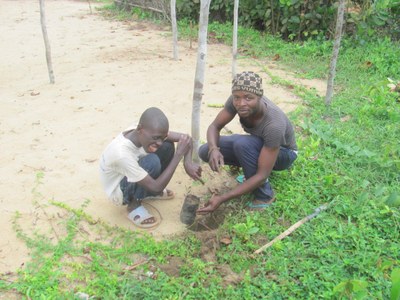
<p style="text-align: justify; "><img src="http://coast.iwlearn.org/en/News%20and%20Events/IMG_1313.JPG/@@images/28aac938-fbfc-4fe8-aa72-06bd60915f1d.jpeg" alt="Tree planting" class="image-right" title="Tree planting" />Another feature that characterizes the Kribi area is the rapid industrialization of the city and, more particularly, in the Ocean Division. Currently, the Demo Site area is at the centre of many industrial, agro-industrial and transport projects. For instance, there is a regional deep sea port complex currently under construction. Together with rapid urban growth and development of the transport network, all these factors are contributing to increased pressure on the coastal and marine ecosystems. Hence the COAST Project team in Kribi is grappling with the challenge of making tourism and industrial development compatible in the area.</p>
<p style="text-align: justify; ">Some of the environmental challenges in the area include:</p>
<ul style="text-align: justify; ">
<li>Coastal erosion aggravated by human activities      such as sand digging, deforestation;</li>
<li>Increased urban pressure on the coastline;</li>
<li>Industrial pollutants and risk of oil spills;</li>
<li>Unsustainable management of natural resources; </li>
<li>Absence of adequate sustainable management      structures resulting from inadequate policy enforcement and absence of      land-use management plans.</li>
</ul>
<p style="text-align: justify; "><b> </b></p>
<p style="text-align: justify; "><b>Showcasing COAST Project Activities in the Kribi Demo Site</b></p>
<p style="text-align: justify; "><b> </b></p>
<ol style="text-align: justify; ">
<li><b>The      COAST Project Working Towards a Better Londji through Eco-tourism</b></li>
</ol>
<p style="text-align: justify; ">Londji is one of the Demo Site areas of the COAST Project in Kribi that is working to leave behind its reputation of a “<i>dirty village</i>” through the support of the COAST Project. It is now set to become the next Eco-tourism destination in Cameroon. Located 15 kilometers west of Kribi, Londji is the largest fishermen village and fish market in Cameroon. The village showcases a vast diversity of peoples and ethnic groups, as the dynamism of the fishing activity has attracted communities from throughout West Africa over recent the years. The community is heterogeneous but integrated.</p>
<p style="text-align: justify; "><img src="http://coast.iwlearn.org/en/News%20and%20Events/cicack.jpg/@@images/59d29d27-793a-45dc-a04f-579e7438d616.jpeg" alt="CICAK" class="image-left" title="CICAK" />This bubbling activity gave Londji the name of “le petit port” (<i>the little harbor</i>) as many merchandises arrived to the country via this village.  In the 1970s, Londji with its wide white sand beaches was appointed by the former President Amadou Ahidjo as a tourism development area. However, many years passed and little was done to see this to fruition. On the other hand, illegal activities, bad roads, and inappropriate waste management gave Londji a bad reputation. However, it remained with the tag as the “most beautiful bay of Cameroon” according to most international guides (<i>Bradt, Petit Futé</i>) but lost much of its appeal as a tourism destination.</p>
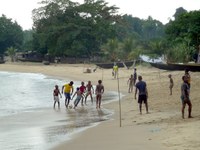
<p style="text-align: justify; ">The COAST Project, aware that waste management and poor sanitation was a real risk for the health of Londji’s inhabitants, consolidated through regular participatory meetings a community group that took the responsibility of regularly cleaning the beach, and coordinating the development of new Eco-tourism products. The underlying idea was that “<i>A clean environment keeps illness away and attracts tourists</i>”, and it worked. The group recently received its agreement as a community tourism operator under the name of “Londji Eco-tourism Group”.</p>
<p style="text-align: justify; ">Additionally, the project works to foster ongoing conservation efforts of mangroves, and aims at creating tourism value through promoting sustainability products such as mangrove nature trails, walks and boat trips. The position of Londji as the main fishing harbor west of Kribi gives Londji a lot of potential as a departure point for sea boat trips to virgin unexplored beaches in the Lokoundje and Nyong estuaries.  In an increasingly urbanized Kribi, this coast becomes an oasis of paradise with pristine beaches and wetlands, where manatees and dolphins can be spotted during some periods of the year. It is important to note here that, as envisaged by the COAST Project, the resultant partnership in project implementation helps the local community extract some real economic benefits from the touristic activities, and therefore promotes a relationship where the local community and the local industry have found a way to live and work in harmony with the environment. In addition, tourism activities are now taking place in a controlled sustainable way that is good for the environment but also for their economic activities and livelihoods.<b> </b></p>
<p style="text-align: justify; ">The goal is to give tourists visiting Kribi a good reason to do an additional excursion, to stop in Londji to buy some fresh and smoked fish, or to simply relax on the now clean beaches. For this year, a number of activities have been planned by the COAST Project including some training on customer care and tourism handling for the staff of a number of hotels in the area.</p>
<ol style="text-align: justify; ">
<li><b>The COAST Project Inspires a Study to Monitor      Changes in Coastal Areas in Kribi</b></li>
</ol>
<p style="text-align: justify; ">The COAST Project work in Cameroon inspired an initiative by a team of researchers from the Polytechnic University of Madrid in Spain to develop and publish a paper titled, “<i>Use of satellite images for monitoring changes in natural spaces of the coastline”. </i>Our COAST Project team member, Mr. Santiago Ormeno, was part of the research team that co-authored this paper.<i> </i>This study shows that methodologies based on satellite images can be used successfully for monitoring environmental changes in coastal areas. The study was motivated by the realization that 48, 000 km of coastline in Sub Saharan Africa are threatened by the impact of development related activities. In the Kribi Demo Site area, tourism, fisheries, agro-industrial and port activities are competing for dominance in the context of rapid urbanization and industrialization. With a rich biodiversity of vulnerable habitats, it is important to integrate conservation principles in the area.</p>
<p style="text-align: justify; ">During the research, the team working in the field of geodesy<b> </b><b> </b><b>(</b><i>T</i><i>he science of measuring and monitoring the size and shape of the Earth including its gravity field and determining the location of points on the Earth’s surface<b> </b>(NOAA 2013</i><i>) </i>and remote sensing from the Polytechnic University of Madrid developed a technical methodology which produced some useful results for the monitoring and evaluation of changes occurring in the coastal strip. In this study, images from satellites Landsat 5 and 7 were used to obtain environmental indicators and biophysical parameters. The study indicates a reduction of nearly 50% of vegetation cover in the coastal strip from 1984 to 2010.</p>
<p style="text-align: justify; ">Higher intensity land-use changes were observed in the sector from Londji to Kribi, compared to those observed between Kribi and Grand Batanga. Two typologies of change have been identified; the ones resulting from the intensification of agricultural activities, and those due the expansion of the urban area and its communications network. The study concludes that methodologies based on satellite images can be successfully used for monitoring environmental changes in similar cases. The model presented has been used in the mentioned studies and have successfully been used by the authors in other areas. They also offer good potential for replication in analyzing the changes in coastal areas, and it is hoped that the results from this study will be up scaled and used to influence further actions by all the stakeholders in Kribi.</p>
<p style="text-align: justify; "><img src="http://coast.iwlearn.org/en/News%20and%20Events/londji8.JPG/@@images/64538d86-11cb-49c1-b8be-9cf694bd5d68.jpeg" alt="Londji beach" class="image-left" title="Londji beach" /></p>
<ol style="text-align: justify; ">
<li><b>The      COAST Project supports Local Tree Planting Efforts in Kribi </b></li>
</ol>
<p style="text-align: justify; ">Beaches in the Kribi coastline suffer from extreme coastal erosion resulting from changes in tides related to global warming. This erosion reduces the extension of beach shores and presents a real risk for the sustainability of coastal tourism activities in many areas of Kribi. These erosion problems are usually worsened by anthropogenic factors such as illegal sand digging activities and the rapid urbanization of the Kribi coastline, which entails deforestation and loss of vegetation cover. This exposes the adjacent lands to wind and marine erosion.</p>
<p style="text-align: justify; "> </p>
<p style="text-align: justify; ">In cooperation with the National Agency of Forestry Development (ANAFOR), and the Kribi First City Council, the COAST Project in Cameroon launched a tree planting pilot initiative in the Demo Site of Bongahélé (Grand Batanga) in May and June 2012.  The initiative received the name “<i>One tree, one child</i>”. Children from the local community planted over 235 trees donated by the Kribi First<sup> </sup>City Council, individual tourists and local associations.</p>
<p style="text-align: justify; ">This exercise was conducted in cooperation with the Eco-tourism Group of Grand Batanga and endorsed by the village’s traditional chief.  An educational forum about coastal erosion and how it affects livelihoods was also organized in cooperation with environmental NGOs (<i>Model Forest, WWF</i>). A second tree planting activity that attracted significant media coverage by the national TV was organized in June 2012. This activity served to extract valuable lessons regarding the technical requirements needed to carry out a tree planting activity on beach shores, such as the importance of choosing appropriate varieties, taking tides into account, the need of constant follow up in early stages, and the requirement of doing a good sensitization among communities, as trees are normally very easy targets for vandalism. In the long run, a number of tree nurseries should be established to enhance sustainability of such initiatives.</p>
<p style="text-align: justify; ">The COAST Project aims at extending this initiative to other villages in Kribi affected by coastal erosion, specifically in the Lobe Falls area.  A larger proposal to include reforestation of beaches in Kribi will be considered by the Kribi City Hall in its upcoming board meeting.</p>
<p><b> </b></p>
<p><b>Other COAST Project Activities in Kribi</b></p>
<ol> </ol> 
<ul>
<li>On September 21<sup>st</sup> and December 17<sup>th</sup> 2012, the COAST Project organized two workshops in Kribi to validate the sustainable tourism management plans drafted by the project and to review the planned environmental activities. More than 50 representatives from the community, government officials, and private sector participated in these meetings, whose main goal was to build a shared vision regarding development of sustainable tourism activities and development priorities in Demo Sites. </li>
</ul>
<ol> </ol>
<p> </p>
<ol> </ol> 
<ul>
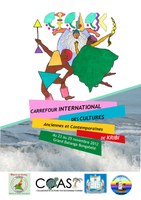
<li>The COAST Project and the Sustainable Coastal Tourism partners showcased Eco-tourism activities in the Grand Batanga Demo Site. The project also supported the 5<sup>th</sup> Edition of the International Cultural Crossroad Kribi festival, a cultural and touristic festival which year after year aims at becoming a “<i>Crossroad of cultural exchanges among different countries and generations</i>” in Cameroon. </li>
</ul>
<ol> </ol>
<p> </p>
<ol> </ol> 
<ul>
<li>The Project partnered with the Campo Ma’an National Park Conservation Service and the Ebotour Marine Turtle Conservation initiatives in the Kribi region. Both Eco-tourism sites are based on the idea that tourism can support conservation efforts of endangered species (<i>great apes and elephants in Campo Ma’an, and marine turtles in Ebodgé</i>). </li>
</ul>
<ol> </ol>
<p><b> </b></p>
<p><b>Conclusion</b></p>
<p style="text-align: justify; ">Some of the results emerging from the Kribi Demo Site clearly place the Site at a vantage position to drive the national plans for sustainable coastal tourism in Cameroon. The COAST Project investments in Londji, Grand Batanga and Lobe Falls, under the Sustainable Coastal Tourism Project, if sustained in the long run will result in improved ecosystems and biodiversity. In this way, the project is delivering on its objective of demonstrating and supporting adoption of best practice approaches for sustainable tourism that reduces the degradation of marine and coastal environments of trans-boundary significance. At the Kribi Demo Site, the ongoing activities are building partnerships that are helping the local community extract real economic benefits from the tourism industry. This has led to a relationship where the local community and the local tourism industry have found a way to live and work in harmony with the environment. In addition, tourism activities are now taking place in a controlled sustainable way that is good for the environment.</p>
<p style="text-align: justify; ">It is important to note here that by safeguarding the environment in the tourism industry at Kribi, sustainable livelihoods and incomes are being realized and are assured in the long run. While challenges associated with rapid urbanization and industrialization remain, further partnerships need to be fostered to ensure sustainability of these initiatives. For instance, the results from the study that monitored changes in the coastal area at Kribi would benefit immensely from concerted actions by all stakeholders, including private–public partnerships, to reduce the harmful impacts resulting from human activities in the coastal area. In this regard, increasing tourist numbers should not be allowed to negatively impact on the fragile ecosystems in Kribi, and this is at the heart of COAST Project at this Demo Site. This will go a long way in helping nurture a shared vision towards sustainable tourism in coastal areas in Africa.</p>]]></content:encoded>
    <dc:publisher>No publisher</dc:publisher>
    <dc:creator>g.omedo@unido.org</dc:creator>
    <dc:rights></dc:rights>
    <dc:date>2013-04-11T09:55:00Z</dc:date>
    <dc:type>News Item</dc:type>
  </item>


  <item rdf:about="http://coast.iwlearn.org/en/News%20and%20Events/the-coast-project2019s-governance-and-management-mechanisms-for-sustainable-tourism-in-coastal-areas-in-africa">
    <title>The COAST Project’s Governance and Management Mechanisms for Sustainable Tourism in Coastal Areas in Africa</title>
    <link>http://coast.iwlearn.org/en/News%20and%20Events/the-coast-project2019s-governance-and-management-mechanisms-for-sustainable-tourism-in-coastal-areas-in-africa</link>
    <description>By Marcel Leijzer, UNWTO </description>
    <content:encoded xmlns:content="http://purl.org/rss/1.0/modules/content/"><![CDATA[<p style="text-align: justify; "><b> </b></p>
<p style="text-align: justify; "><i>Figure 1: School children planting trees in Kribi Demo Site. Sustainable coastal tourism is about investing in the future.</i></p>
<p style="text-align: justify; "><b> </b></p>
<p style="text-align: justify; "><b>What is the Place of Sustainable Governance in the Tourism Industry? </b></p>
<p style="text-align: justify; ">The Collaborative Actions for Sustainable Tourism (COAST) Project is a five-year project in its fourth year of implementation. It is a Global Environment Facility (GEF) funded Project with the United Nations Environment Programme (UNEP) as the implementing agency; United Nations Industrial Development Organization (UNIDO) as executing agency in partnership with the United Nations World Tourism Organization (UNWTO). At the very outset during the formulation process of the project, the nine participating countries (<i>Cameroon, Senegal, Kenya, Tanzania, Mozambique, The Gambia, Ghana, Nigeria and Seychelles</i>) identified the need for a more integrated approach to planning for coastal tourism. They all had appreciation of the need to protect biodiversity alongside socio-economic and cultural priorities, and the need for a comprehensive and effective regulatory framework to ensure the long term sustainability of the tourism sector.</p>
<p style="text-align: justify; ">It is important to note here that even those countries that had already started developing a policy and strategy framework for sustainable tourism (<i>good examples being Seychelles and Senegal</i>) identified the need to strengthen their policy and regulatory framework for sustainable tourism as a key priority. In this regard, it was felt that the lack of mid to long term planning mechanism of tourism developments and regulation of tourism activities impacted directly on the health and well-being of the marine and coastal environment, and the quality of life of people who live there.</p>
<p style="text-align: justify; ">The COAST Project therefore included a Sustainable Tourism Governance and Management (STGM) component titled “<i>Development and Implementation of Mechanisms for Sustainable Tourism and Management</i>”. This component is being implemented by UNWTO through desk and field research into the mechanisms for sustainable tourism governance and management in coastal areas of Africa.</p>
<p style="text-align: justify; ">The purpose of the research on sustainable tourism governance and management is:</p>
<ul style="text-align: justify; ">
<li>To determine whether the nine countries’ policies facilitate the long term sustainability of tourism and identify gaps, needs and options for sustainable tourism governance and management;</li>
<li>To provide a vision and recommendations for the most appropriate type of mechanisms for sustainable tourism governance and management;</li>
<li>To provide guidance for key stakeholders in the nine countries on the reform of sustainable tourism governance and management as it relates to coastal tourism.</li>
</ul>
<p style="text-align: justify; "> </p>
<p style="text-align: justify; "><b>Towards Sustainable Tourism Governance: The UNWTO Approach and Methodology</b></p>
<p style="text-align: justify; "><b> </b></p>
<p style="text-align: justify; ">The UNWTO has adopted a methodology based on literature review and wide stakeholder consultations in the nine COAST Project countries. The research addresses mechanisms for sustainable tourism governance and management at both country level and local (<i>Demonstration site</i>) level. It starts from the understanding that the fundamental requirement of governance for sustainable tourism is to have effective engagement of the key public and private stakeholder bodies whose policies and actions can affect the impact of tourism.  It also builds on the understanding that sustainable tourism governance requires engagement and coordination of tourism, environment, community and wider development interests at a local level.</p>
<p style="text-align: justify; ">Indeed, it is at this level that much of the necessary planning, networking, capacity building and information delivery occurs and where tourism needs to be effectively integrated into local sustainable development.  A particular issue is how national policies and governance processes are reflected and implemented at a local level, which may be influenced by decentralization policies and actions as well as local governance capacity and community engagement structures. To attain the foregoing, the research has taken its approach and direction partly from the UNWTO and UNEP publication ‘<i>Making Tourism More Sustainable, a Guide for Policy Makers’</i>, which contains guidelines on governance structures, sustainability aims and management instruments relevant to all types of destination (<i>UNWTO and UNEP, 2005</i>).</p>
<p style="text-align: justify; "> </p>
<p style="text-align: justify; "><b>Field Missions in the COAST Project Countries</b></p>
<p style="text-align: justify; "><img src="http://coast.iwlearn.org/en/News%20and%20Events/ML4.jpg/@@images/5dedb3dd-8092-4e6f-b2b1-e9fc01bd9672.jpeg" alt="Dr Denman" class="image-left" title="Dr Denman" /><i>Figure 2: The UNWTO Consultant Dr. Richard Denman posing with tourism stakeholders after a consultation meeting in Watamu, Kenya</i></p>
<p style="text-align: justify; ">The first phase of the research was based on a series of field missions to each of the nine COAST partner countries conducted between March and July 2011. These missions lasted approximately seven days each and involved time in the capital cities consulting with government and other national level bodies and in the COAST Project Demo Sites, consulting with local stakeholders and observing the situation on the ground. Based upon recommendations from the Mid-Term Review of the COAST Project, a second phase has been added to the study, which looks particularly at financial incentives for sustainable tourism governance. Field and desk research for this phase were completed in the fourth quarter of 2012, including missions to Tanzania and Ghana and phone interviews with selected key-stakeholders from other countries.</p>
<p style="text-align: justify; "><b> </b></p>
<p style="text-align: justify; ">The initial field and desk research looked particularly at policy aims related to:</p>
<ul style="text-align: justify; ">
<li>Environmental impacts – Biological diversity, physical integrity and environmental purity. This reflects the GEF funding and ultimate project aim of conserving coastal and marine ecosystems and biodiversity. It relates to coastal landscapes, terrestrial and marine habitats, waste management, and pollution control among others</li>
<li>Sustainable livelihoods – Local prosperity, social equity and community wellbeing.  This recognises the positive and negative impact of tourism on coastal communities and the interrelationship between poverty alleviation and conservation.</li>
</ul>
<p style="text-align: justify; ">The study investigated the extent to which policies and management in the nine countries are covering potential areas for intervention in order to achieve more sustainable tourism.  Areas of particular relevance to coastal tourism, assessed during the research, include providing strategic direction for coastal destinations, and influencing tourism development, the operation or tourism enterprises and the behaviour of visitors. The research identified and assessed the current policy frameworks in the nine countries which do, or could, influence tourism sustainability.</p>
<table class="listing" style="text-align: justify; ">
<tbody>
<tr>
<td>
<p>Particular attention was paid to:</p>
<ul>
<li>Tourism policies,   which may be contained within national tourism strategies and may or may not   embrace sustainability aims</li>
<li>Environmental   policies, which may or may not have specific reference to tourism but should   provide a basis for influencing tourism development and management</li>
<li>Sustainable   development policies and/or more specific poverty reduction strategies, which   may or may not have specific reference to tourism </li>
<li>Policies and   programmes aimed specifically at coastal management, including integrated   coastal zone management strategies and plans</li>
</ul>
</td>
</tr>
</tbody>
</table>
<p style="text-align: justify; "><b> </b></p>
<p style="text-align: justify; "><b>Some preliminary results from ongoing work</b></p>
<p style="text-align: justify; "><b> </b></p>
<table class="grid listing" style="text-align: justify; ">
<tbody>
<tr>
<td><ol> </ol> 
<ul>
<li><b>Sustainable Coastal Tourism Results from        Coherent Policy at National Level</b></li>
</ul>
<ol> </ol>
<p style="text-align: justify; ">As we move to policy development issues, it is   important to note that the research has Demonstrated that effective   governance of sustainable coastal tourism requires a coherent policy   framework to guide and drive action and appropriate bodies to see that the   policies are implemented. To strengthen policy frameworks for sustainable   coastal tourism, it should be ensured that development policies accurately   identify the role of sustainable tourism and that sustainability aims are   mainstreamed in updated tourism policies.    Similarly, coastal tourism opportunities and challenges should be   clarified in national tourism policies and strategies. Specific emphasis   needs to be placed on destination-level sustainable tourism planning and   action, and wider policies and legislation needs to be pursued to support transparent   land use planning and tourism development processes.<b> </b></p>
</td>
</tr>
<tr>
<td><ol> </ol> 
<ul>
<li><b>Importance of        Participation and Sound Coordination </b></li>
</ul>
<ol> </ol>
<p style="text-align: justify; ">To be effective, a primary requirement for governance   structures for sustainable coastal tourism is the effective engagement of   different stakeholder interests at all levels, while clarifying roles and   responsibilities and ensuring sufficient capacity to deliver. Strong liaison   and coordination should be maintained between government ministries,   departments and agencies on tourism and environment issues, and the private   sector should be encouraged to engage with sustainability, for example   through public-private coordination bodies. The development and operation of   multi-stakeholder destination management bodies can be seen as a key to effective   sustainable tourism governance and management at destination level.</p>
</td>
</tr>
<tr>
<td>
<ul>
<li><b>Environmental        Conservation is Essential for Sustainability</b></li>
</ul>
<p style="text-align: justify; "><b> </b>From the study, all the COAST Project countries have   procedures in place for the assessment and control of development on the   coastal areas, but this could be significantly strengthened to make the   process more effective, while also encouraging positive sustainable tourism   development outcomes. Effective application of Environmental Impact   Assessments (EIAs) for coastal tourism developments can be strengthened by   clarifying and being consistent about EIA requirements and procedures for   tourism projects while also strengthening community consultation and   engagement in EIAs.</p>
</td>
</tr>
<tr>
<td>
<ul>
<li> <b>Coordination of        Environmental Issues is Critical</b></li>
</ul>
</td>
</tr>
<tr>
<td><ol> </ol>
<p style="text-align: justify; ">Practical guidelines should be drawn up by tourism   ministries on the kinds of development considered most suitable to particular   types of location, including guidance on design, impact on biodiversity,   energy, water and waste management. Developers should be provided with a   single point of contact that can help guide the procedure and provide advice   on requirements. In some countries development promotion agencies can fulfil   this function. To improve the monitoring of the operation of tourism   enterprises, the reach and potency of inspection processes should be   strengthened and enterprises should be stimulated and assisted to improve   their environmental and sustainability management.</p>
</td>
</tr>
<tr>
<td><ol> </ol> 
<ul>
<li><b>Financing        Conservation Measures from Tourism Revenue is Essential</b></li>
</ul>
<ol> </ol>
<p style="text-align: justify; ">Several coastal management issues, including waste   management, coastal erosion and biodiversity conservation, may have a strong   bearing on the future of coastal tourism in destinations.  These issues can be addressed by generating   resources from tourism to support conservation and management and by raising   awareness and facilitating community engagement in conservation and   management. The delivery of benefits to local communities from tourism should   be seen as an important sustainability goal in its own right.  This can be encouraged through   strengthening supply and demand conditions for growing local employment,   building and maintaining local supply chains, managing informal local trading   and fostering community-based initiatives that meet conditions for sustainability   and success.</p>
</td>
</tr>
<tr>
<td><ol> </ol> 
<ul>
<li><b>All Stakeholders        have an Important Role to Play         (Governments, Private Sector and Civil Society) </b></li>
</ul>
<ol> </ol>
<p style="text-align: justify; ">The overall responsibility for the proposed actions   to improve governance and management for sustainable coastal tourism in   Africa should rest with government, who should provide the policy and   legislative framework for protection and sustainable development, and ensure   that effective management processes are in place.  Of course, tourism enterprises and their   associations should also commit to acting responsibly towards the environment   and communities, backing this up with appropriate action.  In addition, NGOs and civil society bodies   have potentially a very important role to play in the area of advocacy,   facilitation and capacity building.  A   key opportunity is the involvement of local NGOs in destinations to bring   together the different interests and provide assistance and expertise.  Academic and research bodies, training   institutions and local consultants can also provide highly valuable knowledge   and services.</p>
<p style="text-align: justify; "><b> </b></p>
<p style="text-align: justify; ">Last but not least, international agencies should   continue to help African nations in the planning and management of tourism on   their coasts. They should recognise tourism as a key issue linking the   economy and the environment, relevant to international programmes in both   these fields.  International assistance   can help both through providing financial and technical support, and through   enabling the sharing of experience and knowledge between countries.</p>
</td>
</tr>
</tbody>
</table>
<p style="text-align: justify; "><b>Conclusion and Way forward</b></p>
<p style="text-align: justify; ">Emerging from the work of the COAST Project in the Sustainable Tourism Governance area, individual reports for each country have been prepared, which look in detail at the policy context, governance structures and management processes relating to coastal tourism and at the experiences and needs in the Demo Sites.  These country reports contain recommendations for the country as a whole and for the Demo Sites, and will be used as the basis for preparing an action framework for sustainable tourism governance and management in coastal areas for each of the COAST countries. The final overall report of the sustainable tourism governance study will be published in 2013, and used as a basis to organize regional capacity building workshops for stakeholders in the COAST Project. In the workshops, the focal points can exchange views and experiences on how to implement the recommendations from the sustainable tourism governance study, and further guidance will be given regarding the use of the action framework to strengthen the mechanisms for sustainable tourism governance and management in each of the COAST countries and Demo Sites.</p>
<p style="text-align: justify; "> </p>
<p style="text-align: justify; "><b>Some references for this article, for further reading</b></p>
<table style="text-align: justify; ">
<tbody>
<tr>
<td>
<p><i>Making Tourism More Sustainable: a   Guide for Policy Makers UNEP/UNWTO available at <a href="http://www.unep.fr/shared/publications/pdf/DTIx0592xPA-TourismPolicyEN.pdf">http://www.unep.fr/shared/publications/pdf/DTIx0592xPA-TourismPolicyEN.pdf</a>; </i></p>
</td>
</tr>
<tr>
<td>
<p><i>UNWTO site</i> <i>http://sdt.unwto.org/en</i></p>
<p><i> </i></p>
</td>
</tr>
<tr>
<td>
<p><i> </i></p>
<p><i>COAST Project Site available at : <a href="http://www.coast.iwlearn.org">www.coast.iwlearn.org</a>; </i></p>
</td>
</tr>
</tbody>
</table>]]></content:encoded>
    <dc:publisher>No publisher</dc:publisher>
    <dc:creator>g.omedo@unido.org</dc:creator>
    <dc:rights></dc:rights>
    <dc:date>2013-04-11T09:48:12Z</dc:date>
    <dc:type>News Item</dc:type>
  </item>


  <item rdf:about="http://coast.iwlearn.org/en/News%20and%20Events/gambia-coast-project-calls-for-responsible-tourism-protection-of-coastal-environment">
    <title>Gambia: Coast Project Calls for Responsible Tourism, Protection of Coastal Environment</title>
    <link>http://coast.iwlearn.org/en/News%20and%20Events/gambia-coast-project-calls-for-responsible-tourism-protection-of-coastal-environment</link>
    <description>The goal of the COAST Project is to support and enhance the conservation of globally significant coastal and marine ecosystems and associated biodiversity in sub-Saharan Africa, through the reduction of the negative environmental impact, which they receive as a result of coastal tourism.</description>
    <content:encoded xmlns:content="http://purl.org/rss/1.0/modules/content/"><![CDATA[<p><img src="http://coast.iwlearn.org/en/copy_of_Coverpage.jpg/@@images/22a29ed7-82dc-4867-aa72-fa91ed88cbd6.jpeg" alt="" class="image-left" title="" />The coordinator of the Collaborative Action for Sustainable Tourism (COAST) project has said that the goal of the project is to support and enhance the conservation of globally significant coastal and marine ecosystems and associated biodiversity in sub-Saharan Africa, through the reduction of the negative environmental impact, which they receive as a result of coastal tourism.</p>
<p>Speaking in an exclusive interview with the Daily Observer, the project coordinator, Abubacarr Kujabi, disclosed that the ultimate objective of the COAST project is to demonstrate best practices &amp; strategies to reduce the degradation of marine and coastal environments , and to enhance sustainable tourism practices and approaches for sustainable tourismin Africa.</p>
<p>The project, which was launched in Kartong village as one of the demonstration sites on 15th December 2012, is being implemented by the National Environment Agency (NEA) in collaboration with the Gambia Tourism Board. The objective is to "demonstrate and support the adoption of best practice approaches for sustainable tourism that reduces the degradation of marine and coastal environments of trans-boundary significance".</p>
<p>According to Kujabi, who doubles as the Programme Assistant for Coastal Zone Management Unit (CZMU) at the NEA, the project will provide cross-learning lessons on how to sustain the emerging and dynamic tourism sector in Africa. He said it also safeguards the fragile coastal ecosystems within the context of rapidly changing environments and increased international tourism.</p>
<p>He continued: "The project is expected to implement the following activities in Kartong within the lifespan of the project: Promotion of village tours, introducing camping, demonstrations of Gambian home cooking, bicycle hiring, cross-village excursions, promoting/developing craft, introduction of sports tourism, training and awareness raising on sustainable environment management, production of maps of the demo site and public private partnership planning."</p>
<p>Kujabi revealed that under the project, Kartong's ancient sacred site Folonko crocodile pool will be rehabilitated. "To introduce more environmentally-friendly activities, the project already bought and handed over 20 wheel-waste bins and 10 bicycles to Kartong Association for Responsible Tourism (KART)," he added.</p>
<p>He further revealed that the project will organise a one-day triathlon (run, bike and regatta style rowing competition on the Allahein Bolong) during the Kartong Annual Cultural Festival.The purpose, he said, is to enhance the capacity of stakeholders within the project area. Kujabi added that the project recently conducted a three-day cross learning training on Responsible Tourism and environmental management held in Kartong.</p>
<p><img src="http://coast.iwlearn.org/en/News%20and%20Events/DSCN5926.JPG/@@images/82f1580d-67eb-473f-beb0-2d14a01713de.jpeg" alt="COAST Project" class="image-right" title="COAST Project" />He further disclosed that the project will also train 20 members of the community on environmental protection and management issues to enable them to protect the marine and coastal ecosystems. "In addition to a Training of Trainers (TOT) for six KART and VDC members to build capacity within the community for further replications, the project would also develop Tesito Camp into a camping site with modern facilities and enhance the Sandele craft showcase by introducing new craft products, among a long list of benefiting programmes and activities KART and VDC will benefit," Kujabi added.</p>
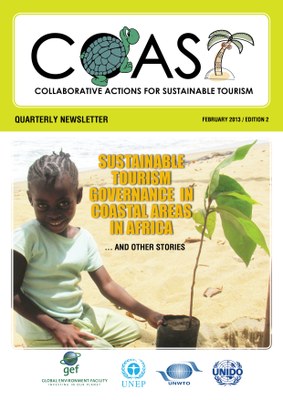
<p>He thanked the community for taking ownership of the project, which according to him, is a testimony that the project will be sustainable. He further urged the villagers to synergise tourism and tradition as there are lots of untapped opportunities that the village can harness to enhance responsible tourism while at the same improving their livelihood.</p>
<p>The COAST Project is a UNEP implemented, Global Environmental Facility (GEF) supported project that is executed by UNIDO in collaboration with UNWTO (UN World Tourism Organization). The COAST project also promotes rights of indigenous people by identifying community needs and gaps through community visioning exercise particularly regarding ecotourism developments and subsistence resource uses in protected areas in its three demo sites in Kartong, Tumani Tenda and Denton Bridge.</p>
<p><b>Countries involved in the project are: Cameroon, Ghana, Nigeria, Senegal, Kenya, Tanzania, Mozambique, Seychelles and The Gambia.</b></p>
<p><b><a class="external-link" href="http://allafrica.com/stories/201303121036.html">For this Article source check here</a></b></p>]]></content:encoded>
    <dc:publisher>No publisher</dc:publisher>
    <dc:creator>g.omedo@unido.org</dc:creator>
    <dc:rights></dc:rights>
    <dc:date>2013-03-13T11:56:42Z</dc:date>
    <dc:type>News Item</dc:type>
  </item>


  <item rdf:about="http://coast.iwlearn.org/en/Newsletter/2nd-coast-project-newsletter-february-2013-edition-3">
    <title>COAST Project Newsletter 2nd Quarterly Newsletter</title>
    <link>http://coast.iwlearn.org/en/Newsletter/2nd-coast-project-newsletter-february-2013-edition-3</link>
    <description>This Newsletter covers the months of November, December, January and February 2013. It contains a special feature on UNWTO's Sustainable Tourism Governance and Management for coastal areas in Africa. It also shares some of the emerging lessons and experiences from our COAST Demonstration Site in Kribi Cameroon. </description>
    <content:encoded xmlns:content="http://purl.org/rss/1.0/modules/content/"><![CDATA[<p><b>COAST Project Newsletter</b></p>
<p><b>Quarterly Newsletter, February 2013/Edition 2</b></p>
<p>The  COAST Project Newsletter is an easy to read 26 page Newsletter that highlights some developments in the<img src="http://coast.iwlearn.org/en/copy_of_Coverpage.jpg/@@images/44579fae-0b9e-4220-9620-a50f19135508.jpeg" alt="" class="image-right" title="" /> subject of sustainable coastal tourism in the global discourse and progress in COAST Project implementation.</p>
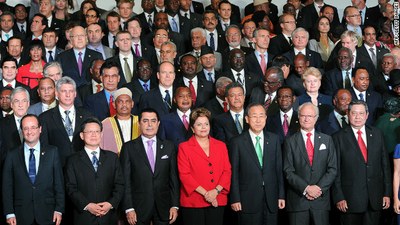
<p>The September Edition of this Newsletter contains the following stories and articles:</p>
<ul>
<li>A Foreword by <b>Mr. FRÉDÉRIC PIERRET</b> the UNWTO Executive Director</li>
<li>A Cover Story on <b>Governance and Management Mechanisms for Sustainable Coastal Tourism in Africa</b></li>
<li><b>Lessons</b> and <b>experiences</b> emerging from COAST Project implementation in Kribi, Cameroon</li>
<li>Some News from the COAST Demo Sites in all the nine Project Countries</li>
<li>A picture gallery of the COAST Demo Site activities</li>
<li>A <b>Question</b> &amp; <b>Answer</b> Section with Mr. Marcel Leijzer, the UNWTO Programme Coordinator</li>
<li>An Opinion Article on implementing Environmental Management System (EMS) in Africa</li>
</ul>
<p align="center"> </p>
<p align="center"><b><a href="http://coast.iwlearn.org/en/Newsletter/2nd%20COAST%20Project%20Newsletter%20%20Edition%20%28Feb%202013%29.pdf" class="internal-link">Download the PDF Newsletter Edition here.</a></b></p>
<p style="text-align: center; "><b><a href="http://coast.iwlearn.org/en/Newsletter/2nd-coast-project-newsletter-february-2013-edition-3/DeuxiemeeditionduBulletindinformationduprojetCOAST1.pdf" class="internal-link">Download the French Edition of this Newsletter here</a><br /></b></p>
<p align="center">Please, share with us your feedback on any of these stories. if you want us to follow up on any of these stories, or would wish more information on these articles, please write to the COAST Project's Knowledge Management and Communications Officer on the contacts below.</p>
<p align="center"><b>THE EDITORIAL TEAM - UNIDO COAST PROJECT</b></p>
<p align="center"><b>Office Number: +254 20 7625286</b></p>
<p align="center"><b>Cell. Number: +254 722 508010</b></p>
<p align="center"><b>E-mail: <a href="mailto:g.omedo@unido.org?subject=Newsletter">G.Omedo@unido.org</a></b></p>]]></content:encoded>
    <dc:publisher>No publisher</dc:publisher>
    <dc:creator>g.omedo@unido.org</dc:creator>
    <dc:rights></dc:rights>
    <dc:date>2013-03-01T13:55:00Z</dc:date>
    <dc:type>Issue</dc:type>
  </item>


  <item rdf:about="http://coast.iwlearn.org/en/News%20and%20Events/chinese-appetite-for-shark-fin-soup-devastating-mozambique-coastline">
    <title>Chinese appetite for shark fin soup devastating Mozambique coastline</title>
    <link>http://coast.iwlearn.org/en/News%20and%20Events/chinese-appetite-for-shark-fin-soup-devastating-mozambique-coastline</link>
    <description>Mantas and hammerheads to 'disappear' from divers' paradise if plunder is unchecked</description>
    <content:encoded xmlns:content="http://purl.org/rss/1.0/modules/content/"><![CDATA[<p style="text-align: justify; "><a href="http://www.guardian.co.uk/profile/davidsmith">David Smith</a> in Inhambane</p>
<p style="text-align: justify; "><a href="http://www.guardian.co.uk/theguardian">The Guardian</a>, Thursday 14 February 2013 20.04 GMT</p>
<p><span style="text-align: justify; ">Standing among coconut and mango trees near the coast of </span><a href="http://www.guardian.co.uk/world/mozambique" style="text-align: justify; " title="More from guardian.co.uk on Mozambique">Mozambique</a><span style="text-align: justify; ">, Fernando Nhamussua carefully prepares shark meat for a family meal – and contemplates a basket with a profitable haul of four dried shark fins.</span></p>
<p style="text-align: justify; "><span>"I want to sell them to the Chinese," the 33-year-old admits with disarming candour, estimating that a kilogram's worth will fetch around 5,000 meticals (£104). "We take them to town where there is a place for Chinese buyers. It's good money."</span></p>
<p style="text-align: justify; ">Nhamussua reckons he has sold 20 fins so far, boosting his normal income and his hopes of completing a modest concrete house that stands unfinished. But this burgeoning trade along the Mozambican coast is putting precious species such as manta rays in existential danger, according to local conservationists.</p>
<p style="text-align: justify; "><a href="http://www.guardian.co.uk/environment/fishing" title="More from guardian.co.uk on Fishing">Fishing</a> for sustenance has long been a staple here, with few alternative sources of income. But it is an open secret that Chinese syndicates are supplying improved fishing nets, buying shark fins and manta ray "wing" tips and shipping them back to Asia, where there is increasing demand for delicacies such as shark fin soup.</p>
<p style="text-align: justify; "><span>Nhamussua's nephew, Americo Gilamba, is 19 and has scant other career prospects. "We do it because we don't have a good job," he explained, standing in the small, sandy family settlement that includes huts made of reeds and coconut leaves. "We know it's not good and the Chinese are killing things that are not allowed to be killed, but we do it to survive and get some money. We don't want to have to steal from other people. If we were given an alternative, we would stop."</span></p>
<p style="text-align: justify; ">Inhambane's beaches and ocean are a diver's paradise with one of the most fabulous concentrations of <a href="http://www.guardian.co.uk/environment/marine-life" title="More from guardian.co.uk on Marine life">marine life</a> in the world. Tourism, a vital lifeline in one of the world's poorest countries, could be threatened.</p>
<p style="text-align: justify; "> </p>
<p style="text-align: justify; "><a href="http://www.bitongadivers.org/551/kudzi.html">Carla Victorino Guicome</a>, who last year became the first Mozambican woman to qualify as a diving instructor, said: "I am sad, I am angry because if it continues like this it's going to kill tourism in Mozambique. No more tourists will come here."</p>
<p style="text-align: justify; "> </p>
<p style="text-align: center; "><img src="http://coast.iwlearn.org/en/News%20and%20Events/SharkfinharvestinginM008.jpg" alt="" class="image-inline" title="" /></p>
<p style="text-align: justify; ">Shark fin harvesting in Mozambique. Photograph: Alamy</p>
<p style="text-align: justify; "> </p>
<p style="text-align: justify; ">She continued: "People come from all over the world to enjoy diving with sharks and manta rays, but if this goes on, they won't be there any more.</p>
<p style="text-align: justify; ">"The Chinese don't respect marine life and they're trying to destroy our heritage. We have tried and tried, but the government don't seem to be doing anything to stop it. If nothing is done, the <a href="http://www.guardian.co.uk/world/animals" title="More from guardian.co.uk on Animals">animals</a> will disappear."</p>
<p style="text-align: justify; ">Conservationists have called for legal protection of species such as sharks and manta rays, the banning of gillnets – which create a wall of netting to catch fish – and greater education of and alternative livelihoods for fishermen. But the fisheries ministry is powerful.</p>
<p style="text-align: justify; "><a href="http://saveourseas.com/articles/andrea_queen_of_mantas">Andrea Marshall</a>, director of the Marine <a href="http://marinemegafauna.org/">Megafauna Foundation</a> in Tofu, said: "I would argue that far more people benefit from tourism here than from the fishing industry. The economic argument for preserving these charismatic animals in the long term surely outweighs a one-off profit for a few fishermen and Chinese."</p>
<p style="text-align: justify; ">Time is running out for the manta ray, a beautiful fish with big, triangular pectoral "wings" that has a meagre reproductive cycle.</p>
<p style="text-align: justify; ">Inhambane has one of the biggest populations in the world, with 908 known to the foundation, but has witnessed an 87% drop in the past decade. This means that where visitors could once expect to see six or seven of the creatures in a single dive, now the average is less than one.</p>
<p style="text-align: justify; ">Marshall, principal scientist for the manta ray programme, said: "We're looking at decimation in the next decade or decade-and-a-half. Manta rays are in big trouble along the coastline. If current trends continue, I don't give this population more than a few generations."</p>
<p style="text-align: justify; ">Fishermen are more efficient than ever before thanks to bigger nets and more sophisticated equipment. "Sometimes the fishing nets are given by the Chinese, other times they're part of official schemes intended to benefit fishing communities," Marshall added. "We've been to the fishing camps and you can see the high-quality hooks and lines that they have now."</p>
<p style="text-align: justify; ">And when she followed the money, it led to <a href="http://www.guardian.co.uk/world/china" title="More from guardian.co.uk on China">China</a>. "It's a very secretive operation, but we've had confirmation of the Chinese buying and shipping them out. There are containers that are just reeking. Everyone knows who owns those containers, but nobody does anything."</p>
<p style="text-align: justify; ">Many Chinese people are in Inhambane on legitimate business and working on government infrastructure programmes.</p>
<p style="text-align: justify; ">But the fishing controversy echoes wider concerns over what some in <a href="http://www.guardian.co.uk/world/africa" title="More from guardian.co.uk on Africa">Africa</a> regard as a <a href="http://www.guardian.co.uk/world/2012/aug/01/hillary-clinton-africa-china">Faustian pact with China</a>. The Environmental Investigation Agency has said nearly half of the timber exported from Mozambique to China is done so illegally, costing <a href="http://www.bbc.co.uk/news/world-africa-21366123">the impoverished nation tens of millions of dollars a year</a>.</p>
<p style="text-align: justify; ">Based on evidence given by fishermen, the Guardian visited a Chinese-run shop said to be a front for the illicit trade in marine life; an expensive car was parked outside. Its owners said they were aware of such trade in recent years, but claimed it had declined of late. Asked where shark fins could be obtained, a co-owner shook her head and said: "I don't know."</p>
<p style="text-align: justify; ">But Lon Chen, a resident of five years and owner of a supermarket in Inhambane, claimed that he been offered such items in the past. "The local people kill them and bring them," he said.</p>
<p style="text-align: justify; ">"They came here to ask if we needed it or not. I said no, but some Chinese are buying that kind of food. They don't eat it at all; they are buying it to export to Asia. It's their business and they're surviving on that."</p>
<p style="text-align: justify; ">Mozambican authorities are said to be taking the problem seriously, but are working with limited resources, including only one or two patrol boats to cover the immense coastline, although focusing on Inhambane with its abundant marine life would be a start.</p>
<p style="text-align: justify; ">Carlos Carvalho, an activist based in the capital, Maputo, claimed that sea turtles and dolphins are also being targeted for their flippers and organs, although observers in Inhambane could not verify this. Chinese traders are seeking to obtain boats to extend the fishermen's range, he added.</p>
<p style="text-align: justify; ">"The Chinese are gangsters and they have the protection of certain officials in Inhambane province," Carvalho said. "Every month it is escalating. Inhambane is out of control. It is the killing field of Mozambique and nobody is doing anything about it. It absolutely devastates me."</p>
<p style="text-align: justify; ">But the issues are complex and there is a danger that fishermen will be scapegoated. Timothy Dykman, director of <a href="http://www.oceanrevolution.org/">Ocean Revolution, </a>said: "It's about the markets, conditions and global impacts far beyond the control of local fishermen that are being run by organised criminal networks. Networks are also selling drugs and engaged in human trafficking."</p>
<p style="text-align: center; "><img src="http://coast.iwlearn.org/en/News%20and%20Events/Fishermanwithhammerhead008.jpg/@@images/940cb8d7-5ed9-4e29-a11e-ea73ffd8ab23.jpeg" alt="" class="image-inline" title="" /></p>
<p style="text-align: justify; ">A fisherman with a hammerhead shark caught off the coast of Mozambique. ‘We do it to survive,’ one man said. Photograph: Alamy</p>
<p style="text-align: justify; "><strong><a class="external-link" href="http://www.guardian.co.uk/world/2013/feb/14/chinese-shark-fin-soup-mozambique?CMP=twt_gu">This article is available here</a></strong></p>]]></content:encoded>
    <dc:publisher>No publisher</dc:publisher>
    <dc:creator>g.omedo@unido.org</dc:creator>
    <dc:rights></dc:rights>
    <dc:date>2013-02-19T10:22:13Z</dc:date>
    <dc:type>News Item</dc:type>
  </item>


  <item rdf:about="http://coast.iwlearn.org/en/News%20and%20Events/the-future-we-want-from-rio-20-analysis-of-outcomes-on-coastal-and-marine-ecosystems-in-the-sustainable-coastal-tourism-context">
    <title>The Future We Want From Rio+20: Analysis of Outcomes on Coastal and Marine Ecosystems in the Sustainable Coastal Tourism Context</title>
    <link>http://coast.iwlearn.org/en/News%20and%20Events/the-future-we-want-from-rio-20-analysis-of-outcomes-on-coastal-and-marine-ecosystems-in-the-sustainable-coastal-tourism-context</link>
    <description>Careless exploitation of the oceans and their resources puts at risk the ability of oceans to continue to provide food, other economic benefits and environmental services to humankind.</description>
    <content:encoded xmlns:content="http://purl.org/rss/1.0/modules/content/"><![CDATA[<h1 style="text-align: center; ">Preamble</h1>
<p style="text-align: center; "><i>“……… We recognize that oceans are critical to sustaining Earth’s life support systems. Careless exploitation of the oceans and their resources puts at risk the ability of oceans to continue to provide food, other economic benefits and environmental services to humankind.  We stress the importance of the conservation, sustainable management and equitable sharing of marine and ocean resources. We also recognize the significant economic, social and environmental contribution of coral reefs to island and coastal States, and support cooperation based on the Coral Triangle Initiative (CTI), and the International Coral Reef Initiative (ICRI)…….</i>.”<strong> </strong></p>
<p style="text-align: center; "><strong>Excerpts from ’<i>The Future We Want UNCSD Rio+20 Declaration’</i> by the World Leaders, Rio de Janeiro, 22<sup>nd</sup> June 2012.</strong></p>
<p style="text-align: center; "><img src="http://coast.iwlearn.org/en/News%20and%20Events/120622033718rio20worldleadershorizontalgallery.jpg/@@images/36de557e-4667-4b7f-910a-38f74203d26e.jpeg" alt="Rio+20" class="image-inline" title="Rio+20" /></p>
<p style="text-align: justify; "><strong> </strong></p>
<p style="text-align: justify; "><strong>Introduction: The Rio+20 Summit</strong></p>
<p style="text-align: justify; "><span>The statement above amply summarizes the global leaders call for action in ensuring the sustainable utilization of coastal ecosystems including seas, oceans, and the marine bio diversity for socio economic development ventures that includes tourism. This statement is part of the declaration developed and adopted by the leaders and representatives of 191 UN Members states including 79 Heads of State and Government who attended the recently concluded UN Conference on Sustainable Development (UNCSD, or Rio+20).</span></p>
<p style="text-align: justify; ">The Summit was held in Rio de Janeiro, Brazil, from 13-24 June 2012 amid a backdrop of a weakened global economy, dampening the global expectations from this year’s conference. However, after heightened negotiations and sustained advocacy by civil society organizations, UN agencies, the curtains finally fell on the conference with some ‘<i>glimmer of hope’</i> as, the global leaders issued what is hoped to be, yet another important declaration for the future of sustainable development. Many of the civil society stakeholders and environmental activists who attended the Summit however regret the failure by the international community to include ‘<i>concrete or measurable results in key areas’</i> within this agreement.</p>
<p style="text-align: justify; "><strong>Rio+20 Outcomes: In the Context of COAST Project Work in Africa</strong></p>
<p style="text-align: justify; ">Many stakeholders are continuing to analyze the process, final products and way forward of Rio+20, and opinion remains divided on the final impact of the Rio+20 conferences. However, it is clear that for sustainable coastal tourism issues in the context of the COAST Project, this declaration is a step in the right direction. The Collaborative Actions for Sustainable Tourism (COAST) Project is working in 9 coastal states in Africa (<i>Cameroon, Senegal, Kenya, Tanzania, Mozambique, the Gambia, Ghana, Nigeria and Seychelles</i>) to enhance the adoption of Best Available Practices/Technologies for sustainable tourism practices in three main thematic areas; Eco-tourism Practices, Environmental Management Systems by hotels and Reef and Marine Recreation Management.</p>
<p style="text-align: justify; ">The COAST Project hopes to document working best practices on the afore-mentioned thematic areas and other areas such as waste management, energy efficiency, community participation in tourism and conservation of coral reefs through proactive engagement with the tourism sector. These are at the very core of some of the final Rio+20 outcomes. Indeed, the final outcomes in the Rio+20 Declaration highlighted issues around oceans and coastal marine biodiversity and the need to conserve them. In addition, and for the very first time, the issue of sustainable tourism was part and parcel of the deliberations at Rio+20 and was included in the outcome document from the conference.</p>
<p style="text-align: justify; ">On sustainable tourism, the global Leaders emphasized that well-designed and managed tourism could make a significant contribution to the three pillars of sustainable development (<i>People, Planet and Profit</i>) and could protect the environment (<i>giving the environment and economic value</i>) create decent jobs and generate trade opportunities. They further called for increased support to sustainable tourism activities and relevant capacity building that promote environmental awareness, conserve and protect the environment, respect wildlife, flora, biodiversity, ecosystems and cultural diversity, and improve the welfare and livelihoods of local communities. In addition, the Rio+20 Outcome document noted the importance of Eco-tourism as a sustainable touristic venture that needed more investment by the countries.</p>
<p style="text-align: justify; "><img src="http://coast.iwlearn.org/en/News%20and%20Events/kribi.jpg/@@images/ab206687-f066-416e-828a-0b7189e77db4.jpeg" alt="" class="image-right" title="" />For oceans, coastal and marine ecosystems and their associated biodiversity, the Rio+20 deliberations noted the importance of countries working to  ...”<i>advance implementation of the Global Programme of Action for the Protection of the Marine Environment from Land-based Activities, including further capacity-building and mobilization of resources for investment in treatment of human wastes and waste water and to develop a global action plan to combat marine litter and pollution</i>”.  Some of these issues were positively received by the Global Ocean Forum that brought together 375 participants from 46 countries during the Oceans Day celebrations held on the sidelines of Rio+20. In the Global Ocean Forum’s Declaration, the leaders expressed their appreciation for the high level of attention given to oceans, coasts, and SIDS in the Rio+20 Outcome document, and the recognition of their importance in achieving the three pillars of sustainable development<strong>. </strong></p>
<p style="text-align: justify; ">These twin issues of coastal ecosystems and their marine biodiversity; and sustainable tourism highlighted in the  Rio+20 Outcome Document represent an integral element of the work of UNEP, UNWTO and UNIDO GEF’s COAST Project.</p>
<table style="text-align: justify; ">
<tbody>
<tr>
<td>
<p align="center"><strong>OTHER AGREEMENTS   REACHED AT THE RIO+20 CONFERENCE</strong></p>
<p>There were   many other agreements on sustainable development that were reached during the   Rio+20 Conference. In the final outcome document global leaders renewed their   political commitment to sustainable development agreed to establish a set of   sustainable development goals (SDGs) to take up from the MDGs in the post   2015 period and established a high-level political forum on sustainable   development. They also called for a wide range of actions such as   detailing how the green economy could be used as a tool to achieve   sustainable development; measures for strengthening the UN Environment   Programme (UNEP); promoting corporate sustainability reporting measures;   taking steps to go beyond gross domestic product to assess the well-being of   a country; developing a strategy for sustainable development financing; and   adopting a framework for tackling sustainable consumption and production. The   Rio+20 Outcome document also focuses on improving gender equity; recognizing   the importance of voluntary commitments on sustainable development; and   stressing the need to engage civil society and incorporate science into   policy; among other points.</p>
<p>With regard to financing   sustainable development, the Rio+20   Secretariat together with the UN Global Compact and the Sustainable Energy   for All initiative reported receiving over 700 Rio+20 voluntary commitments.   These commitments were made by all stakeholders including governments UN   system &amp; IGOs the private sector civil society and NGOs. Collectively   these tangible commitments mobilize more than $500 billion in actions towards   sustainable development (<i>UNCSD Figures</i>).   If these are sustained in the long term, the global efforts for sustainable   development may bequeath a more prosperous future to the coming generations.  <strong> </strong></p>
</td>
</tr>
</tbody>
</table>
<p style="text-align: justify; "><strong> </strong></p>
<p style="text-align: justify; "><strong>CONCLUSION</strong></p>
<p style="text-align: justify; "><img src="http://coast.iwlearn.org/en/News%20and%20Events/DSC00970.JPG/@@images/0f822e2f-5519-4df8-9107-ddd0b097b976.jpeg" alt="Mida Creek" class="image-left" title="Mida Creek" />For Africa, sustainable Coastal tourism and conservation of coastal marine biodiversity are of critical importance now than ever before, and the global leader’s commitment in the Rio+20 Outcomes only serves to bolster the efforts of most players, like the COAST Project that are working towards this realization. As the global community sets out to confront the challenge of translating the Rio+20 outcomes into tangible achievable and measureable targets, our work in the nine Coastal Countries (<i>Cameroon, Senegal, Kenya, Tanzania, Mozambique, Gambia, Ghana, Nigeria and Seychelles</i>) will go a long way in informing the course of the activities in this thematic areas (<i>Eco-Tourism, Environmental Management Systems and Reef and Marine Recreation and Management</i>).</p>
<p style="text-align: justify; ">It is important to reiterate here that the COAST Project is in the process of developing, documenting and disseminating important lessons, best practices and technologies in the subject area of coastal tourism. As our experiences from the Demo  Sites mature, we expect to be able to document some useful lessons on governance, management and policy - proposals that we will share with the global community. It is therefore important for the international community to lead the way in facilitating real sustainable development criteria for all sectors. In the days to come, the emerging Best Available Practices and Technologies, experiences and lessons leant from the COAST Project Demo Sites will be documented and disseminated broadly to help towards realization of the global vision as encapsulated in “<i>The Future We Want</i>” Declaration in areas pertaining to coastal ecosystems for Africa, and the rest of the world.</p>
<table style="text-align: justify; ">
<tbody>
<tr>
<td>
<p><strong>REFERENCES </strong></p>
</td>
</tr>
<tr>
<td>
<ul>
<li><strong>The Final Rio+20   Outcome Document at </strong><a href="http://www.uncsd2012.org/thefuturewewant.html">http://www.uncsd2012.org/thefuturewewant.html</a>;   <strong> </strong></li>
<li><strong>Summary of   Voluntary Commitments at </strong><a href="http://www.uncsd2012.org/index.php?page=view&amp;type=111&amp;menu=14&amp;nr=790">http://www.uncsd2012.org/index.php?page=view&amp;type=111&amp;menu=14&amp;nr=790</a>;   <strong> </strong></li>
<li><strong>Global Ocean   Forum Declaration on The Oceans day at Rio at, </strong></li>
</ul>
</td>
</tr>
<tr>
<td></td>
</tr>
<tr>
<td>
<p><a href="http://www.globaloceans.org/sites/udel.edu.globaloceans/files/RioOceanDeclaration.pdf">http://www.globaloceans.org/sites/udel.edu.globaloceans/files/RioOceanDeclaration.pdf</a>;   <strong> </strong></p>
</td>
</tr>
</tbody>
</table>
<p style="text-align: justify; "><strong>By Geoffrey Omedo,</strong></p>
<p style="text-align: justify; "><strong>Knowledge Management and Communications Officer,</strong></p>
<p style="text-align: justify; "><strong>COAST Project</strong></p>]]></content:encoded>
    <dc:publisher>No publisher</dc:publisher>
    <dc:creator>g.omedo@unido.org</dc:creator>
    <dc:rights></dc:rights>
    <dc:date>2013-02-19T09:45:00Z</dc:date>
    <dc:type>News Item</dc:type>
  </item>


  <item rdf:about="http://coast.iwlearn.org/en/News%20and%20Events/why-knowledge-management-is-vital-for-the-coast-project-success">
    <title>Why Knowledge Management is Vital for the COAST Project Success</title>
    <link>http://coast.iwlearn.org/en/News%20and%20Events/why-knowledge-management-is-vital-for-the-coast-project-success</link>
    <description></description>
    <content:encoded xmlns:content="http://purl.org/rss/1.0/modules/content/"><![CDATA[<p style="text-align: justify; "><strong>What is Knowledge Management? </strong></p>
<p style="text-align: justify; ">There are as many definitions for Knowledge Management as there are organizations, and there is still no consensus yet on the most effective way to define ‘KM’ (a popularly used synonym). While some institutions define KM to be about systems and technologies, others have defined KM to be about people, processes and learning organizations/systems. This complex interplay of organizational features however all have some indication of what KM actually means, but it varies from one organization to the other.</p>
<p style="text-align: justify; "><img src="http://coast.iwlearn.org/en/News%20and%20Events/copy_of_Dugoutcanoetoursatsunset.JPG/@@images/d5ab082e-83f0-4877-a52a-ef44bcec163b.jpeg" alt="Canoe" class="image-left" title="Canoe" /></p>
<p style="text-align: justify; ">Some UN agencies (UNICEF, UNDP) have defined KM as "<i>an integrated, systematic approach to identifying, managing and sharing an organization’s knowledge, and enabling groups of people to create new knowledge collectively in order to achieve the objectives of the organization</i>". Such a definition tries to broaden the operational scope of KM to include human knowledge (<i>intelligence</i>) inherent within the organization. The Global Environmental Facility (GEF) on its part defines  Knowledge Managements as a ‘ …<i>set of specific actions developed (gathering data, analyzing processes, results and personal experiences, capturing and sharing lessons learned) so that the knowledge of an individual or an institution reaches, in a timely manner, the largest number of people who can benefit from it…’ (GEF KMI 2011)</i>.</p>
<p style="text-align: justify; "><strong>How is KM applied in different institutions?</strong></p>
<p style="text-align: justify; ">Since Knowledge Management is still new and evolving, its definition is still quite ambiguous. However, most institutions have adopted one or more components of what KM is and are applying it to enhance operational efficiency, improved documentation, measurement of results and information sharing. Other institutions have mainstreamed KM into their critical strategy documents to drive corporate ‘turnaround’. For instance, UNIDO’s Knowledge Management Strategy Paper, seeks to apply its KM Strategy as a pathway to transforming the institution from “..<i>a </i><i>multi-platform, silo-based Knowledge Management environment to a future-proof, single-platform and collaboration-oriented knowledge-based organization.</i>” KM therefore seeks to respond to the different needs and targets of various Organizations/Institutions for improved results.</p>
<p style="text-align: justify; ">For instance, private sector institutions value a KM definition/model that could enhance productivity resulting in improved profit margins and general effectiveness. Government institutions could value KM models that result in improved service delivery, accountability and resourcefulness of its citizenry. For development institutions, and in this case the United Nations agencies such as <i>UNIDO, UNEP and UNWTO</i>, knowledge platforms resulting in improved capabilities to drive societal change and spur innovative actions for sustainable development would be more practical and sound.</p>
<p style="text-align: justify; "><strong>KM in the context of the COAST Project: What to expect in Project Implementation?</strong></p>
<p style="text-align: justify; "><img src="http://coast.iwlearn.org/en/News%20and%20Events/Mangroveboardwalkandrestaurant.JPG/@@images/c2ce2a95-98f9-4527-9bd1-18105b1b4ed9.jpeg" alt="Mangrove " class="image-right" title="Mangrove " />In the context of the COAST Project, and as we move to implement the recommendations of the Mid Term Evaluation, a strategic shift has taken place to adopt a KM Strategy that will focus on capturing and disseminating knowledge, best practices and lessons learned coming out of the COAST project. The Strategy aims to develop and implement appropriate activities to foster a new level of engagement with all coastal tourism stakeholders involved in this project at the local, national and international levels. This Strategy will seek to assist the partner countries to strengthen the integration and impact of the project objectives and activities, as well as to feed key outputs into local, national and international policies and practices.</p>
<p style="text-align: justify; ">The lessons learned and best practice case studies, as well as know-how on appropriate processes and concrete recommendations for improving the environment and coastal management will be repackaged into different knowledge management tools. Our KM Strategy will be implemented using an array of knowledge management tools and approaches (<i>i.e. written and visual materials such as Newsletters, fact sheets, exposes and reports etc</i>). These tools and approaches will engage global and country-based media agencies, the respective Ministries of Tourism and Environment in the partner countries, locally-based coastal tourism stakeholders and the communities surrounding the COAST project activities.</p>
<p style="text-align: justify; "><strong>The Strategy intends to thereby generate increased public awareness and demand for actions to prevent, and control the degradation of marine and coastal ecosystems from potential pollution and contamination. </strong></p>
<p style="text-align: justify; "><strong>Knowledge Management Result Areas for the COAST Project </strong></p>
<p style="text-align: justify; ">The COAST Project Knowledge Management Strategy will have four main result areas, as summarized in the table below:</p>
<table style="text-align: justify; ">
<tbody>
<tr>
<td>
<p align="center"><strong>Knowledge   Management Result Areas for the COAST Project</strong></p>
</td>
</tr>
<tr>
<td>
<p><strong>THEME 1:   COASTAL BEST PRACTICES AND TECHNOLOGIES</strong> – These KM products will document some of the best practices and   processes within the three main thematic areas of the COAST Project (<i>EMS, Eco-tourism, Reef and Marine   Recreation Management</i>) emerging from the COAST Demo Sites. It will focus on   showcasing some of the demonstrated localized BAP/BATs. The portrayal of the best   practices will contain comprehensive information on the various processes and   technologies being applied in the respective local realities.</p>
</td>
</tr>
<tr>
<td>
<p><strong>THEME 2: COASTAL LOCAL VOICES</strong> – This COAST KM result area will   focus on documenting the impacts of the project within, as well as to the   local communities. It will entail following up with project leaders,   beneficiaries and communities in all the countries and capturing their voices   to provide a human account of how their interactions with the project have   improved their livelihood. This will use participatory methodologies and   approaches to ensure we document the human stories of sustainable coastal   tourism in Africa.</p>
</td>
</tr>
<tr>
<td>
<p><strong>THEME 3:   COASTAL ENVIRONMENTAL ECONOMIC DYNAMICS</strong> – The coastal ecosystem is very   valuable to the countries we work in. Hence this KM result area will seek to   document the value of our work in real economic terms. This KM result area   will give a special emphasis to the private sector players and how   implementation of COAST project themes (<i>RMRM,   EMS, Eco-Tourism including Small and Medium Enterprise (SME) developments</i>)   is contributing to improved results. It is expected that the Private sector   players will drive the work to ensure long-term sustainability.</p>
</td>
</tr>
<tr>
<td>
<p><strong>THEME 4: COASTAL POLICY CHANGE PROCESSES</strong> – The COAST Project KM   Strategy will seek to identify some of the policy interventions emerging and   those that are needed to enhance sustainable coastal tourism at national,   regional and global levels. These will closely follow the Sustainable Tourism   Governance work being driven by UNWTO and UNIDO under the COAST Project. <strong> </strong></p>
</td>
</tr>
</tbody>
</table>
<p style="text-align: justify; "><strong>Conclusion</strong></p>
<p style="text-align: justify; ">The role of a sound Knowledge Management and Communication Strategy to the COAST Project is now more than ever before of critical importance for sustained delivery. With the four KM themes of Coastal Best Practices and Technologies; Coastal Local Voices; Coastal Environmental Economic Dynamics; and Coastal Policy Change processes, the COAST Project will generate useful products that will inform public discourse in the area of sustainable tourism in Africa and to be able to contribute to the ongoing global dialogue on the same.  It is hoped that the lessons learned and know-how coming out of the COAST Project will be transformed into specific recommendations that have the potential to serve as valuable contributions and inputs to the respective national Tourism and Environment strategies, policies and practices and to future similar project initiatives. In this way, the COAST Project will be able to contribute to policy changes in tourism practices and inspire replications and spin off projects through this KM Strategy.</p>
<p style="text-align: justify; "> </p>
<p style="text-align: justify; "><strong>By Geoffrey Omedo,</strong></p>
<p style="text-align: justify; "><strong>Knowledge Management and Communications Officer</strong></p>]]></content:encoded>
    <dc:publisher>No publisher</dc:publisher>
    <dc:creator>g.omedo@unido.org</dc:creator>
    <dc:rights></dc:rights>
    <dc:date>2013-02-19T09:25:00Z</dc:date>
    <dc:type>News Item</dc:type>
  </item>


</rdf:RDF>